
- PRICING
- LIVE QUOTES
- LEARN
- HELP


EN
Inflation risk intensified+demand from life insurance companies weakens, South Korea's 30-year treasury bond yield rises to a record high
The Zhitong Finance App learned that the Korean treasury bond market is under pressure due to high energy prices increasing inflationary pressure and weakening demand from life insurance companies. Among them, the yield on 30-year treasury bonds rose to 4.67%, the highest level since the introduction of this term treasury bond in 2012; the yield on 2-year treasury bonds rose slightly to 3.64%.
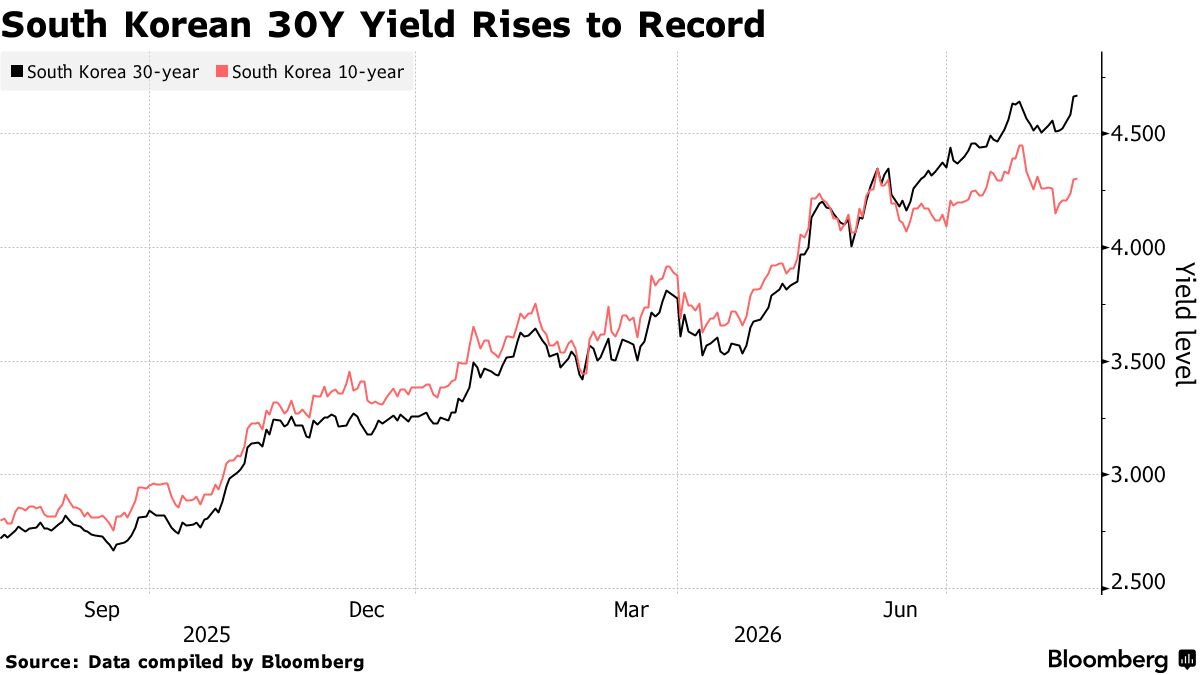
As geopolitical tension in the Middle East continues to push up international oil prices, South Korea, which is highly dependent on imported energy, is facing a growing risk of inflation. According to data released by Korea's statistics department earlier this month, the consumer price index (CPI) rose 2.8% year on year in July, falling below 3% for the first time in three months. Previously, in May and June, due to the increase in international oil prices driven up by the Middle East war, South Korea's inflation was above 3% for two consecutive months, and once reached a 30-month high of 3.2% in June. As the US and Iran signed a memorandum of understanding to terminate, international oil prices fell back, and government price stabilization measures came into effect, inflation returned to the 2% range.
At the same time, however, the year-on-year increase in core CPI excluding food and energy accelerated from 2.5% in June to 2.6%, the highest level since December 2023, mainly driven by rising prices for IT equipment, electric vehicles, and travel-related services.
As far as South Korea is concerned, core inflation is still high, the rise in agricultural product prices has not abated, the basis for falling overall inflation is not strong, and the risk of rising prices still exists. Once the situation in the Middle East becomes volatile again, the oil price flames may reignite inflation in South Korea at any time.
The Bank of Korea's statement after the price evaluation meeting at the beginning of this month said that due to the base effect of last year's mobile communication fee discounts, consumer inflation in South Korea may rise in August. The Bank of Korea added that in view of the uncertainty brought about by the Middle East conflict and ongoing underlying price pressure, it will continue to closely monitor the inflation situation.
In fact, in a report released in June, the Bank of Korea warned that even if the Middle East conflict ends and international oil prices fall, prices may remain high for some time to come due to factors such as a recovery in consumption and rising wages. The report predicts that the improved performance of information technology (IT) companies will drive a further increase in consumption momentum, and the economic recovery momentum will gradually increase. However, the recent trend of wage increases in some IT industries is likely to spread to the entire industrial sector, leading to a further increase in upward pressure on prices.
Yoo Sang-dae, the outgoing senior vice governor of the Bank of Korea, echoed the Bank of Korea's warning on Tuesday. Ryu Sang-dae pointed out that with the expansion of the semiconductor boom, wage increases in the information technology industry are turning into long-lasting upward pressure on prices. He said, “It is worrying that rising wages in the IT sector are becoming a source of pressure to increase prices. The price increase may not be significant, but it will be very sustainable.” This means that it is difficult to change the situation where the consumer price index is above the central bank's 2% target for a long period of time.
Yoo Sang-dae also said that as economic growth continues to be transmitted to core inflation, it is “very likely” that the Bank of Korea will raise the benchmark interest rate further unless there is an extreme shock. Just last month, the Bank of Korea raised its benchmark interest rate by 25 basis points to 2.75%. This is the first time that the central bank has turned to austerity after a lapse of three and a half years, and suggests that the door remains open. Bank of Korea Governor Shin Hyun-song said at the time that the next few meetings will be “live discussions” and that no options are ruled out. Currently, most market participants have set their sights on the central bank's next interest rate meeting on August 27, and the possibility of continuous interest rate hikes is still generally taken into account in expectations.
Yoo Sang-dae added that the recent stabilization of the Korean won, along with the fall in Korea's benchmark stock index Kospi, “gave members of the Monetary Policy Committee some room for maneuver, but I don't think this is a key factor” and “whether core inflation will remain high in the future, whether the economy can maintain its growth momentum, and financial stability issues are the focus.”
In addition to the risk of inflation, the weakening of life insurance companies, a key source of demand, is also a major reason why South Korea's treasury bonds are under pressure. As changes in regulatory rules have reduced the urgency of extending the longevity of assets, Korean life insurance companies have reduced the purchase of ultra-long-term treasury bonds.
Cho Yong-goo, a fixed income strategist at Korea's Xinrong Securities, said, “Demand has been weak since this year. Real capital purchases by insurance companies, especially life insurance companies, have always been weak.” He added that the outlook for the bond market will depend to a certain extent on the global interest rate environment and the domestic supply of Korean treasury bonds. “If the government cuts the share of ultra-long-term treasury bonds to less than 30% in next year's issuance plan, then market demand for treasury bonds of this maturity may rise again.”