
- PRICING
- LIVE QUOTES
- LEARN
- HELP


EN
The results soared after that! Demand for the cloud continues to explode, and the backlog of orders for the AI computing power “barometer” CoreWeave (CRWV.US) exceeded US$104 billion, raising the annual guideline
The Zhitong Finance App learned that the financial report released by Nvidia-supported AI cloud infrastructure provider CoreWeave (CRWV.US) after the market on Tuesday injected a dose of strength into the recent AI investment boom that has been questioned. After the market on August 11, the AI computing power provider known as “neocloud (neocloud)” announced its results for the second quarter of 2026 up to June 30. Both revenue and profit exceeded Wall Street expectations, and the backlog of orders broke through the 100 billion US dollar mark, driving the stock price to soar by more than 14% during post-market trading.
By the close before the earnings report was released, CoreWeave's stock price had accumulated a cumulative increase of about 26% this year. However, the stock has experienced significant fluctuations before — falling about 21% over the past three months and retreating more than 40% from a 52-week high of $153.20. The options market fluctuated about 15% in both directions before earnings reports. This performance, which has exceeded expectations, is re-anchoring the market's valuation expectations for this leading AI computing power company.
Core financial data: Revenue crushed expectations, losses narrowed beyond expectations
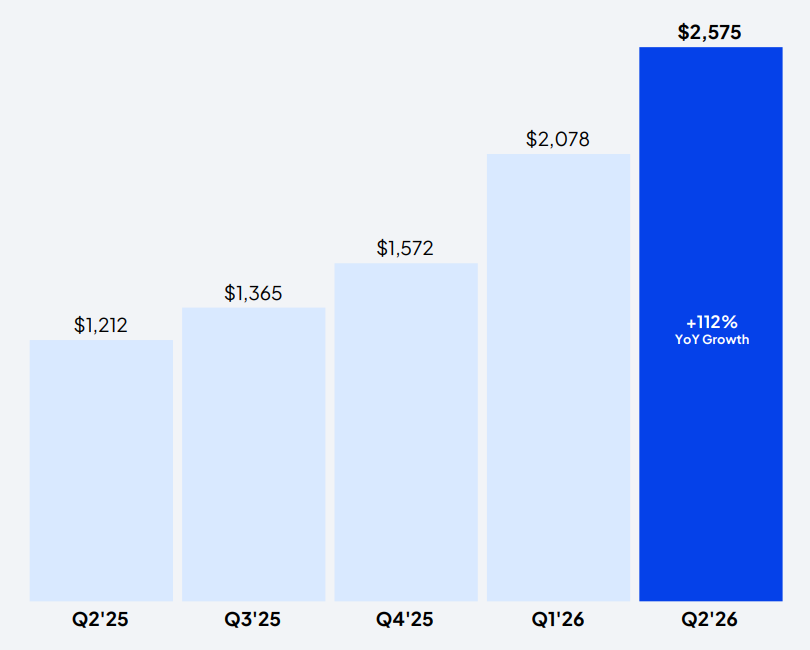
CoreWeave achieved second-quarter revenue of $2.58 billion, up 112% year over year, exceeding analysts' average expectations of $2.56 billion. This figure falls at the high end of the $2.45 billion to $2.6 billion guidance range previously given by the company.
In terms of profit indicators, the company's net loss for the quarter was US$626 million, or loss of US$1.14 per share, mainly due to huge interest expenses to expand infrastructure — net interest expenses for the quarter reached US$640 million, more than double the same period last year, but it was still significantly better than analysts' expectations of a loss of $1.41 per share. Adjusted EBITDA reached US$1.51 billion, which also exceeded analysts' expectations of US$1.43 billion. The adjusted operating income is within the range of 30 million to 90 million US dollars previously given by management.
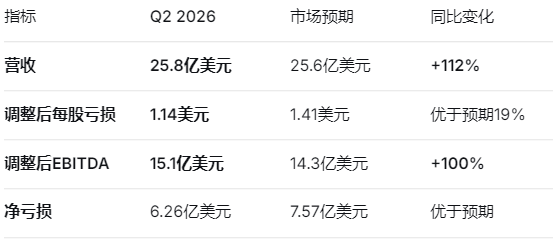
Despite a year-on-year increase in losses — net loss of $290 million in the same period last year — the margin of loss was better than market expectations, indicating that the company maintained a certain level of financial discipline amid rapid expansion. In terms of debt size, the total debt on the company's balance sheet as of the end of the quarter reached US$35 billion, mainly to cover the procurement costs of Nvidia GPUs and other equipment. Interest expenses reached $536 million in the first quarter, more than eleven times the adjusted operating income, highlighting the financial pressure of the highly leveraged expansion model.
Backlog of orders surpassing $104 billion: irrefutable proof that AI computing power is “in short supply”
CoreWeave's most exciting data for the second quarter was that the backlog of orders (Revenue Backlog) reached about 104 billion US dollars, up 246% year over year, and continued to rise from 99.4 billion US dollars at the end of the previous quarter. The company also revealed that it added more than $25 billion in net new customer commitments in early July, which means that the actual backlog far exceeds $104 billion.
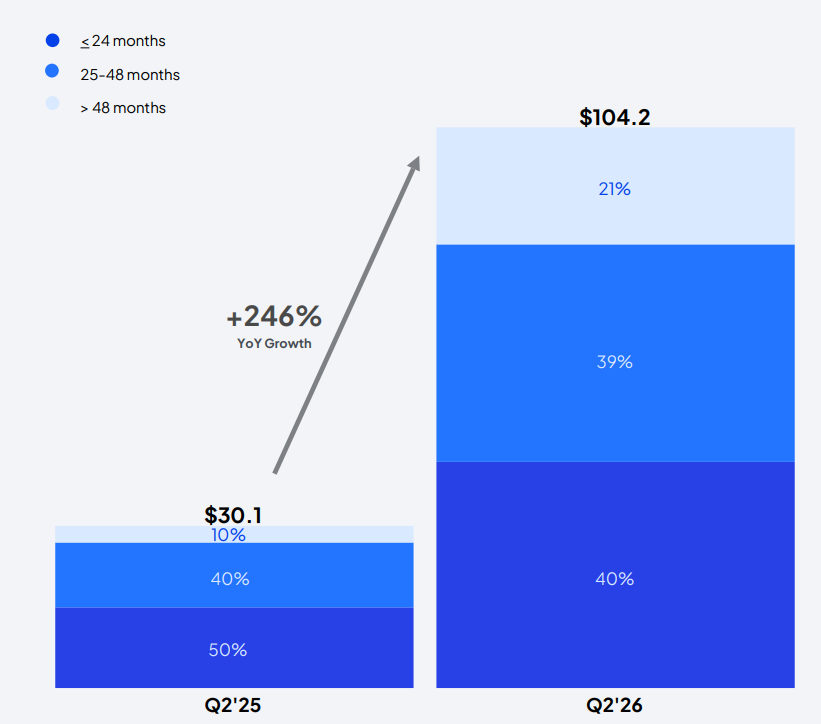
At the beginning of July, a net commitment of more than $25 billion from new customers was obtained, not included in the $104 billion backlog of orders mentioned above. This means that as of early July, the total number of contracts the company has signed but has yet to confirm revenue is close to $130 billion.
CEO Michael Intrator said in an earnings statement: “CoreWeave reached an important inflection point this quarter, and our scale began to translate into ever-expanding operating leverage.”
Jefferies analysts pointed out that CoreWeave has contracted more than 3.86 gigawatts of electricity, with an implied annual revenue potential of more than $46 billion. Cantor Fitzgerald previously predicted that the backlog of orders could reach 131 billion US dollars by June 30.
Judging from order conversion, the company expects about 36% of remaining performance obligations to be converted into revenue within 24 months, which means that the annualized revenue pool is about US$17.8 billion, which is far higher than the median value of US$12.5 billion in revenue guidance for fiscal year 2026. The analysis points out that the growing backlog of orders indicates “demand for artificial intelligence remains strong.”
In terms of customer development, Meta promised an additional $21 billion in CoreWeave this quarter; Anthropic signed a multi-year cooperation agreement; and quantitative trading giant Jane Street pledged $6 billion. CoreWeave's main customers also include OpenAI and Microsoft. The company also announced a partnership with defense contractor Leidos to provide secure AI cloud services to US federal agencies.
Intrator said in a conference call with analysts that the agreement signed by the company in the second quarter would increase profit margins by 5 to 10 percentage points compared to recent quarters. This was partly due to tight production capacity, which enabled the company to obtain more favorable terms.
Active expansion: Entering Asia, increasing capital expenditure and full-year guidance
CoreWeave is speeding up global deployment. The company announced that it will enter the Asian market for the first time and build three data centers with a total capacity of 360 megawatts in Indonesia. By the end of the quarter, 1.5 gigawatts of the company's contracted electricity capacity had been put into operation, and active power generation is expected to exceed 1.85 gigawatts by the end of the year.
CoreWeave expects third-quarter revenue to be between $3.45 billion and $3.6 billion, with a median value of $3.525 billion representing a year-on-year increase of about 158%. According to the data, analysts' previously anticipated sales would be at the lower end of this range.
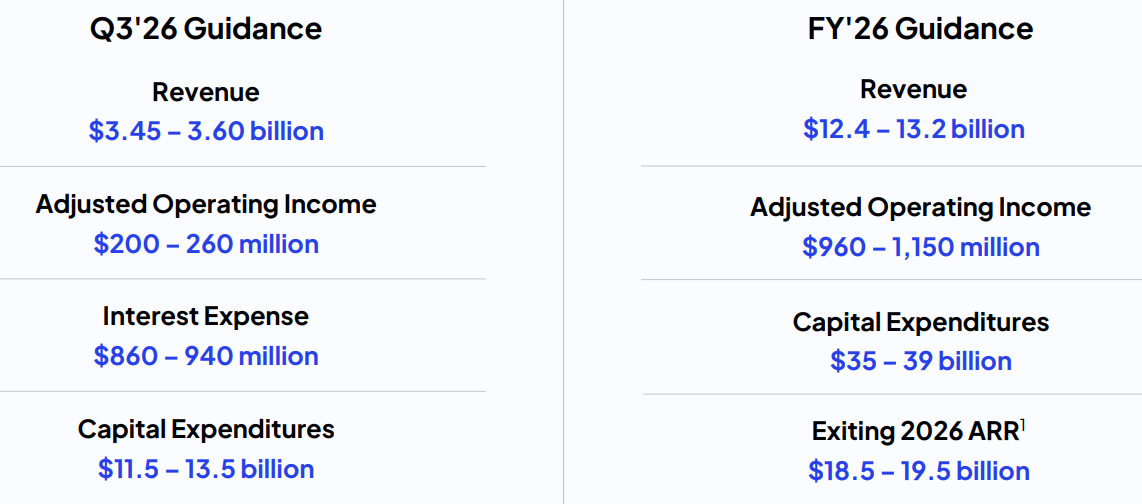
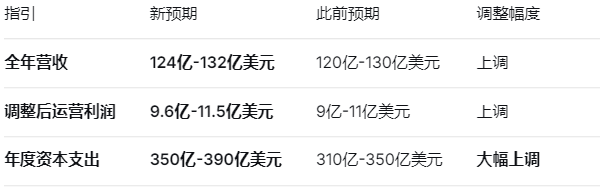
Based on strong demand momentum, CoreWeave also raised its full-year outlook:
Revenue guidance for the full year 2026 was raised from US$12 billion to US$13 billion to US$12.4 billion to US$13.2 billion. Analysts had previously estimated full-year revenue of $12.63 billion.
The adjusted operating profit forecast was raised from $900 million to $1.1 billion to $960 million to $1.15 billion.
Annual capital expenditure was raised from $31 billion to $35 billion to $35 billion to $39 billion.
Industry barometer: AI infrastructure investment boom continues to be verified
As one of the few new cloud computing vendors to go public, CoreWeave's performance is seen as an important weather vane for overall AI computing power requirements. Its performance that exceeded expectations confirmed the continued rise in AI infrastructure investment boom.
CoreWeave completed its IPO in March 2025 and attracted a large number of investors due to its deep partnership with Nvidia (Nvidia is both its core chip supplier and important shareholder). Company CEO Mike Intrator said in an analysts' conference call that the pricing and profit margins of the Blackwell and Vera Rubin SKU are “hitting new highs”; CFO Nitin Agrawal pointed out that the company is passing on component price increases to customers.
At a time when investment in AI infrastructure is moving from an “arms race” to “structural growth,” CoreWeave is becoming the most representative “new cloud” benchmark in this multi-trillion dollar AI infrastructure wave with deep ties to Nvidia, a backlog of over 100 billion US dollars of contracts, and a constantly expanding global data center footprint. As CEO Intrator said, the company has reached an inflection point where “scale is beginning to be transformed into operational leverage” — the next critical question is whether the $35 billion debt can be converted quickly enough into sustainable profits in the context of a continuing blowout in demand.
Looking at the broader industry background, many AI-related companies have recently revealed impressive data one after another. Last month, Microsoft said its cloud business had achieved the fastest growth rate in four years; the revenue of Alphabet's Google Cloud business exceeded expectations, and the backlog of orders increased from about 460 billion US dollars to 514 billion US dollars. The AI server manufacturer Ultramicrocomputer released its earnings report on the same day, and the chip equipment manufacturer Applied Materials will announce its results this Thursday.
It is worth mentioning that CoreWeave has experienced sharp fluctuations over the past two weeks — the AI-based hedge fund Situational Awareness was forced to clear its public positions due to the bursting of leverage, putting pressure on the stock prices of several technology companies. As of March 31, the fund held approximately 1.6% of CoreWeave's tradable shares. Castle Securities, owned by Ken Griffin, eventually took over a large number of AI stock positions. CoreWeave's financial report, which has exceeded expectations, is helping the market to reconfirm the true undertones of AI computing power demand.