
- PRICING
- LIVE QUOTES
- LEARN
- HELP


EN
This Mag 7 Dividend Stock Is Trading Near 2026 Highs. Why It's Still a Buy.
Usually we don’t use “Magnificent 7” and “dividends” in the same breath, and for good reasons. Looking at the constituents, Tesla (TSLA) and Amazon (AMZN) don’t pay a dividend at all, while Meta Platforms (META) and Alphabet (GOOG) (GOOGL) initiated one only in 2024. Apple (AAPL) did initiate its dividend in 1985 but stopped the payouts in 1995. The iPhone maker re-initiated its dividends only in 2012, which was incidentally the same year when Nvidia (NVDA) also initiated its dividends.
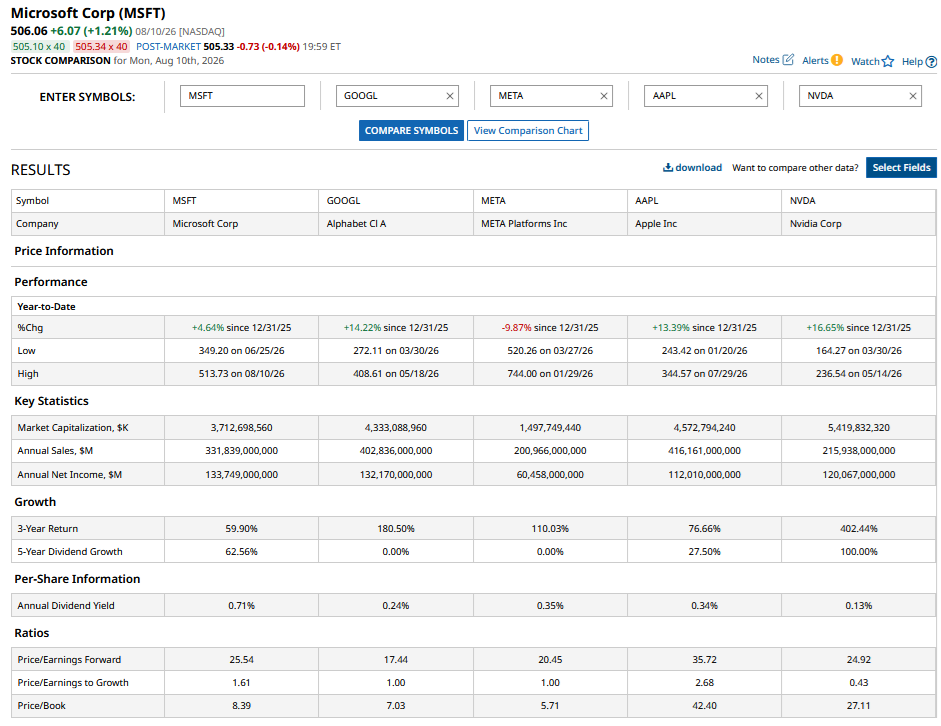
However, Microsoft (MSFT) has the longest continuous streak of dividend payments among its Mag 7 peers and has paid one every year since 2003. The company is on the verge of becoming a Dividend Aristocrat, a pristine group that mostly comprises companies from energy, food, utilities, and other defensive sectors. MSFT has a dividend yield of 0.72%, which, while below that of the S&P 500 Index ($SPX), is by far the highest among the Magnificent 7 companies.
Microsoft Rises to 2026 Highs
Microsoft's stock is having a turbulent run in 2026 and fell below $350 in June. The stock has since soared above $500 as its June quarter earnings blew past estimates. Moreover, the management maintained its 2026 capex guide at a time when fellow Big Tech companies are raising their forecasts pretty much left, right, and center. For me, the key takeaway was Microsoft talking about positive free cash flows next year despite an expected increase in capex. Meanwhile, even though MSFT stock is up nearly 45% from its 2026 lows, the stock is up just under 5% for the year.
MSFT Stock Forecast
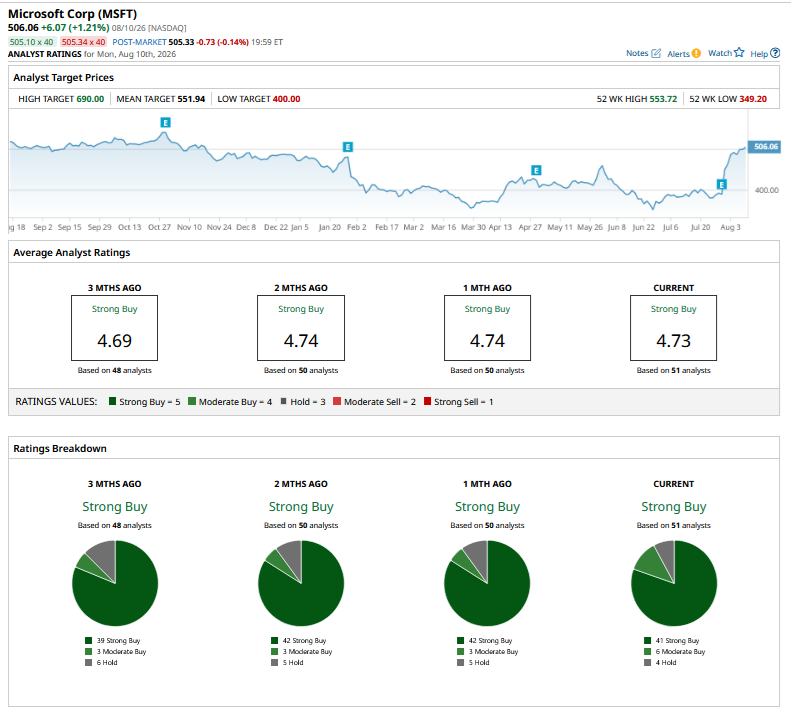
Several brokerages raised Microsoft’s target price following the company’s fiscal Q4 2026 earnings. Among others, Wells Fargo raised its target price from $625 to $650, while Stifel Nicolas raised its from $400 to $450, even as the firm kept its rating at “Hold.” MSFT’s mean target price is $551.94, which is just over 9% higher than current levels. However, I believe that the consensus view in terms of target price is still a bit circumspect, and there weren’t any major revisions following the Q4 confessional.
The overall sentiment is quite bullish, though, and of the 51 analysts polled by Barchart, 41 rate it as a “Strong Buy” and six as a “Moderate Buy.” The remaining four rate it as a “Hold” or some equivalent.
Why MSFT Stock Looks Like a Buy
Here’s my bullish case for Microsoft. First and foremost, while MSFT stock has bounced back sharply from its 2026 lows, it still looks attractive at a forward price-to-earnings (P/E) multiple of 25.5x. Second, Microsoft showed good progress on artificial intelligence (AI) monetization in the recent quarter, with Azure revenues rising 43% year-over-year (YoY), versus the 40% growth in the previous quarter and ahead of Street estimates. For the current quarter, Microsoft expects Azure revenues to rise 45% YoY, which easily surpassed the 41.4% growth that analysts were expecting. Incidentally, Azure's annual revenues topped $100 billion for the first time in the last fiscal year. Microsoft’s cloud remaining performance obligations (RPOs) are getting diversified beyond OpenAI, with the 8% incremental rise coming from companies outside the frontier model universe.
Microsoft 365 Copilot also showed strong traction in fiscal Q4 with paid users rising to 30 million. For context, in its previous update in April, Microsoft put that number at 20 million.
Microsoft is also scaling up its chip business, and while its Maia AI chip might have trailed Amazon and Alphabet, whose AI chip business is booming, reports suggest that the Satya Nadella-led company is looking to unveil its Maia 300 AI chip soon, possibly as early as this month. Chips have emerged as a key monetization tool for hyperscalers as both Alphabet and Amazon ramp up their third-party sales. Moreover, in-house silicon helps Big Tech companies reduce their reliance on Nvidia, and using them internally is invariably margin accretive.
Overall, I believe “SaaSpocalypse” fears and lingering concerns over Microsoft’s ability to monetize its AI capex have kept a lid on MSFT stock for far too long. While the margin of safety in MSFT is not as lucrative as it was previously, I believe the stock still has room to run higher on reasonable valuations.
On the date of publication, Mohit Oberoi had a position in: MSFT , GOOG , AMZN , TSLA , META , NVDA . All information and data in this article is solely for informational purposes. For more information please view the Barchart Disclosure Policy here.