
- PRICING
- LIVE QUOTES
- LEARN
- HELP


EN
After 2 months of downturns, Legendary Creatures (LEGN.US) unearthed a valuation trap or a gold pit?
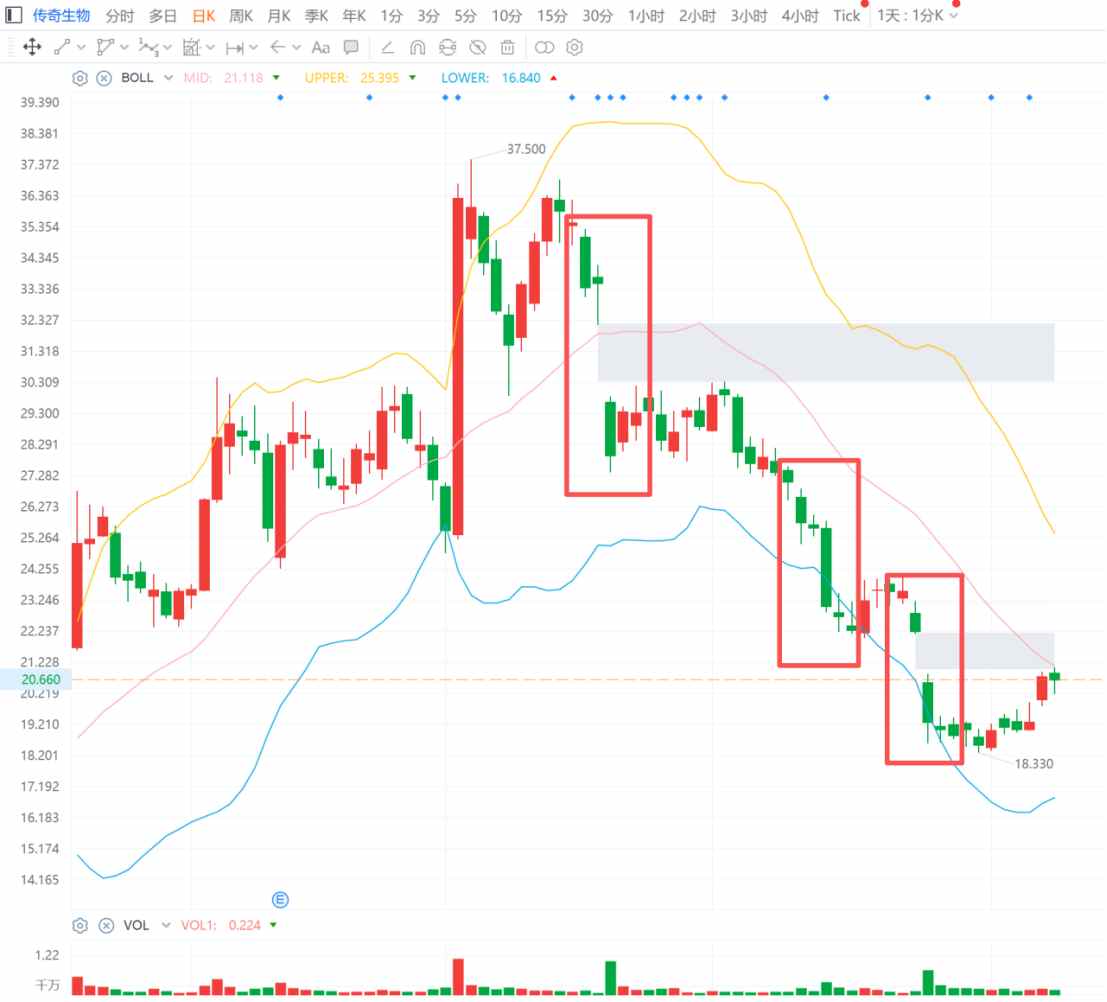
I thought a “40cm” Taiyang line was the beginning of a new round of valuation counterattacks, but unexpectedly, it was the final chapter of the previous round of stock price rebound. After 2 months of pulling the stock price back to a high of $37.50, LEGN.US (LEGN.US) took another 2 months to drop the stock price back to the starting point below $20, taking back the full share price increase in April and May.
The Zhitong Finance App observed that after hitting a phased high of $37.50 in the intraday market on June 3 this year, although Legend Biotech's stock price showed a 3-day technical correction under overbought signals, market sentiment was still quite high at the time. On June 8, the company's stock price pulled a long downward line before hitting the middle track of the BOLL line, and then stepped out for three consecutive days with support from many parties present.
Just when investors thought that Legendary Biotech's stock price was about to break through the previous high in an upward trend, 3 consecutive negative losses within 2 months interrupted this round of upward market growth, and finally caused Legendary Biotech's stock price to take back all of the previous 2 months' gains. The biggest drop in the stock price reached 51.12%.
From discounted sales to CEO resignation
Within the decline range of June 16 to August 3 of this year, Legend Biotech had three distinct periods of stock price decline, which occurred on June 18, July 15, and July 27, respectively. These three nodes correspond exactly to the three negative events that occurred within the legendary creature range.
The Zhitong Finance App learned that on June 18 of this year, Legend Biotech's stock price plummeted 16.68% in a single day to close at 27.93 US dollars. The company's corresponding market value directly shrunk from 6.226 billion US dollars to 5.188 billion US dollars, evaporating nearly 1 billion US dollars in one trading day.
It was only on June 14 that Legendary Biotech announced the amazing data of its in vivo CAR-T therapy LB2501 in patients with relapsed/refractory B-cell non-Hodgkin lymphoma (R/R B-NHL) at the EHA annual conference. That is, NHL patients have an ORR of 100% (6/6) and a CR of 83.3% (5/6). This early clinical data is already at the top level in the NHL CAR-T field.
Such excellent clinical data gave Legendary Biotech confidence to get through the second growth curve, but an important reason to ignite Legendary Biotech's short-term stock price also appeared later — an increase in discounted prices.
Before the market on June 18, Legendary Biotech issued an announcement announcing the public offering of 7.7 million ADS shares at a price of 29.35 US dollars per share (12.4% off the closing price of US$33.52 on the previous trading day), raising about US$226 million. Underwriters were also granted the option to buy up to an additional 15% of the shares over 30 days.
The additional use given by Legendary Creatures in the announcement is very clear — for pipeline research and development. Considering that the current core commercial product Carvykti is already in the release stage, superimposing the excellent data of the in vivo CAR-T product revealed a few days ago, the basic brand was issued this time to accelerate pipeline research and development, mainly LB2501, and open up a second growth curve for the company.
However, even with astonishing clinical data, US stock investors are still not buying it. The reason for this is that, on the one hand, the previous 2025 report showed that the company had cash of 835 million US dollars and was expected to make an official profit in 2026; on the other hand, the 26H1 financial report was imminent, but the company chose to pay more than 10% off for pipeline research and development before the financial report was disclosed. This operation was clearly not conducive to stabilizing market sentiment.
As a result, Legend Biotech's stock price directly went short and opened lower on June 18. It opened low throughout the day and finally closed at $27.93, falling below the price increase.
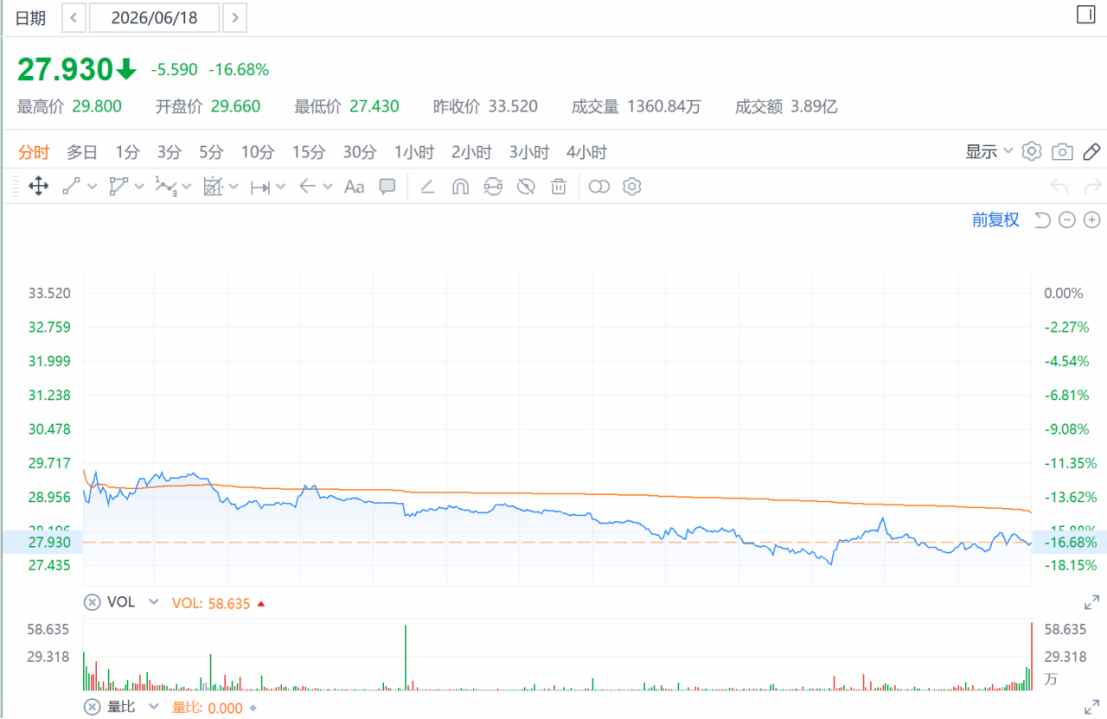
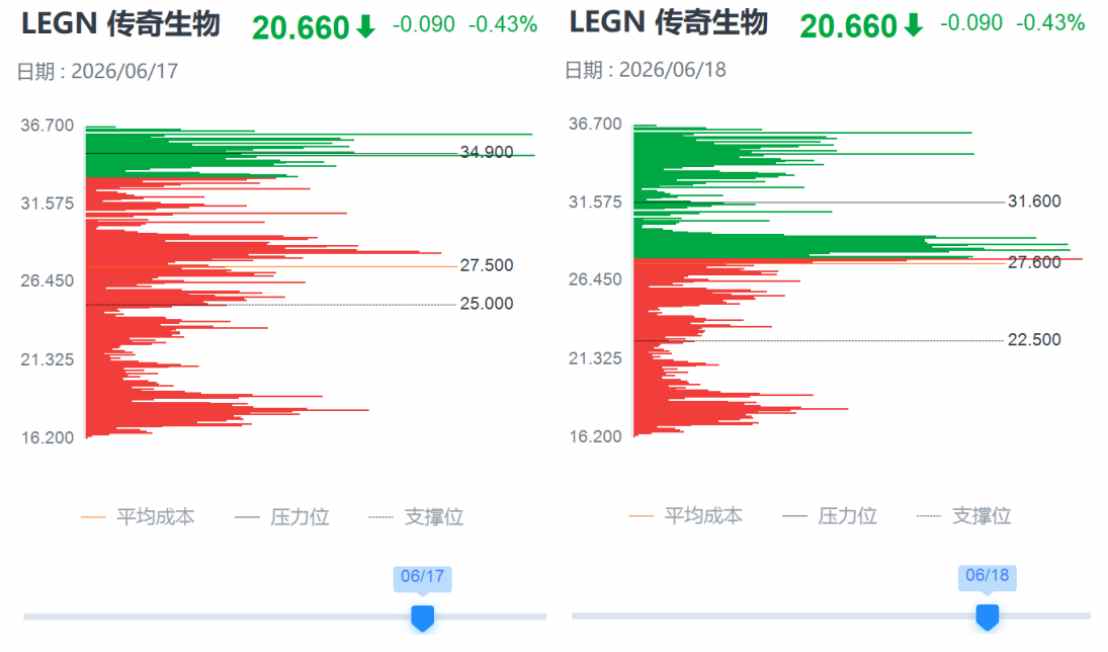
From a quantitative perspective, on June 18, Legendary Biotech traded 13.6.084 million shares in a single day. The intense trading situation showed serious differences in the market over the company's discounting attitude. Judging from the comparison chart of chip distribution on June 17 and 18, although there was a certain decrease in the amount of chips above the $34.9 pressure level in the previous period, the amount of chips in the $27.93 range increased markedly, indicating that many investors chose to fall to the bottom in the midst of a sharp decline, and its important logical support is still the volume expectations of the company's core commercial product, Carvykti, at 26Q2.
However, this market sentiment changed somewhat after Legendary Biotech announced Huang Ying's resignation as CEO and director on July 27.
In fact, at that time, Johnson & Johnson had already released Carvykti's 26Q2 results: Carvykti's current sales reached US$657 million, up 49.4% year on year; cumulative sales for the first half of the year were US$1,254 million, up 55.1% year on year. In other words, the drug continued to be released at an accelerated pace in the face of many previous market questions.
The reason why the departure of the CEO of the city greatly disrupted the short-term market of Legendary Biotech is because Huang Ying is the core leader of Legendary Biotech's completion of the transition from the clinical stage to the global commercialization stage. The impact of the withdrawal of key management roles on market investor confidence is also reflected in the secondary market's quantitative performance and chip movements.
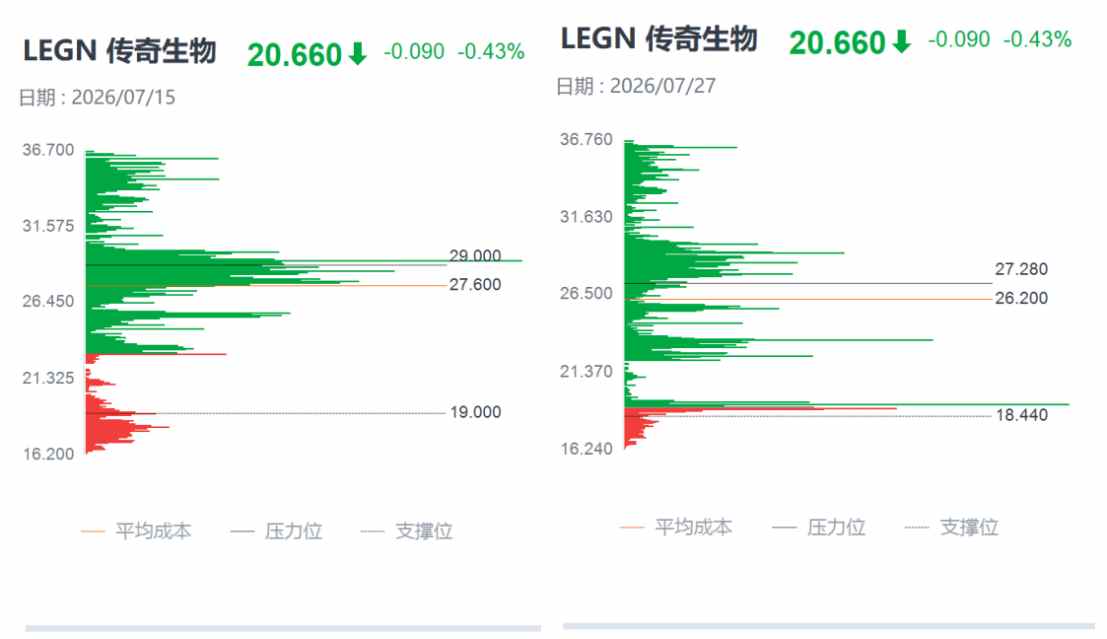
On July 27, Legendary Biotech's single-day trading volume reached another 10 million shares, reaching 1.00709 million shares. On the same day, the company's stock price jumped low, and the chips that had previously been concentrated at $27.6-29 declined significantly, accompanied by a large number of chips above $21.37 and chips at the bottom of $18.00.
Is Johnson & Johnson's statement a key factor influencing market confidence?
In the midst of this round of decline in Legend Biotech's stock price, the two major downsides that led to the downturn in the skipping were undoubtedly additional discounts and CEO departure. However, in the midst of these two events, partner Johnson & Johnson's Q2 earnings report disclosure and its statement at the earnings conference were also key factors influencing legendary biotech's market confidence.
On July 15, Legendary Biotech's stock price continued to expand within an hour of opening. The stock price drop fell to about 10% from near the opening line. Then, the company's stock price fluctuated all the way to a low level, and finally closed down 10.25%.
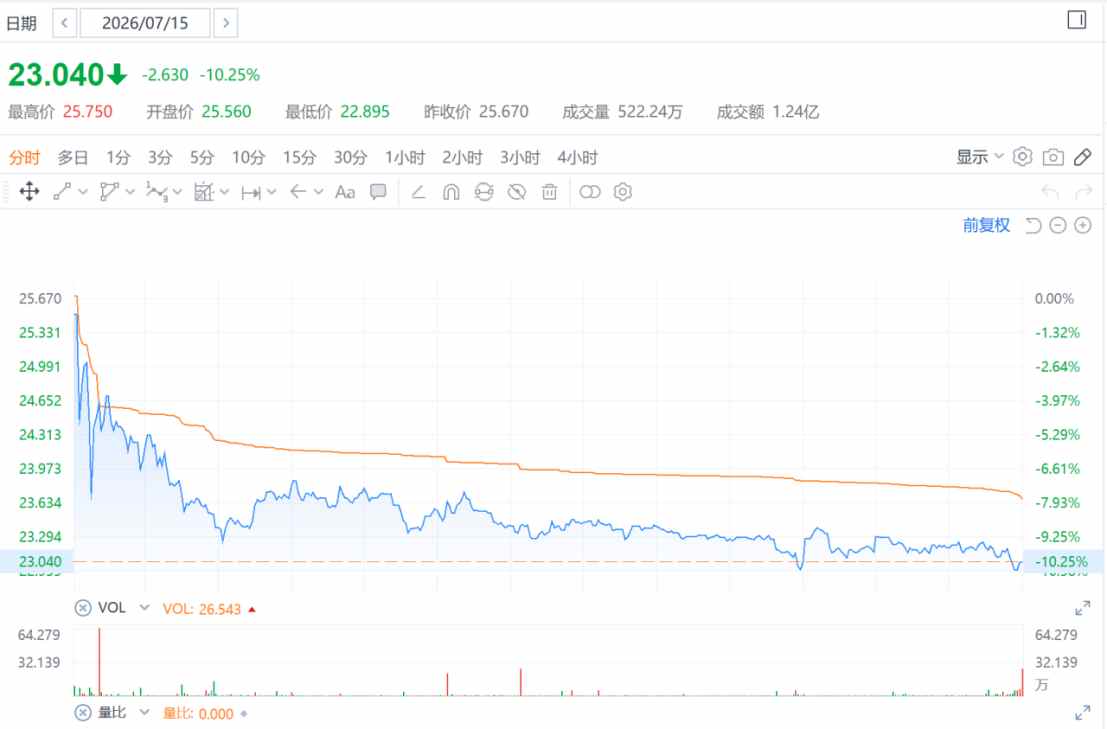
On the same day, legendary biotech partner Johnson & Johnson announced its 26Q2 quarterly results and revealed Carvykti's global sales of $657 million for the quarter. In fact, this performance is generally in line with previous market expectations.
One possible reason for the sharp drop in Legendary Biotech's stock price is a statement from a Johnson & Johnson executive during the conference call: Tecvayli + Darzalex, the dual antibody combination Tecvayli + Darzalex, which is owned by Johnson & Johnson, has “potential for cure” (potential for cure) in second-line multiple myeloma.
The subtext is that in Johnson & Johnson's secondary market map for multiple myeloma, the Tecvayli+Darzalex combination is in the same position as Carvykti, which clearly weakens the market's expectations for Carvykti's monopoly position.
In fact, this isn't the first time a legendary creature has been “backstabbed” by a partner. At the beginning of December last year, when Legendary Biotech's stock price began to rebound, a critical blow from partner Johnson & Johnson hit Legendary Creatures's life.
On December 9 of last year, Johnson & Johnson announced Phase 3 MajesteC-3 clinical data for its self-developed BCMA/CD3 dual antibody (Tecvayli) combined with CD38 monoclonal antibody (Darzalex) at the ASH2025 conference.
In terms of main clinical endpoints, the 36-month PFS rate in the Tec-Dara combination treatment group reached 83.4%, the control group DPD/DVD reached 29.7%, and the DPD/DVD median PFS in the control group reached 18.1 months. The Tec-Dara combination treatment group had not yet reached, and HR reached 0.17, which significantly mitigated disease progression.
It is worth mentioning that compared to the legendary BCMA Car-T drug Carvykti, the 34-month long-term follow-up study of the similar study CARTITUDE-4 released in 2024, its 30-month median PFS rate was 59.4%, which is clearly lower than the treatment data for Tec-Dara's current combined treatment group. Also, compared with Carvykti's 34-month follow-up data, the Tec-Dara combination treatment group has surpassed its 84.6% response rate and 76.4% OS rate, and is consistent with Carvykti in terms of negative residual lesion rate.
In this context, since the Tec-Dara combination treatment group is a spot product or a 100% equity product of Johnson & Johnson, there is a “benefit-oriented resource bias” in the market by Johnson & Johnson on this combination therapy, which also influenced the valuation of Legendary Biotech and caused its stock price to plummet at the time.
However, from a market perspective, Carvykti is a one-time cell therapy plan while Tecvayli + Darzalex is an ongoing treatment plan. There is a clear difference between the target groups of patients. The Carvykti and TEC-DARA combination treatment group are two weights for Johnson & Johnson in the MM market. Adding two products can only further stabilize Johnson & Johnson's market advantage. As Johnson & Johnson management made it clear during the call: approximately 80% of patients with multiple myeloma should use at least one strong product during treatment.
In other words, Carvykti, which has maintained about 50% quarterly sales growth, is still one of the fastest-growing oncology assets in Johnson & Johnson's MM layout, and there is no reason for Johnson & Johnson to cut back on its commercialization potential.
From the perspective of Legendary Biotech, the current valuation of Legendary Biotech's market sales rate, which has once again plummeted, is only 3.51 times, far lower than the industry average of 9.47 times. It is still quite attractive to investors who are optimistic in the long run.