
- PRICING
- LIVE QUOTES
- LEARN
- HELP


EN
Tamkeen Human Resources Company (TADAWUL:1835) Pays A ر.س1.43 Dividend In Just Four Days
Some investors rely on dividends for growing their wealth, and if you're one of those dividend sleuths, you might be intrigued to know that Tamkeen Human Resources Company (TADAWUL:1835) is about to go ex-dividend in just four days. Typically, the ex-dividend date is two business days before the record date, which is the date on which a company determines the shareholders eligible to receive a dividend. The ex-dividend date is important as the process of settlement involves at least two full business days. So if you miss that date, you would not show up on the company's books on the record date. This means that investors who purchase Tamkeen Human Resources' shares on or after the 16th of August will not receive the dividend, which will be paid on the 27th of August.
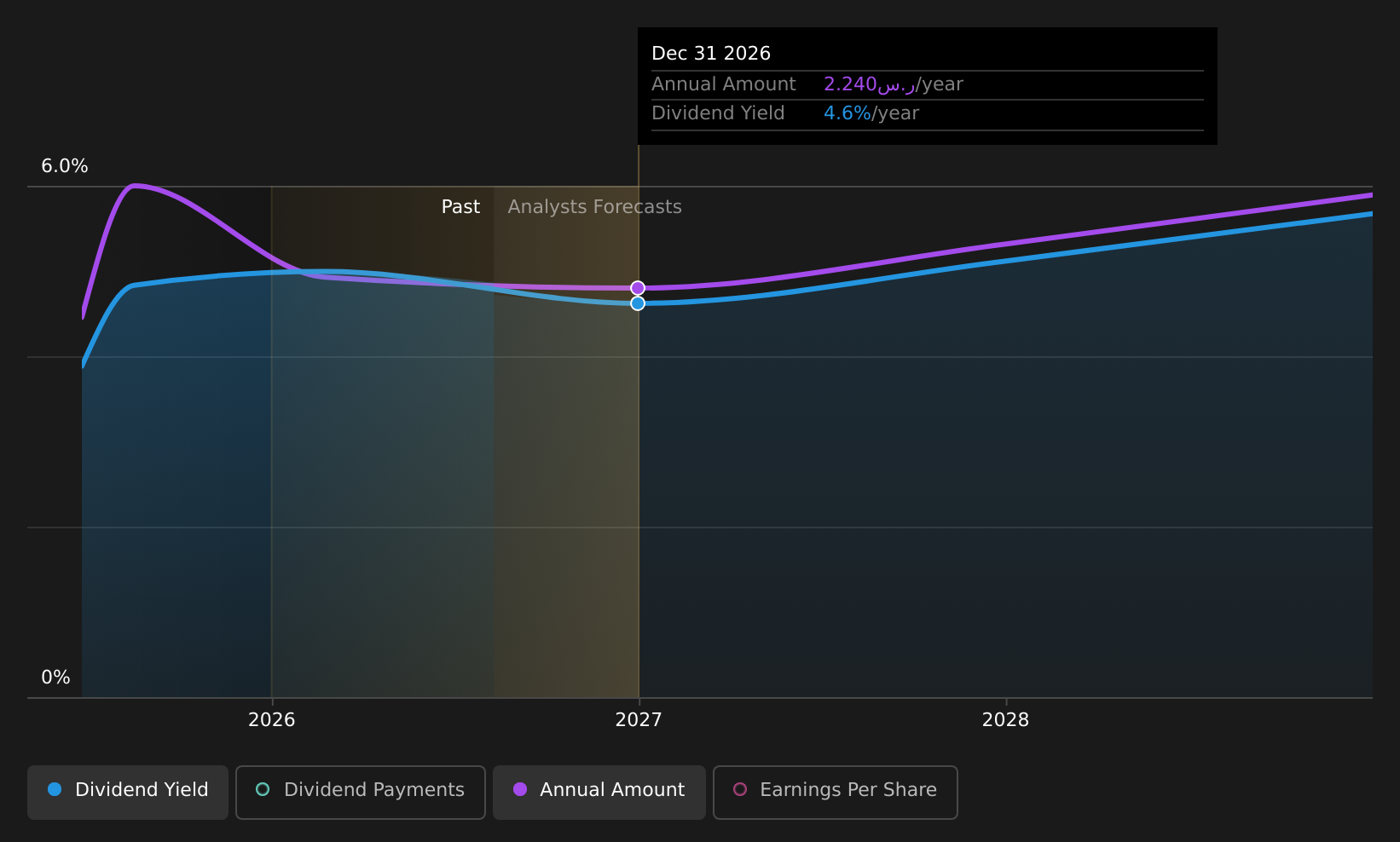
The company's next dividend payment will be ر.س1.43 per share, and in the last 12 months, the company paid a total of ر.س2.30 per share. Looking at the last 12 months of distributions, Tamkeen Human Resources has a trailing yield of approximately 4.7% on its current stock price of ر.س48.48. If you buy this business for its dividend, you should have an idea of whether Tamkeen Human Resources's dividend is reliable and sustainable. That's why we should always check whether the dividend payments appear sustainable, and if the company is growing.
Dividends are usually paid out of company profits, so if a company pays out more than it earned then its dividend is usually at greater risk of being cut. Tamkeen Human Resources paid out more than half (71%) of its earnings last year, which is a regular payout ratio for most companies. Yet cash flow is typically more important than profit for assessing dividend sustainability, so we should always check if the company generated enough cash to afford its dividend. Over the last year, it paid out more than three-quarters (89%) of its free cash flow generated, which is fairly high and may be starting to limit reinvestment in the business.
It's encouraging to see that the dividend is covered by both profit and cash flow. This generally suggests the dividend is sustainable, as long as earnings don't drop precipitously.
Check out our latest analysis for Tamkeen Human Resources
Click here to see how much of its profit Tamkeen Human Resources paid out over the last 12 months.
Have Earnings And Dividends Been Growing?
Stocks in companies that generate sustainable earnings growth often make the best dividend prospects, as it is easier to lift the dividend when earnings are rising. If business enters a downturn and the dividend is cut, the company could see its value fall precipitously. That's why we're glad to see earnings per share up 9.7% over the past 12 months. Decent historical earnings per share growth suggests Tamkeen Human Resources has been effectively growing value for shareholders. However, it's now paying out more than half its earnings as dividends. If management lifts the payout ratio further, we'd take this as a tacit signal that the company's growth prospects are slowing.
We do note though, one year is too short a time to be drawing strong conclusions about a company's future growth prospects.
Given that Tamkeen Human Resources has only been paying a dividend for a year, there's not much of a past history to draw insight from.
Final Takeaway
Is Tamkeen Human Resources an attractive dividend stock, or better left on the shelf? Earnings per share have been growing modestly and Tamkeen Human Resources paid out a bit over half of its earnings and free cash flow last year. All things considered, we are not particularly enthused about Tamkeen Human Resources from a dividend perspective.
Curious about whether Tamkeen Human Resources has been able to consistently generate growth? Here's a chart of its historical revenue and earnings growth.
If you're in the market for strong dividend payers, we recommend checking our selection of top dividend stocks.
Have feedback on this article? Concerned about the content? Get in touch with us directly. Alternatively, email editorial-team (at) simplywallst.com.
This article by Simply Wall St is general in nature. We provide commentary based on historical data and analyst forecasts only using an unbiased methodology and our articles are not intended to be financial advice. It does not constitute a recommendation to buy or sell any stock, and does not take account of your objectives, or your financial situation. We aim to bring you long-term focused analysis driven by fundamental data. Note that our analysis may not factor in the latest price-sensitive company announcements or qualitative material. Simply Wall St has no position in any stocks mentioned.