
- PRICING
- LIVE QUOTES
- LEARN
- HELP


EN
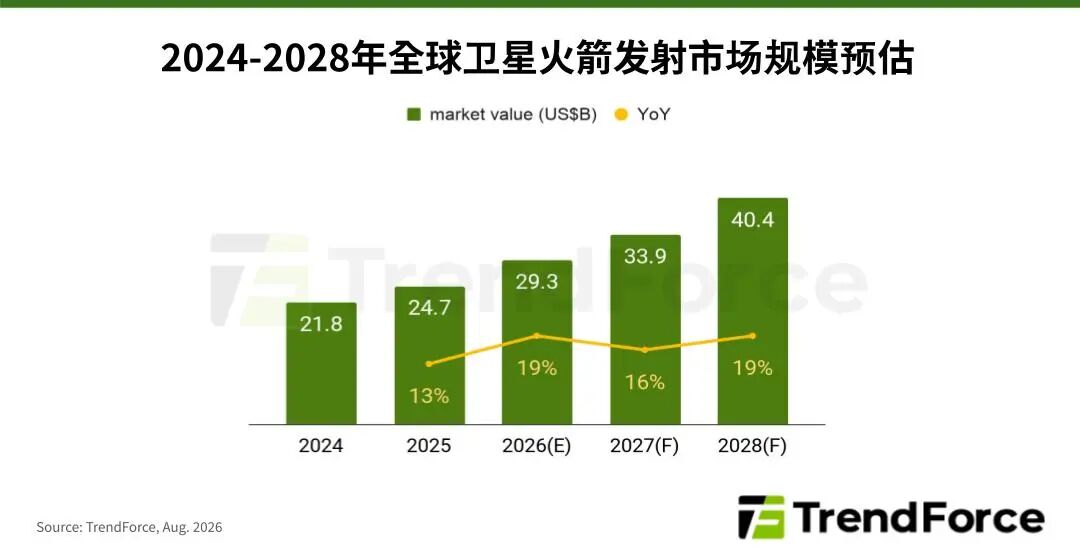
TrendForce Jibang Consulting: Starlink completes V3 satellite deployment verification and expects the global rocket launch market to be about US$40.4 billion in 2028
The Zhitong Finance App learned that according to TrendForce Jibang Consulting's latest satellite industry research, Starlink (Starlink) recently completed the deployment of the first batch of V3 satellites. Through measures such as ultra-large phase array antennas equipped with 2,048 array units and reducing orbital altitude, it can provide extremely low latency bandwidth and satellite services directly connected to mobile phones. As the V3 satellite will be deployed on a large scale, demand for launch missions from Starlink's parent company SpaceX will gradually grow, which is expected to drive the global satellite rocket launch market to 40.4 billion US dollars in 2028.
TrendForce Jibang Consulting said that in recent years, demand for satellite communication from urban edge and suburban users has increased significantly, prompting Starlink to fully upgrade the V2 Mini satellite to the V3 specification. Considering that in the past, the V2 Mini was deployed in orbit more than 500 km from the surface and was too crowded. In order to solve the noise interference caused by signal density in the traditional Ka and Ku bands, Starlink lowered the V3 satellite orbit to 350 km from the surface, not only drastically shortening the transmission delay to within 20 ms, but also providing a single user with an average high latency satellite broadband transmission rate of 100-200 Mbps and 1-2 Gbps downlink for suburban areas such as the United States, Brazil, Chile and Argentina, and also supports voice services for mobile phones directly connected to satellites, and higher Quality in-flight internet service.
Due to the addition of ultra-high millimeter wave bands such as V (50-75 GHz) and W (75-110 GHz) to the V3 satellite, the electronic scanning array antenna (ESA) antenna unit and overall size of the terrestrial receiver have been reduced. However, in the face of the serious challenge of UHF signal attenuation, RF (radio frequency) front-end modules must evolve towards highly integrated ultra-high frequency monolithic microwave integrated circuits (MMICs) and low-power materials (such as GaN and GaAs) used in high-frequency power amplifiers to balance miniaturization and high transmission performance. This technological transformation not only prompted Starlink to release orders for next-generation RF-related modules to major semiconductor and microwave device manufacturers such as Shengdake, Wenmao, and Quanxin, but also brought business opportunities to Qige, which has a one-stop RF module integration solution.
The SpaceX Starship has completed launch verification, and the cost of carrying the rocket has been drastically reduced
TrendForce Jibang Consulting pointed out that the current v3 satellite launch mission was carried out by SpaceX's Starship (Starship) rocket, and the successful deployment of the satellite means that the Starship has completed launch verification. To carry 20 massive V3 satellites, the super-heavy propeller ignited 33 Raptor (Raptor) engine-driven rockets and simultaneously collected key technical data such as the performance of the insulation cover.
As the number of satellite communication users continues to grow, the V3 satellite will enter a large-scale deployment period. With the gradual formation of 6G mobile communication technology in 2028, it is expected that emerging application scenarios integrating satellites, high-altitude platform base stations (HAPS), and drones will be added. The above factors will boost demand for rocket launches, starting with Starships. It is estimated that the global satellite rocket launch market will rise from US$29.3 billion in 2026 to US$40.4 billion in 2028.
From the perspective of rocket cost, compared to the Falcon 9, which is currently mainly used, can only recycle first-stage rockets, Starship has the ability to recycle first-stage rockets (super-heavy propellers) and second-stage rockets to help SpaceX switch from making new rockets every time to only paying routine maintenance costs. It is estimated that this change will ease the pressure on SpaceX's cash flow and invest more money in emerging services such as AI in-orbit computing in space.