
- PRICING
- LIVE QUOTES
- LEARN
- HELP


EN
Omdia: Global tablet shipments fell 10% year on year in the second quarter Lenovo (00992) bucked the trend and increased 27%
The Zhitong Finance App learned that according to Omdia's latest research, in the second quarter of 2026, the global tablet market entered a downward cycle, with shipments falling 10% year-on-year to 36 million units. Notably, this is the first time in recent years that tablet shipments have broken the seasonal trend of month-on-month growth in shipments driven by back-to-school demand in the second quarter.
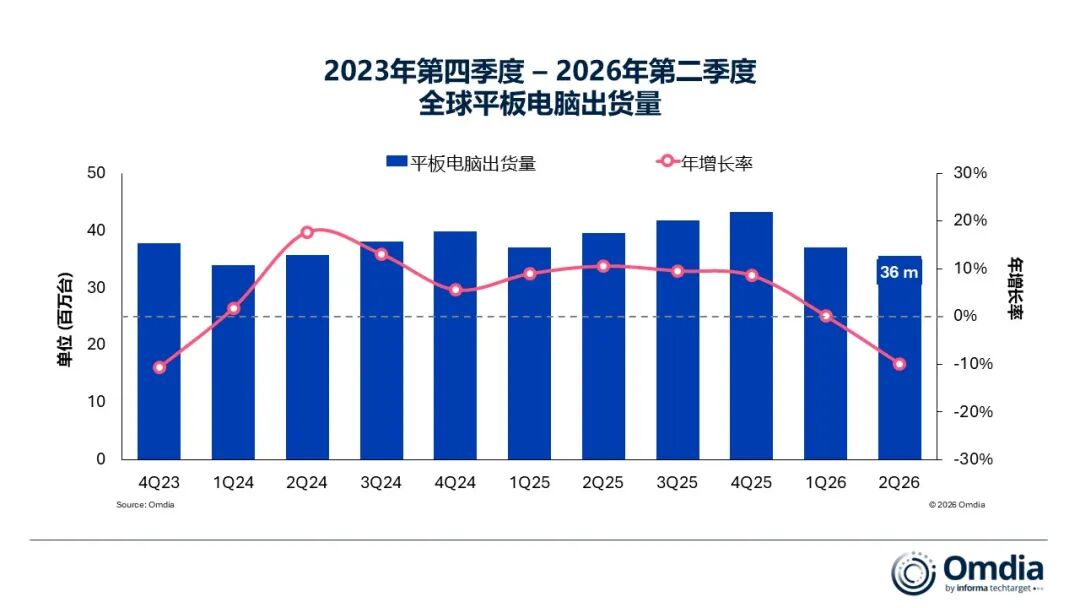
The global tablet market has entered an expected period of decline
“This past quarter, the tablet market experienced one of the most significant declines in nearly two years,” said Himani Mukka, research manager at Omdia. Although the slowdown was in line with expectations, the market's performance in previous quarters was more resilient than expected. Tablets have become an integral part of many households, and in various consumer use scenarios, detachable tablets are increasingly replacing traditional PCs for everyday computing processing. Despite the overall market weakness, relatively affordable prices, increased supply of large-screen models, and the established position of tablets in the education sector and the field business environment continue to support an important demand sector.”
As supply is limited, high-end tablets are the focus of attention
Mukka added, “Looking ahead, in the current environment where the supply of components is limited, it is unlikely that manufacturers will give broad priority to developing the tablet category. Instead, they will focus their limited resources on flagship and high-end models to further shift their product portfolio to high-end devices.”
In addition to hardware, tablet makers will increasingly rely on services, optimized AI strategies and use cases, and new marketing strategies to drive revenue growth and achieve product differentiation. Omdia anticipates that tablets will continue to decline for the rest of 2026. This not only reflects limited supply of low-cost tablets, but also reflects that consumers are delaying purchasing decisions due to rising prices, further curbing market demand.
Apple maintains its leading position in the market, and Lenovo (00992) achieves strong growth
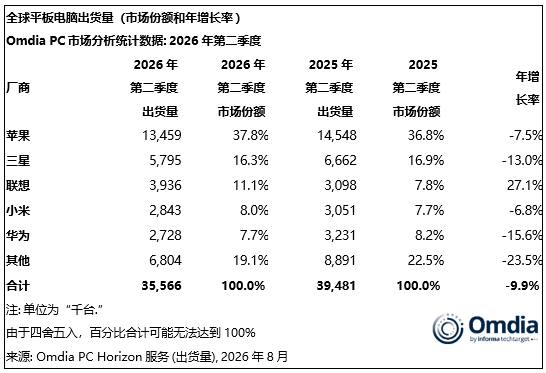
In the second quarter of 2026, despite an 8% year-on-year decline in shipments, Apple maintained its leading position. Global iPad shipments reached 13.5 million units, accounting for 38% of the market share. Standard iPads account for most of the shipments, with the Air and Mini models accounting for a relatively small share.
Despite a 13% year-on-year decline, Samsung maintained its position as the second-largest tablet manufacturer, with shipments of close to 6 million units. As component supply restrictions continue, the company is expected to dynamically adjust its product portfolio during the year, prioritizing the development of high-margin models to protect profit margins and profitability.
Among the leading manufacturers, Lenovo was the only manufacturer to achieve an increase in shipment volume, which increased 27% year over year. Although part of the increase stemmed from actual end user demand, it was also supported by anticipated price increases and pre-channel stocking for major retail promotions.
Huawei ranked in the top five, with 2.7 million units shipped, down 16% year-on-year in the current quarter.
Chromebook shipments continue to decline due to weak demand for education
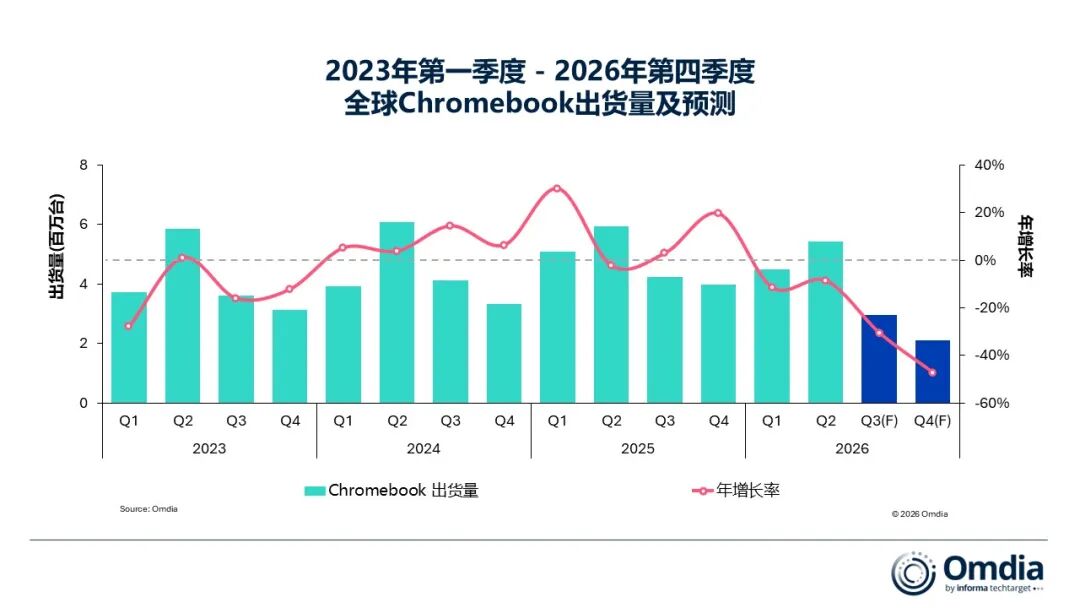
In the second quarter of 2026, the Chromebook market experienced another decline. Since memory currently accounts for a disproportionate share of the bill of materials for entry-level and education-level devices, Chromebooks have become one of the hardest hit equipment categories in the current supply-limited environment. Despite a 4% year-on-year decline, Acer jumped to second place with 1.18 million units shipped. Its steady demand in North America and the incremental share it received from HP in the region supported its relatively steady performance.
HP shipped 1.15 million units, down 13% year on year, ranking third. Relatively weak demand in the education sector continues to affect its shipments.
Asus performed well, with shipments increasing 66% year over year to 749,000 units, doubling its market share from 8% to 16% in the second quarter of 2026. This growth is due to its role as a key supplier of GIGA 2.0, the US K-12 education equipment renewal cycle, and back-to-school inventory.
Dell had the second largest drop, with shipments plummeting 47% year over year to 465,000 units.
More broadly, this decline can be attributed to manufacturers reducing the priority of the category due to relatively low profit margins on Chromebooks, as well as a high shipment base when education deployment was at its peak in the second quarter of 2025. Even pre-agreed Chromebook deployments have experienced delays this year, further dragging down shipments.