
- PRICING
- LIVE QUOTES
- LEARN
- HELP


EN
Rocket Lab (RKLB.US) plummeted after the results! Q2 performance is mixed +Q3 profit forecast falls short of expectations, Neutron rocket project faces risk of delay
The Zhitong Finance App learned that although Rocket Lab (RKLB.US) announced record revenue and backlog of orders, the second-quarter earnings report itself was mixed. Combined with the profit forecast given by the company at the same time, it fell short of expectations, and hinted that its Neutron rocket project might experience a new risk of postponement, causing the stock performance to decline later. As of press release, Rocket Lab's US stocks fell more than 6% after the market on Monday.
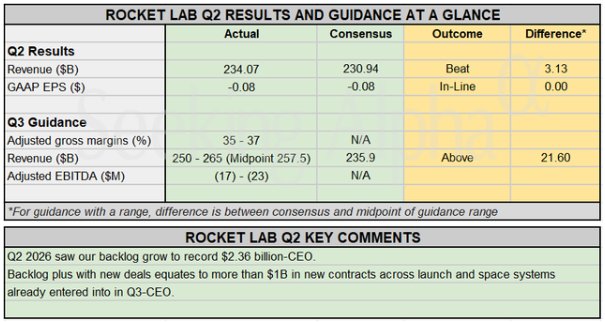
According to financial reports, Rocket Lab's second-quarter revenue increased 62% year-on-year to US$234 million, slightly higher than analysts' general expectations of US$232 million; net loss narrowed from US$66.4 million in the same period last year to US$49.3 million; after dilution, the loss per share was 8 cents, higher than analysts' general expectations of a loss of 6 cents per share. By the end of the quarter, backlog of orders increased 137% year over year to a record $2.36 billion; non-GAAP gross margin reached 41.5%, higher than analysts' expectations of 38%.
Looking ahead, Rocket Lab management expects third-quarter revenue of between US$250 million and US$265 million, which is significantly higher than analysts' general expectations of US$235.9 million. However, profitability is expected to decline. The company expects GAAP gross margin of 29% to 31% in the third quarter compared to 36.1% in the second quarter; non-GAAP gross margin is expected to be 35% to 37%, down from 41.5% in the second quarter. Additionally, the company expects an adjusted EBITDA loss of between $17 million and $23 million, while analysts generally expect a loss of around $10 million.
Additionally, Rocket Lab has hinted that its Neutron rocket project may face a new risk of delays, increasing the possibility that this carrier rocket, which is designed to challenge SpaceX (SPCX.US)'s main Falcon 9 rocket, may not take off for the first time until 2027.
Currently, Rocket Lab has a backlog of more than 90 launch orders, and the Neutron rocket remains one of the most important components of the company's long-term growth plans. The Neutron rocket is a larger and more powerful version of Rocket Lab's current main Electron rocket. The company said that the Neutron rocket is still scheduled to arrive at the launch site in the fourth quarter according to the previous schedule, but it has not been specified that the rocket will complete its first flight this year. Earlier, Rocket Lab stated that the goal is to complete the first neutron rocket launch by the end of 2026.
“There are still risks and uncertainties in the complex R&D cycle,” Rocket Lab said on Monday. The company said the exact launch time of the Neutron rocket will depend on booster test results and other factors.
In a conference call with investors, Rocket Lab CEO Peter Beck said that the time window is currently “narrowing” if he hopes to complete the first launch before the end of this year. At the same time, he stressed that Rocket Lab places more emphasis on careful progress rather than hastily carrying out the first Neutron rocket tests in order to catch up with progress.
Although there is still uncertainty about the timing of the first launch, Rocket Lab announced on Monday that Kepler Communications has purchased an exclusive launch service for the Neutron rocket, and the launch will be no earlier than 2028.
It is worth mentioning that Rocket Lab has also been expanding its business scope in 2026, gradually moving away from its position as only an Electron rocket launch service provider. In June of this year, the company agreed to acquire Iridium Communications for about $8 billion. The deal is expected to be completed by mid-2027, making it capable of competing in the emerging “direct-connect device” satellite communications service market. Rocket Lab has also completed acquisitions of Mynaric and Motiv to further acquire relevant technology to support the company's strategy to expand into spacecraft and space systems.
Government contracts have also become another important driving force for Rocket Lab's development this year. Last week, Rocket Lab announced that it has received a contract worth 397 million US dollars from the US Space Force to develop and launch a dedicated Flaxite satellite mounted on a Neutron rocket.