
- PRICING
- LIVE QUOTES
- LEARN
- HELP


EN
Copper Tests 6.50 Pivot as Tariff Bets, Congo Supply Curbs, and Chilean Mine Woes Collide
What Is Driving Copper's Record Run
Copper has gained more than 17% on Comex so far this year, and the rally accelerated sharply in early August, with the metal touching an all-time high near 6.90 per pound on August 6 before sellers stepped in. The single biggest driver remains the pending US decision on copper import tariffs. The Commerce Department was originally expected to deliver a recommendation by the end of June, but the decision has yet to be announced, and that uncertainty has encouraged importers to keep front running the possibility of higher duties. More than 200,000 tons of copper arrived at US ports in July alone, the largest monthly inflow in data going back to 2014, and that hoarding has starved buyers elsewhere of available metal, tightening inventories on the London Metal Exchange and in China even as US warehouses swell. Supply concerns out of Chile have added to the squeeze, with Codelco warning that development work at the Andes Norte section of its flagship El Teniente mine could remain suspended for up to two years because of geotechnical issues, a meaningful loss of tonnage from the world's top copper producing country.
The other major headline this week came from the Democratic Republic of Congo, which issued an order dated June 29 and revealed by Reuters on August 6 banning exports of copper and cobalt concentrate. The announcement helped push copper to its record high that same session, but the actual disruption looks more limited than the headline implied, since this is the fourth such ban since 2013 and Congo already ships most of its copper as refined cathode rather than raw concentrate. Ivanhoe Mines, whose Kamoa Kakula complex is most exposed, clarified that a similar restriction has effectively been enforced for close to a decade. Broader risk sentiment has also been shaped by speculation over reopening the Strait of Hormuz and continued difficulty reaching a US Iran deal. Reading how copper reacted to these headlines, tariffs and stockpiling remain the dominant theme driving this year's rally, while supply scares out of producer nations like Congo move price quickly but tend to fade once their physical significance is questioned, unlike the more durable, confirmed production loss unfolding in Chile.
What The Market Has Done
- The market used the yearly VWAP near the 5.85 area as support in May and broke up above the Consolidation Block 1 range to print new all-time highs.
- That advance was met with profit taking near the 6.70 area, and a two-way auction subsequently developed as buyers and sellers fought for control.
- Buyers stepped up bids to defend the 6.00 area, identified as Daily Level 2, a zone that is also confluent with the yearly VWAP.
- Since that defense, buyers steadily stepped up bids within Consolidation Block 2.
- More recently, the market probed above Consolidation Block 2 to establish fresh all-time highs before the latest round of profit taking, pulled prices back toward the 6.60 area.
What To Expect in the Coming Weeks
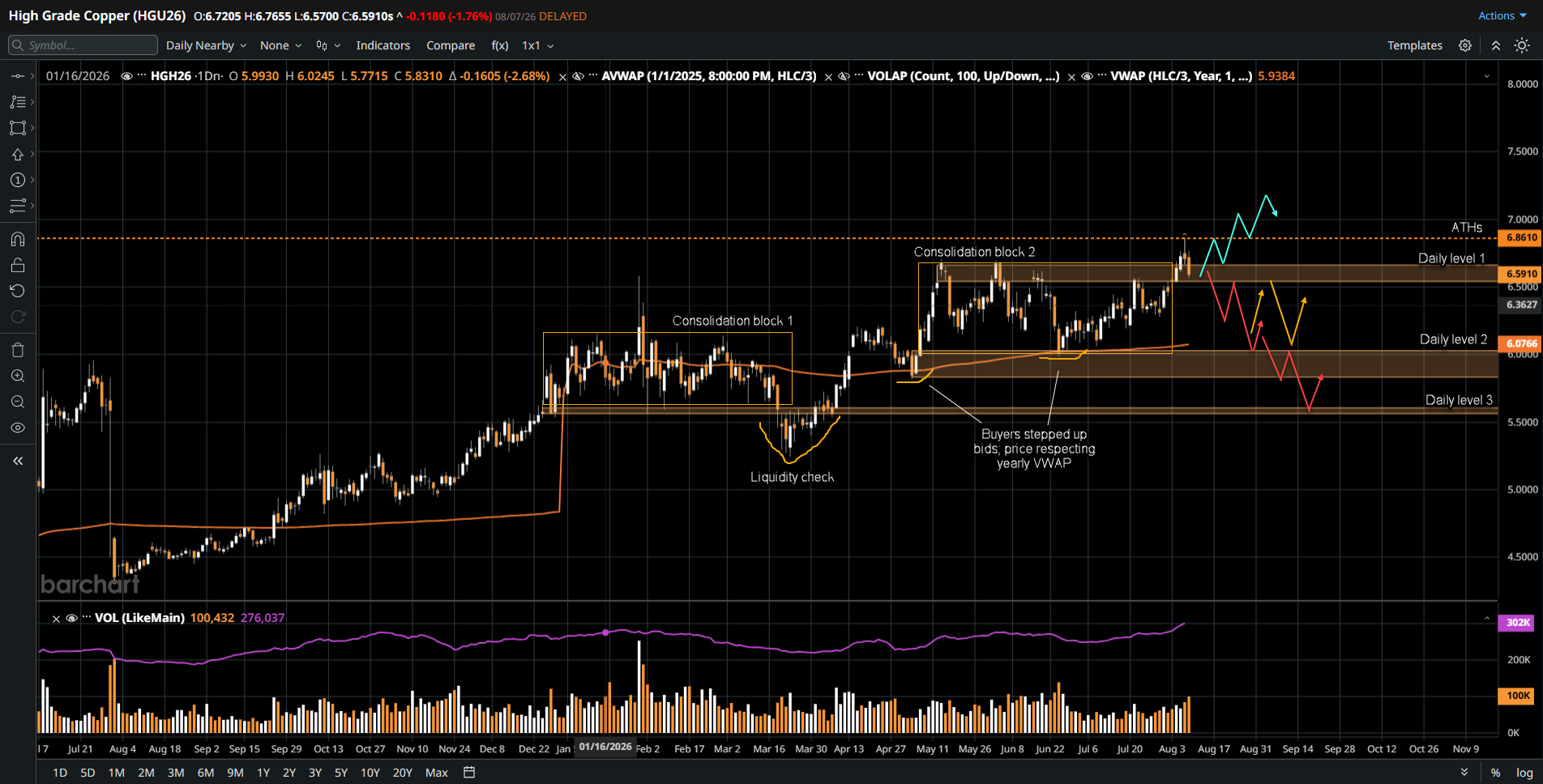
The key level to watch is the 6.50 area, identified as Daily Level 1.
Bullish Scenario
- If buyers are able to defend the 6.50 area, or if the market probes below it and buyers are able to reclaim it quickly, expect a revisit to the 6.86 area, the current all-time highs, and possibly a push to new record levels beyond that.
- A possible trigger for this scenario would be formal confirmation of US import tariffs on refined copper, which would extend the incentive to keep metal flowing into American warehouses and further tighten availability on the LME and in China.
Neutral Scenario
- If buyers are able to defend the 6.00 area, Daily Level 2, after a rotation down through Consolidation Block 2 from the 6.50 area, expect two-way balance to persist within Consolidation Block 2's range between the 6.50 area and the 6.00 area.
- A possible trigger for this scenario would be a delayed or partial US tariff announcement, such as a phased in rate or exemptions for select trading partners, that keeps the current stockpiling flows and supply demand tightness broadly intact without providing a fresh catalyst in either direction, leaving participants content to trade the existing range.
Bearish Scenario
- If buyers are not able to hold the 6.50 area, expect a move back down to the 6.00 area, Daily Level 2, through Consolidation Block 2, where buyers are expected to defend again in the vicinity of the yearly VWAP.
- If that defense fails, expect a further move down to the 5.60 area, Daily Level 3, through Consolidation Block 1.
- A possible trigger for this scenario would be a US tariff decision that comes in below market expectations, or is delayed again without new guidance, prompting importers to unwind the record volumes stockpiled in US warehouses and redirect that metal back toward the LME and Shanghai, easing the very supply tightness that has underpinned prices.
Conclusion
Copper's chart still reflects a market in a structural uptrend that has simply run into a well-earned bout of profit taking after tagging fresh record highs near 6.90. The 6.50 area is now the pivot that matters most, and how buyers and sellers resolve that fight over the coming sessions should reveal whether the broader trend reasserts itself toward new highs or whether the market needs more time to digest gains within the 6.00 to 6.50 range. Underneath the price action, the fundamental backdrop remains constructive but unsettled, with a pending US tariff decision still driving unprecedented stockpiling, a genuine supply loss developing at Codelco's El Teniente mine, and Congo's latest export order keeping resource nationalism and cobalt linked supply risk in focus even if its near term physical impact looks smaller than the headlines suggested. As the market's own reaction this week showed, tariffs remain the primary lens copper is trading through, with supply disruption headlines acting as a faster moving but less durable secondary influence. With so many moving pieces between technical structure and macro catalysts, where do you see copper heading from here, and which of these triggers are you watching most closely?
We built EdgeClear for traders who treat trading as a business. That means low commissions, zero-friction order routing, and free access to EdgeClear Insights—a cloud-based analytics platform that tracks your P&L, discipline, and execution quality in real time. Build your trading business on a foundation that scales with you. Open an Account today
Disclaimer:
This article is provided for informational and educational purposes only and does not constitute financial, investment, or trading advice. The analysis presented reflects the author’s market observations and opinions at the time of writing and is not a recommendation to buy or sell any futures contract, security, or financial instrument. Futures trading involves significant risk and is not suitable for all market participants. Losses may exceed initial margin deposits, and market conditions can change rapidly.
Any scenarios, levels, or market expectations discussed are hypothetical in nature and are intended solely to illustrate potential market behavior. They do not represent actual trading results and should not be interpreted as guarantees of future performance. Past performance, market behavior, or historical price action are not indicative of future outcomes.
Readers are solely responsible for their own trading decisions and risk management. Always conduct independent research, consider your financial situation and risk tolerance, and consult with a qualified financial professional, if necessary, before engaging in futures or derivatives trading.