
- PRICING
- LIVE QUOTES
- LEARN
- HELP


EN
Intel (INTC.US) took advantage of the AI boom and issued an additional $15 billion in common stock betting on “CPU demand fanatic+chip foundry+advanced packaging” to reshape the growth curve
The Zhitong Finance App learned that the established US chip manufacturing giant Intel Corporation (INTC.US) said on Monday that it will issue common shares worth 15 billion US dollars to take advantage of the market's strong investment interest in the “data center CPU+advanced process foundry+advanced packaging” integrated chip business prospects heating up again under the artificial intelligence data center construction boom.
Intel said in a statement on Monday that the funds raised will be used for general corporate purposes. The company said, “Strong progress in emerging fields such as physical AI, special silicon chips, advanced packaging, and external foundry business has brought significant historical growth opportunities for Intel.” “This release is intended to further enhance Intel's ability to seize strong future growth opportunities while maintaining a strong balance sheet and continuing to deliver on its important commitment to maintaining an investment-grade credit rating.”
Robert Schiffman, senior analyst at Bloomberg Intelligence, wrote in the latest report that the capital raised by Intel this time provided “sufficient capital” for artificial intelligence, foundry, and other projects without increasing leverage. “Intel is also strengthening a broader theme in the field of AI computing power infrastructure: growing investments don't have to be entirely borne by bondholders,” he wrote. Intel was also compared to Oracle, SpaceX, Google's parent company Alphabet, Meta Platforms, and Microsoft.
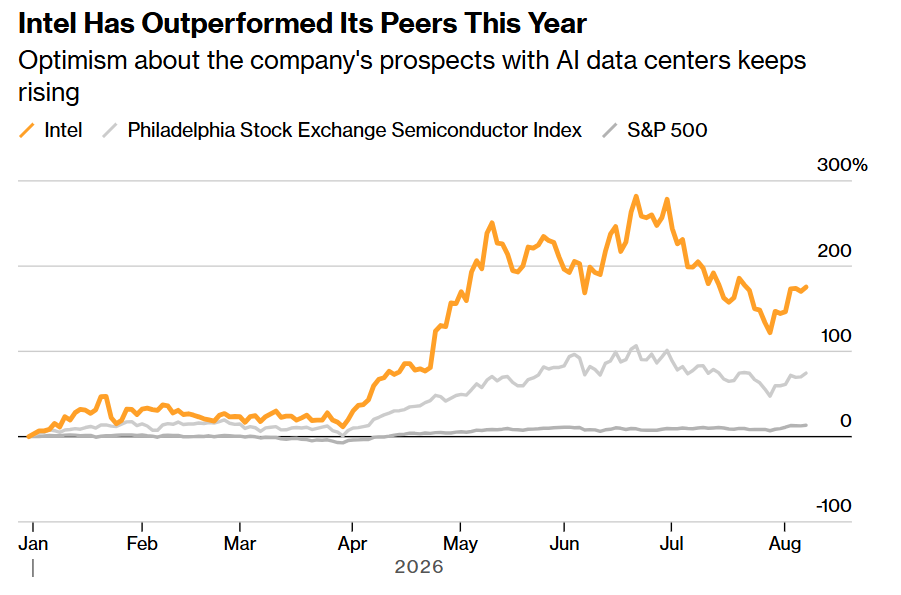
As shown in the chart above, Intel has performed significantly better than its chip peers this year — as market optimism about the company's AI data center-related chip business prospects continues to heat up.
As Intel strives to promote business transformation, the company's stock price has nearly tripled this year. By the end of last week, US stocks closed at $101.65. Although Intel does not have a leading position in the field of AI-specific chips, growing demand in data centers has driven a sharp rise in sales of its x86 architecture central processing units (that is, data center CPUs). Overall sales of Intel's data center business surged 59% in the last quarter, more than double the company's overall revenue growth rate. However, the company is still working hard to obtain external OEM customers such as Apple and Nvidia with important business scales for its wafer manufacturing plants and advanced packaging business layout.
As far as Intel's stock price is concerned, this $15 billion increase in common stock is a typical “short term growth, but long-term value depends on return on capital” financing.
However, from the perspective of the company's financial engineering, the financing is quite rational at this time — Intel exchanged equity capital with significantly reduced costs of 15 billion to 17.25 billion US dollars in cash after experiencing a drastic revaluation of the stock price, rather than further increasing debt leverage; the company clearly stated that the funds would be used for capital expenses and working capital while maintaining an investment grade rating. What really determines whether this financing is ultimately “value creation” or “high dilution” is not the issuance itself, but whether future 18A/14A, advanced packaging, and external wafer businesses can generate ROICs higher than capital costs.
One of the big winners of the AI craze — the “rise of CPU+the boom in foundry and advanced packaging” completely ignited Intel's stock price
With strong demand for data center CPUs, expanding OEM customer relationships, and the AI industry's capital expenditure remaining high, Wall Street analysts can be described as increasingly optimistic about Intel's stock price and basic outlook. The market's investment logic for Intel is fundamentally changing: it is no longer just a traditional consumer electronics central processor manufacturer waiting for the PC cycle to recover, but is beginning to reprice it according to the “data center server CPU+advanced process chip manufacturing/foundry+advanced packaging” full-stack AI computing power infrastructure platform.
This is why international financial giant HSBC (HSBC) raised the agency's price target for Intel by 100% to $200 — this is also the highest target point for Intel among Wall Street analysts. Intel can once again be described as one of the most popular semiconductor stocks among retail and institutional investors around the world. $200 means there is still potential room for growth of about 96.8%; if calculated simply based on the current unchanged share capital benchmark of about 5.104 billion shares, the corresponding market value is about 1.02 trillion US dollars.
At a time when AI agents (Agentic AI) are rapidly gaining popularity around the world, cloud computing giants and AI application leaders such as Anthropic are rapidly expanding artificial intelligence (AI) infrastructure spending, and global AI data center computing power infrastructure is in full swing, HSBC gave this aggressive bullish judgment. This is also the core logical line for Wall Street peers such as Citibank and Bank of America to raise Intel's stock price.
Although AI chip superpower Nvidia (NVDA.US) has always dominated the AI GPU computing infrastructure market, data center CPU, advanced packaging, and wafer/semiconductor manufacturing capacity expenses are becoming an increasingly critical part of the AI computing power supply chain system. HSBC believes Intel can benefit from the continued surge in data center CPUs brought about by AI agents and the global AI semiconductor production capacity expansion frenzy led by Musk TeraFab's “superchip factory.”
$200 is not simply a higher valuation for Xeon CPUs; it is also pricing the four growth curves of “AI server CPU revival+external Foundry customer 18A/14A chip manufacturing foundry platform+Emib advanced packaging”. If this judgment is fulfilled, Intel will no longer be viewed as just a traditional x86 CPU company, but will be revalued as an American semiconductor infrastructure platform spanning AI data center computing, advanced manufacturing processes, and AI heterogeneous packaging; conversely, the biggest risk of the $200 target is also very clear — Foundry's foundry and advanced packaging business entrusters must actually receive real large-scale external orders; otherwise, the potential growth space currently close to doubling can hardly be supported by the CPU cycle alone.
Intel is betting on “Xeon CPU+advanced process chip foundry+advanced packaging” with an additional $15 billion issuance to reshape the existing growth curve
On a short-term level, the market unquestionably traded stock dilution first. This is why Intel's stock price once fell by more than 4% before the market after announcing additional stock issuance. According to a rough calculation of the current stock price of about 101.65 US dollars, 15 billion US dollars corresponds to about 148 million new shares, which is theoretically diluted by at least 2.9%.
Looking at the AI data center engineering architecture, Intel is seizing an important change overshadowed by the GPU narrative: Agentic AI (AI agents with proxy workflows) and large-scale inference are once again increasing the value of CPUs in GPU computing power clusters, and Intel may expand CPU production capacity by issuing stock capital to raise capital. Data Center & AI revenue reached US$6.26 billion in the second quarter, up 59% year on year; but we need to see the structure clearly here — server ASP increased by about 48% year over year, and server shipments only increased by about 9%, indicating that the current outbreak is due not only to Xeon CPU demand in AI data centers, but also from high core count, high-end Xeon product portfolio and stronger pricing, rather than simply a sharp rise in market share. As AI shifts from centralized training to inference, agent orchestration (agent orchestration), data preprocessing, retrieval, network and storage control, the CPU is responsible for increasing the host, control plane, general computing, and data handling workloads.
Intel management even publicly quoted industry judgments. The configuration relationship of about “1 CPU: 4 GPU” in the training era may evolve closer to “1:1” in the Agentic AI reasoning wave.
The really more strategic part of $15 billion is actually the “Foundry+ Advanced Package” — a key bet for Intel's ability to transition from a CPU company to a global system-level semiconductor platform. Intel Foundry's revenue for the second quarter was about 5.77 billion US dollars, an increase of 31% over the previous year, but it is important to emphasize that this figure includes a large amount of internal wafer manufacturing revenue and is not directly equivalent to TSMC-style external foundry revenue; at the same time, Foundry still recorded operating losses of about 2.09 billion US dollars in a single quarter, so the foundry business is still a long way from truly proving the economic model.
The positive aspect is that 18A has already climbed into actual product development, and Intel has re-promised large-scale mass production of 14A in 2028; in addition, 14A advanced process chip foundry will integrate PowerDirect backside power, advanced transistors, and advanced packages such as Foveros Direct 3D and EMIB. The latter two are particularly critical to Intel's AI chip foundry ambition — future AI accelerators will increasingly not be single-chip SoCs, but Compute Die+HBM A heterogeneous system composed of +I/O Chiplet+ Network Die, the strategic value of advanced packaging is almost at the same level as the manufacturing process itself.
As far as Intel's stock price and fundamental expansion prospects are concerned, in the next pricing phase of the stock market, it is necessary to provide more hard-core evidence of growth: can Xeon turn the CPU demand brought by Agentic AI into continuous share and profit, can 18A climb steadily, can 14A get enough external flagship customers, and whether Foundry's losses can narrow rapidly as the utilization rate of advanced external wafer manufacturing processes and advanced packaging increases.