
- PRICING
- LIVE QUOTES
- LEARN
- HELP


EN
US stock outlook | The three major stock index futures had mixed ups and downs. US inflation data revealed this week that Intel (INTC.US) fell more than 3% before the market
Pre-market market trends
1. Before the US stock market on August 10 (Monday), futures for the three major US stock indexes had mixed ups and downs. As of press release, Dow futures were down 0.08%, S&P 500 futures were down 0.01%, and NASDAQ futures were up 0.02%.

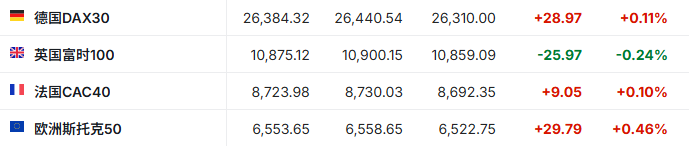
2. As of press release, the German DAX index rose 0.11%, the UK FTSE 100 index fell 0.24%, the French CAC40 index rose 0.10%, and the European Stoxx 50 index rose 0.46%.
3. As of press release, WTI crude oil rose 1.73% to $79.53 per barrel. Brent crude rose 1.75% to $85.01 per barrel.

Market news
Inflation data collided with AI infrastructure earnings reports, and US stocks faced a “double major test” this week after reaching new highs. The first week of the tech giants' earnings season came to an end, and market performance can be described as exceeding investors' expectations. Despite mixed initial results, overall sentiment turned positive as market concerns about AI capital expenditure gradually subsided. However, after the unexpected release of non-agricultural data last Friday, the Federal Reserve's interest rate cut expectations were re-adjusted, and US stocks closed strongly higher over the weekend. As we enter the second half of the earnings season, the market focus will continue to be on two fronts: first, more companies are disclosing their results one after another, and the other is whether economic data can provide a basis for calibrating the US Federal Reserve, which is on the verge of “raising interest rates and staying on hold.” The consumer price index (CPI) released on Wednesday has been highlighted by the market. Economists expect both overall CPI and core CPI (excluding energy and food) to rise 0.2% month-on-month. Wholesale inflation data will be released on Thursday, and the producer price index (PPI) is also expected to rise higher than last month. This week's economic data ended with Friday's retail sales and University of Michigan consumer survey data. At the enterprise level, this week's earnings schedule is relatively lackluster: Cava Group (CAVA.US) on Tuesday, cloud infrastructure companies Nebius Group (NBIS.US) and Cerebras Systems (CBRS.US) on Wednesday, and Applied Materials (AMAT.US) on Thursday will release results one after another.
South Korea spent 5 trillion won to set up a special fund targeting semiconductor materials and companies without wafers. According to reports, South Korea's presidential chief of staff Kang Hoon-sik said on Monday that South Korea will launch a new 5 trillion won (about 3.52 billion US dollars) semiconductor fund to focus on investing in promising chip materials, components, and non-wafer-free companies. This is also part of the government's plan to build a chip cluster. Kang also announced that the government will also provide 5 trillion won in trade finance to support export-oriented suppliers, and will strive to push for the passage of the “Very Large Special Industrial Complex Law” within the year to speed up license approval, environmental assessments, and infrastructure construction in relevant regions. Furthermore, the government plans to guarantee 650,000 tons of water supply for semiconductor projects in Hunan by 2030, while the Yongin Semiconductor Cluster will receive 14.7 billion watts of planned electricity by 2041.
US senators give AI giants an “ultimatum”: stop development or Congress will take action. According to reports, US Senator Sanders urged the CEOs of leading AI companies to suspend AI development, warning that lawmakers will step in if no action is taken. According to reports, the letter has been sent to OpenAI founder Sam Altman, Anthropic's Dario Amodei, and Zuckerberg. Sanders said, “At a time when we've seen humans lose control and create potentially dangerous viruses, your company is still racing ahead — investing tens of billions of dollars in a technology that no one can fully understand, predict, or control.” Current AI legislation, particularly efforts led by progressives like Sanders, is unlikely to receive enough support to become law in the current Congress. What can be expected now are symbolic bills and public pressure actions — and if the Democratic Party takes back any house, there may be congressional investigations and subpoenas to hold tech CEOs to account.
The Bank of Japan indicated that there is an upward risk in prices, and the pace of interest rate hikes may accelerate. The Bank of Japan pointed out in a summary of the minutes of the July meeting that the risk of upward inflation is rising, and one of the members mentioned that the pace of interest rate hikes may accelerate. According to a summary of the minutes of the July 30-31 meeting released on Monday, one of the nine members said, “Since the core CPI inflation rate has always been close to 2%, and more attention should be paid to the upward risk of prices than before, it can be assumed that the pace of policy interest rate hikes will be faster than market expectations.” A member called on the Bank of Japan to show determination to prevent inflation from deviating from the target upward, and to take measures to raise interest rates more drastically if necessary, because central banks around the world are entering the interest rate hike phase. The committee member said that the Bank of Japan “needs to adopt a flexible approach to deal with factors such as changes in the overseas financial environment and discuss the extent of interest rate hikes, rather than being bound by a certain pace of interest rate hikes.”
AI investment sparks a wave of financing! Goldman Sachs: The share issuance scale of US companies is expected to reach a record high in 2026, but repurchases will form a strong hedge. As artificial intelligence (AI) spending brings huge financing needs, US companies are issuing more shares to investors. According to Goldman Sachs data, in the second quarter of this year, US companies raised US$252 billion in capital through initial public offerings (IPOs), subsequent issuances, convertible securities, and SPACs, surpassing the quarterly record of US$234 billion set in the first quarter of 2021. Among them, the scale of subsequent increases in the second quarter reached 70 billion US dollars; as of July, the total volume of subsequent increases this year reached 105 billion US dollars, the highest level for the same period since 2021. However, Goldman Sachs strategist Ben Snyder pointed out that the increase in equity supply is more about returning to normal levels than creating an issuance boom threatening the market. Despite the huge amount of money issued, Snyder said that compared to the overall size of the stock market, the current number of shares issued is still below the historical average. Furthermore, this year's distribution activity was highly concentrated. The top three IPOs and subsequent additional projects accounted for nearly half of the cumulative distribution scale up to July.
The prospects for navigation through the Strait of Hormuz are still uncertain! Iran and Oman have yet to reach a new channel agreement, and Saudi refineries have been attacked. Since Iran and Oman have yet to reach an agreement on reopening the Strait of Hormuz, and the Houthis also claim to have attacked a Saudi oil refinery near the Red Sea, oil prices continue to rise. Iranian Foreign Minister Abbas Alagach said this past weekend that Iran and Oman are “very close” to reaching an agreement to establish a shipping route through the Strait of Hormuz. But at the same time, he also reiterated that deciding on a new route between Iran and Oman does not mean reopening the Strait of Hormuz. This lowered the market's expectations that energy transportation in the Middle East could resume quickly. According to reports, Zulghader, secretary of Iran's Supreme National Security Council, said that if the US does not change its behavior, the Strait of Hormuz will remain closed. The prerequisite for reopening the Strait of Hormuz is that the US fulfills five conditions, namely permanently stopping military operations against Iran and its allies in the region, stopping threatening or insulting Iran, lifting the maritime blockade and all sanctions against Iran, returning Iran's frozen assets, and compensating Iran for losses caused by related military actions. Furthermore, the Yemeni Houthis, backed by Iran, claimed to have attacked Saudi Arabia's Jizan oil refinery. Meanwhile, an oil tanker operated by the Abu Dhabi National Oil Company was also attacked near the Strait of Hormuz last weekend.
Wall Street's “8,000 point camp” expansion: J.P. Morgan raised its S&P 500 target, and AI profit delivery reignited confidence in the bull market. J.P. Morgan Chase raised its year-end target for the S&P 500 index from 7,800 points to 8,000 points on Monday, citing steady corporate profit prospects and AI investments from large hyperscale cloud service providers that are expected to drive faster revenue growth, and market confidence continues to grow. The new price target represents an upward margin of about 3.1% from the index's previous closing point of 775.7.64 points, which also adds to the growing bullish wave — currently at least seven brokers expect the benchmark index to reach 8,000 points by the end of 2026. An analyst at J.P. Morgan Chase said, “As high backlog orders turn into confirmed revenue, cloud computing growth should receive strong support, help validate growing AI capital expenditure, strengthen order coverage, and further ease concerns about return on invested capital (ROIC).” The broker also raised the S&P 500 earnings forecast for 2026 from $350 to $365, and the 2027 forecast from $390 to $420.
Individual stock news
Intel (INTC.US) plans to issue $15 billion in common stock to accelerate the layout of AI data center demand. Intel recently announced that it will issue 15 billion US dollars of common stock with the aim of seizing market opportunities brought about by the surge in demand for artificial intelligence data centers and making full use of investors' renewed confidence in its business prospects. According to a statement issued by Intel on Monday, the funds raised will be used for the company's general purposes. Intel stated in a statement: “Continued breakthroughs in emerging fields such as physical AI, special purpose chips, advanced packaging, and external wafers are bringing significant growth opportunities to Intel. The purpose of this offering is to further enhance the company's ability to seize future growth opportunities while maintaining a sound balance sheet and upholding investment grade credit rating commitments.” Affected by this, Intel's stock price fell more than 3% before the US stock market on Monday.
AI hardware requirements are “resistant to falling” verification! TSM.US's revenue surged 45% in July, and market fluctuations did not change resilience. TSMC recently released revenue data for July, showing that demand for AI hardware is still strong and has not been clearly impacted by recent market shocks. As a core chip supplier for Nvidia (NVDA.US) and Apple (AAPL.US), TSMC's monthly revenue reached NT$467.58 billion (approximately US$14.5 billion), an increase of 45% over the previous year. Analysts on average expect TSMC's revenue to increase by about 46.8% this quarter. TSMC raised its annual capital expenditure and revenue guidelines last month, demonstrating its confidence that demand for AI chips will continue to grow rapidly until 2027 and beyond. The company currently expects a record capital expenditure of 60 billion to 64 billion US dollars in 2026, and the annual revenue growth rate (in US dollars) is expected to be slightly more than 40%.
The storage crisis is getting worse. Will the price of the Apple iPhone 17 rise today? The fall press conference is expected to be scheduled for September 9th. According to reports, due to the soaring cost of memory chips, Apple may raise the price of the iPhone 17 series ahead of schedule on August 10 (Monday), breaking the previous practice of not adjusting prices before the release of new models. Also, the well-known Apple “whistleblower” Mark Gurman revealed that Apple is most likely to hold this year's fall press conference on September 9. Earlier, Apple CEO Tim Cook had publicly warned of an industry crisis, defining the current memory chip price increase as a “once-in-a-century flood,” and product price increases are inevitable. The core reason for the sharp rise in memory chip prices in this round is that the global AI infrastructure boom has greatly crowded out chip supply in the consumer electronics sector, causing the prices of core components such as DRAM and NAND flash memory to continue to rise, and the cost pressure on Apple's supply chain has risen sharply. Apple has raised prices for several product lines such as the iPad, Mac, Apple TV, Apple Vision Pro, and HomePod, but the prices of the iPhone, AirPods, and Apple Watch have remained the same. However, media recently reported that Apple will adjust the price of the iPhone 17 series on August 10, and the production capacity plan has also changed.
The big five giants rushed for 48 billion US dollars in the second quarter, making people amazed! Trump has bombarded “making too much money,” and the oil industry is once again overshadowed by excessive profits and taxes. Major oil companies experienced explosive profits in the second quarter. A key question today is whether the industry will use this cash windfall to return shareholders, strengthen balance sheets, or invest in the future—all while trying to avoid a growing political backlash. Thanks to rising fossil fuel prices in the US-Iran hostilities, the five major oil giants comprised of ExxonMobil (XOM.US), Chevron (CVX.US), British Petroleum (BP.US), Shell (SHEL.US), and TTE.US (TTE.US) generated profits of up to 48 billion US dollars between April and June. During the same period, their cash generation also reached nearly $90 billion, a record high — even higher than the level after the Russian-Ukrainian conflict in early 2022. This huge profit has aroused anger among environmental activists, who have once again called for a profiteering tax on the industry's excess profits; at the same time, it has also sparked dissatisfaction with US President Trump.
Huge investment in layout! Nvidia took a $3 billion stake in the power company Lancium behind Stargate. According to reports, Nvidia has agreed to invest up to $3 billion in Lancium, a power infrastructure developer supported by Blackstone Group (BX.US). According to reports, Lancium is also a power supporting service provider for the “Stargate (Stargate)” OpenAI and Oracle Artificial Intelligence Park in Texas. The agreement will include an initial investment commitment of $2 billion, plus an additional $1 billion based on Lancium's achievement of specific grid access milestones. The deal valued the enterprise value of Lancium, its land and electricity access assets at around $10 billion. The valuation included this investment and corporate debt. This means that the initial investment of 2 billion US dollars will allow Nvidia to acquire about 20% of the power developer's shares, and its final shareholding ratio can rise to about 30%. It is worth noting that Nvidia's current investment is a pure equity investment and does not involve credit guarantees for data center construction and leasing. This is Nvidia's direct move to combat power shortages, which could hinder the deployment of Nvidia's next-generation Vera Rubin architecture in locations designed for high power consumption.
Alibaba Cloud plans to more than double the production capacity of global data centers. Based on the pioneering fully modular design architecture, Alibaba Cloud, a subsidiary of Alibaba (BABA.US), has shortened the delivery period for large-scale AIDC data centers to 100 days. For the same construction period, the traditional domestic delivery cycle is 6 to 12 months, and the US is 12 to 18 months. While the construction period was drastically shortened, the overall construction cost of the Alibaba Cloud data center was reduced by more than 10%. This year, Alibaba Cloud is planning to more than double the global production capacity of modular data centers.
Performance Forecast
Tuesday morning: AST SpaceMobile (ASTS.US), Rocket Lab (RKLB.US)
Tuesday pre-market: Tencent Music (TME.US), Huya (HUYA.US)