
- PRICING
- LIVE QUOTES
- LEARN
- HELP


EN
Will the yen welcome long-term benefits? Japanese Minister: The 370 trillion investment plan will strongly boost the yen
The Zhitong Finance App learned that Japan's minister in charge of economic revitalization Minoru Jonai said that Japan's spending plan will provide a long-term boost to the yen, thereby refuting market concerns about the country's financial situation.
In an interview on Monday, Minoru Jonouchi said, “Japan's fiscal policy is not as expansionary as one might think because we place great importance on sustainability.” He praised the government's efforts to use debt as a share of economic output (debt-to-GDP ratio) that is more in line with “international standards” to measure debt levels.
Japanese Prime Minister Sanae Takaichi announced a series of spending plans aimed at revitalizing the Japanese economy, causing the market to worry about its funding sources.
The city actually downplayed the burden of Takaichi Sanae's unprecedented plan to inject 370 trillion yen (about 2.3 trillion US dollars) of investment into key areas within 14 years. He defended the road map he participated in drafting and said that supporting industries from artificial intelligence and semiconductors to gaming is necessary for the country's growth.
Minoru Jonouchi explained, “As investment in Japanese and yen denominated assets increases, demand for yen will naturally rise.” At the time of this statement, the yen effect, which was strengthened by the rare joint intervention of the US and Japan, is beginning to subside.
At the beginning of this month, the yen fell to a 40-year low of around 164 yen per dollar, then Japan and the US implemented the first joint intervention since 1998 to buy yen together. This operation once pushed the yen to around 155, but then the gains gradually subsided. Currently, the yen has fallen below the 158 mark.
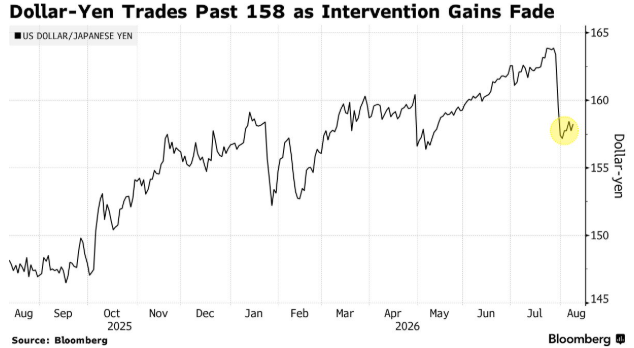
This reversal highlights the fact that while the core factors leading to the weakening of the yen remain unchanged, it is difficult to reverse the overall downward trend of the yen by intervention alone. Despite warnings from both Japan and the US that they are ready to act again if necessary, factors such as huge interest spreads with the US, market concerns about Japan's fiscal outlook, and geopolitical uncertainty continue to weigh on the yen.
In response to the financing of a two-year consumption tax reduction plan that is expected to cost about 5 trillion yen a year, he said this is not that difficult. “Raising 5 trillion yen is not that difficult,” he pointed out, and the savings generated by implementing large-scale reforms to the government's fiscal balance can be used for this purpose.
Briefly referring to monetary policy, Minoru Jonouchi said that the Bank of Japan has done a good job. Given that market expectations for interest rate hikes in September or October continue to heat up, this may indicate that he is not strongly opposed to recent rate hikes.
While Minoru Seonguchi made these remarks, market participants continued to be skeptical about Takaichi Sanae's spending plans and the government's influence on the central bank. These concerns were further exacerbated after the release of the draft growth strategy.
The roadmap, which was announced in late June, covers 17 industries. However, the government has yet to disclose how much of this investment will come from the public sector.
“We're not going to invest in the production of mangoes or papayas,” the city actually said. Instead, investment will be directed to areas where Japan cannot afford to lose global competitiveness, and will help strengthen Japan's productivity, tax base, and monetary strength after years of underinvestment.
Minoru Shirouchi is responsible for formulating the basic policy for this year's annual economic and financial operation (core policy). In this approach, the government hopes to reshape the way the country's finances are managed through multi-year budgets and a shift from balancing the primary balance (Primary Balance) to the debt-to-GDP ratio.
The initial draft of the plan elicited a negative reaction from the market because it gave the impression that the government wanted to influence the central government's policies and make them consistent with the government's plans. The strong rebound in the market triggered revisions to the plan, which included a note emphasizing the independence of the central bank.
This episode deepened the impression of the outside world that Minoru Jonai is one of the most pro-growth members of the cabinet, and is more inclined to the Bank of Japan suspending interest rate hikes. Minoru Shirouchi has attended the central bank's monetary policy meetings many times to express the government's views.
The central bank's latest signals suggest that it may be about to speed up the pace of interest rate hikes. The Bank of Japan's July meeting opinion summary released on Monday included a series of hawkish remarks pointing to a faster pace of interest rate hikes, and possibly even greater action.
When asked if he thought the Bank of Japan was doing a good job, Minoru Jonouchi said, “I think so.” When asked if he would cooperate with early interest rate hikes, Seonguchi actually referred to his memorandum on the government's position on monetary policy standards.
“We respect the independence of the central bank and leave it up to the Bank of Japan to decide how to implement the policy,” he said.
Returning to the government's broader goals, he reiterated that Sanae Takaichi was trying to achieve two goals at the same time: maintain fiscal stability while building a strong economy. He said, “This is the essence of a responsible and active fiscal policy, and it is the core of this historic transformation.”