
- PRICING
- LIVE QUOTES
- LEARN
- HELP


EN
“Standing in the Light” Lumentum (LITE.US) performance is about to be released! “Shorting storage, multi-light” transactions adding another spark?
The Zhitong Finance App learned that Lumentum (LITE.US), the core participant in the “Google TPU AI Computing Power Chain” and an indispensable core optical/optical module component supplier of the “Nvidia and AMD AI GPU AI Computing Power Chain”, will announce the results for the fourth quarter of fiscal year 2026 after the US stock market on August 11, EST. If Lumentum, which has received strategic investment from Nvidia and is bound by a long-term optical device procurement agreement, announces strong performance data and future prospects that far exceed the market's unanimous expectations, it can be described as a major positive catalyst for Lumentum, an “AI superbully stock” that has surged 140% so far in 2026 and 345% for the full year of 2025, and even the “standing in the light” investment theme that has recently taken the global stock market by storm. The “Standing in the Light” investment theme is “AI Data Center Optical Interconnection/Optical Communication Industry Chain Investment Boom”.
For the quarter that will soon release performance data, according to Wall Street analysts' expectations compiled by agencies, Lumentum's revenue for the fourth fiscal quarter (that is, the second calendar quarter) will be between US$960 million and US$1,010 million; earnings per share under NON-GAAP standards are expected to be in the range of $2.85 to $3.05.
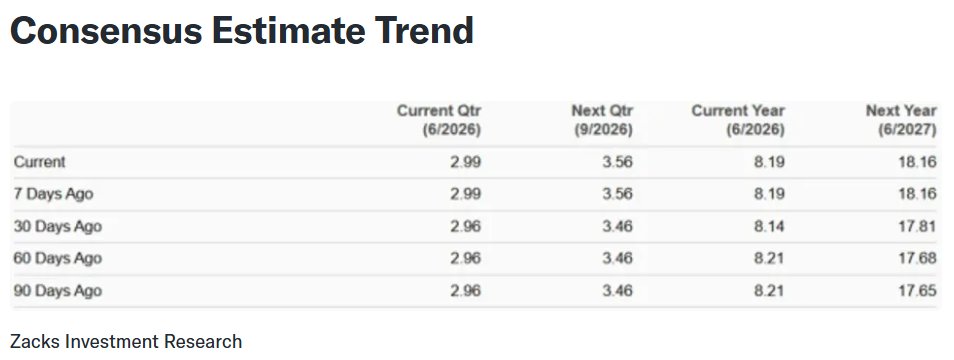
According to the consensus forecast compiled by Zacks Investment Research, analysts' agreed revenue expectations are about US$989 million, which means a sharp increase of about 105.65% compared to the data released in the same period last year. Earnings per share were agreed to be around $2.99, which was raised by 3 cents by analysts in the past 30 days. Compared with Lumentum's earnings per share for the same period last year, only 88 cents.
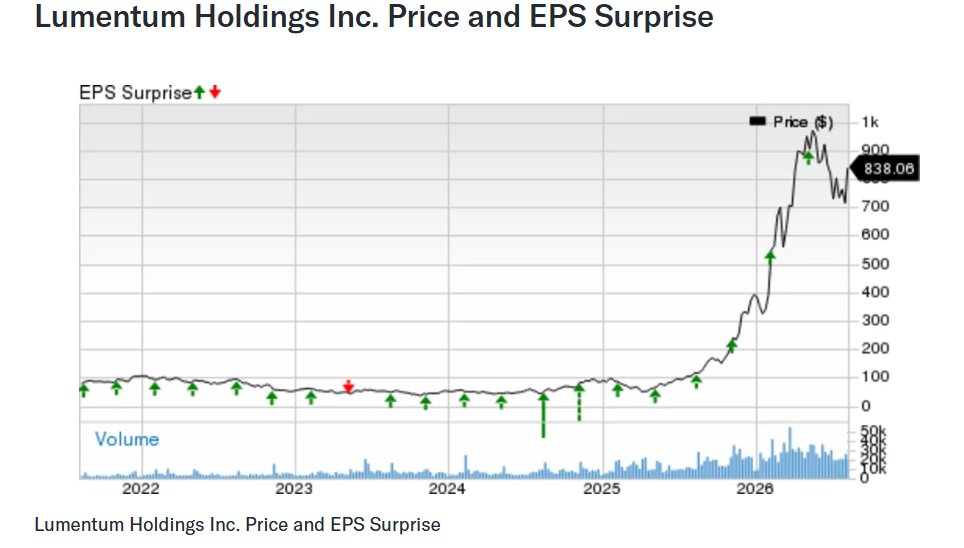
As shown in the chart above — Lumentum's stock price combined with earnings per share exceeding expectations. Lumentum's profit for the past four consecutive quarters has exceeded the unanimous expectations of Wall Street analysts compiled by Zacks, exceeding expectations by an average margin of 9.59%. For a leader in the AI computing power industry chain whose performance growth trajectory has been continuously raised by analysts and growth expectations are becoming more demanding, the margin of exceeding expectations by about 10% is already very strong.
Why can Lumentum's stock price trend from 2025 to be called “extreme”? The main logic is that Lumentum can simultaneously benefit from Google's TPU AI computing power industry chain and the AI GPU computing power industry chain dominated by Nvidia. In the future, whether it is Nvidia's AI GPU computing power infrastructure cluster or Google's TPU cluster (TPU represents the AI ASIC technology route), it will be inseparable from “optical interconnection and CPO silicon optical high-speed interconnection capabilities represented by Lumentum”.
Lumentum has joined the S&P 500 index, the benchmark stock index for US stocks, and the Nasdaq 100 Index (“NASDAQ 100” for short), which has the title of “Global Technology Stock Weather Vane”. In other words, Lumentum has now obtained passive capital allocation qualifications for two core US stock benchmark indices at the same time, which has further strengthened its institutional holding base as a core weighted growth stock for AI Optical Interconnect.
After the inclusion of the benchmark index, it can be said that Lumentum was officially promoted from the “niche supply chain target” of AI data center optical interconnection to the global technology core asset pool. It also means that the main AI computing power investment narrative is rapidly shifting from “a single-point computing power competition around AI GPU/ASIC” to an “artificial intelligence inference end full-stack computing power system driven by AI agents”. In this AI mainline narrative transformation, data center CPUs, memory chips, and optical interconnect/optical communication industry chains are probably the biggest winners.
Recently, the stock prices of many data center optical product suppliers such as Lumentum have continued to be strong. There is also market news that the “AI chip hegemon” Nvidia (NVDA.US) is adjusting the next-generation AI rack computing power system architecture. That is, the next generation AI computing power cluster Rubin Ultra may reduce the HBM configuration of each rack and instead use optical interconnection technology architectures to connect multiple AI racks. As the prices of HBM/DRAM memory systems and NAND memory chip products have continued to soar in recent years, the focus of AI computing power infrastructure investment seems to be shifting from GPU/TPU single-point performance and HBM capacity to overall data center architecture efficiency. Among them, high-speed optical interconnection is probably the most critical direction.
Moving from 800G to 1.6T and 3.2T: Lumentum bets on AI data centers “light to copper retreat”, high-end lasers enter a cycle of short supply
Lumentum's financial results for the fourth quarter of fiscal year 2026 are expected to continue to benefit from continued strong demand for high-speed optics brought about by the cloud computing and AI product portfolio, with strong performance in the components and systems business. Of the 21.3% month-on-month revenue growth corresponding to current performance guidelines, more than half is expected to come from data center optical components, while the rest of the growth is mainly driven by new contributions from high-speed optical transceivers (i.e. optical module products) and optical circuit switches (OCS).
Demand for EML laser chips and Scale-Across products — including pump lasers and narrow linewidth laser components — is likely to remain particularly strong. In the third quarter of fiscal year 2026, shipments of narrow linewidth lasers increased by more than 120% year on year, and shipments of pump lasers increased 80%, and in the foreseeable next 2-3 years, these products will actually be sold out.
Another important catalyst for the fourth quarter of fiscal year 2026 is likely due to a decline in production capacity for 1.6T optical transceivers. When Lumentum entered the quarter, management expected to increase shipments of 1.6T products, including beginning to integrate internally supplied continuous wave (CW) lasers; at the same time, continued improvements in yield and declining scrap rates are expected to help increase the profitability of the optical transceiver business. The migration from 800G to 1.6T has also brought a favorable stand-alone value and pricing structure to the company. Lumentum notes that the average selling price (ASP) of 200G EML for 1.6T applications is roughly double that of 100G EML, which is currently mainly used for 800G optical transceivers.
At the same time, favorable product combinations, strict pricing discipline, manufacturing capacity utilization, and operating leverage are expected to further support profit expansion. These factors have driven non-GAAP gross margin of 540 basis points month-on-month to 47.9% in the third quarter of fiscal year 2026, and operating margin by 700 basis points to 32.2% month-on-month.
Despite the favorable demand environment, supply constraints may limit Lumentum's ability to fully meet customer demand in the fourth quarter of FY2026. Management said the EML supply and demand gap is still over 30%, and the supply restrictions for pump lasers are even more serious, forcing the company to distribute production capacity among different customers. At the same time, due to a sharp increase in the scale of output required by customers, the growth of Lumentum OCS-related business product lines that cloud computing leaders such as Google are rapidly purchasing is also limited by tight production capacity in the supply chain.
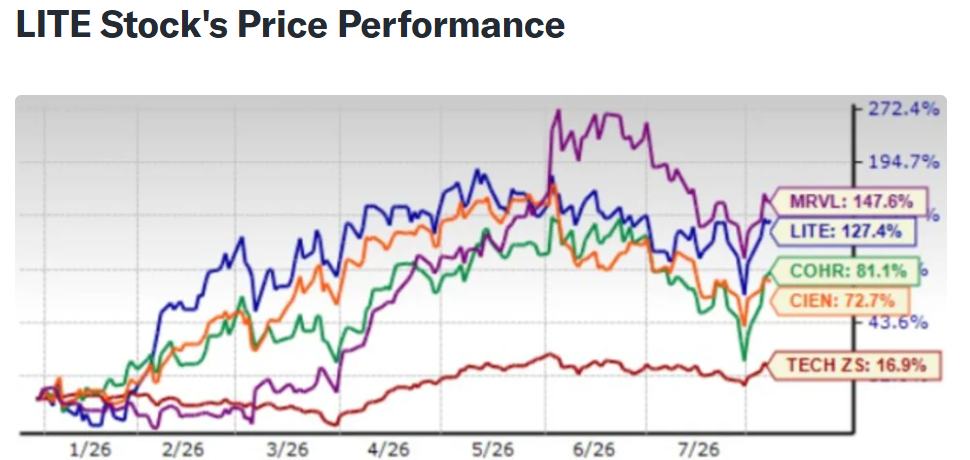
As shown in the chart above, Lumentum (LITE.US) stock price significantly outperformed its industry. Lumentum's stock price has risen sharply by 127.4% since this year (YTD), significantly outperforming the 16.9% increase in the S&P IT computer and technology industry. The company's performance this year has been superior to optical interconnect device competitors Coherent (COHR.US) and Ciena (CIEN.US), but inferior to Marvell Technology (MRVL.US). Over the same period, Coherent, Ciena, and Marvell Technology's share price returns were 81.1%, 72.7%, and 147.6%, respectively.
Lumentum and Coherent compete with each other in high-speed optical modules and optical transceiver products for optical interconnection in data centers and AI infrastructure. Ciena is a leading supplier of optical networking equipment, software and services for optical interconnection between large data centers. Marvell Technology (also known as Marvell Technology) is a competitor in the field of optical networks in AI and data center applications. It competes with Lumentum, Coherent, and CIENA for AI optical products.
Current Lumentum valuations aren't cheap. Based on the market sales ratio (P/S) for the next 12 months, Lumentum's current valuation is 10.93 times higher than the entire industry and most comparable companies. The valuation of the entire industry is about 6.54 times, while Ciena and Coherent are 7.63 times and 6.42 times, respectively. However, Lumentum still has significant valuation discounts compared to Marvell Technology, and the market sales ratio of the latter stock is about 13 times.
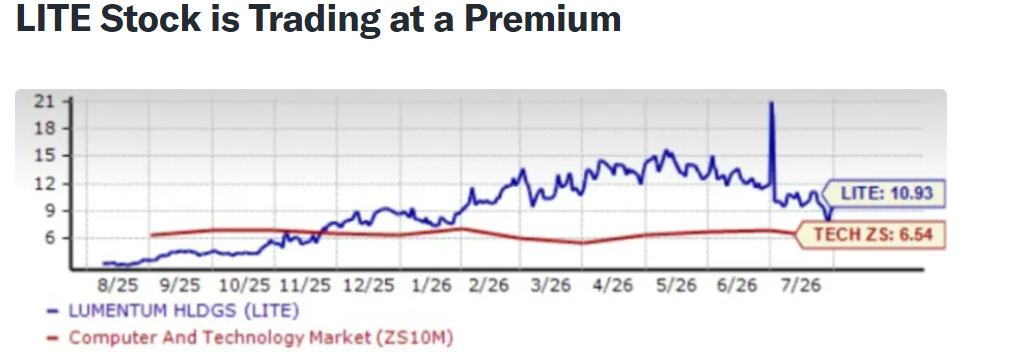
As shown in the chart above, Lumentum (LITE.US) stock is being traded on a premium benchmark — LITE's development prospects depend on whether strong AI computing power infrastructure demand can continue for a long time.
As AI infrastructure increasingly shifts from copper interconnect to optical interconnect systems, the value of stand-alone optical devices is expected to enter a multi-year expansion cycle, and Lumentum appears to be in a good position to benefit. In addition to its current advantages in EML and optical transceivers, the company has also seen four main growth directions — AI data center OCS, AI data center optical scale-out, optical scale-up, and optical transceivers — many of these businesses are still relatively limited in their contribution to revenue. Lumentum management anticipates that future contributions to OCS and optical scale-out businesses will become more significant, while optical scale-up may reach a major inflection point starting in 2027.
The company also placed special emphasis on the trend of migrating to 1.6T and eventually to 3.2T connection technology, which will increase the demand for the value of high-speed optical devices in AI training/inference systems. Lumentum has a strong market position in the field of differentiated high-performance lasers, and factors such as reliability, performance, and customer manufacturing yield constitute significant entry barriers, which may help the company gain considerable market share in this expansion process.
Scale-up interconnections and CPOs/NPOs in particular present highly attractive long-term opportunities. Lumentum anticipates that as optical connections are further deepened within AI racks and high-speed connections between different AI racks, optical scale-up will significantly increase the intensity of use of optical devices and may create a market opportunity far larger than scale-out. According to the judgment of Lumentum management, once scale-up technology is implemented on a large scale, the intensity of optical use may increase by at least three times; at the same time, demand for CPO in data centers is still strong, and demand for CW lasers continues to increase. As customer cooperation and application scenarios continue to expand, OCS technology-related product lines also have huge room for growth, including configurations with higher and lower port numbers, as well as potential in-rack applications.
In the longer term, Lumentum also plans to further expand its optical component product portfolio from lasers to fields such as silicon photonic-level integrated circuits (PICs), photodiodes, laser drivers, and potential transimpedance amplifiers (TIA), thereby expanding the value of the company's serviceable content in next-generation optical systems.
Applied Optoelectronics's performance ignites “making more AI optical interconnection” deals. Is Lumentum, which has a full-stack optical card slot from EML to CPO, about to add another boost to optical interconnection?
Lumentum appears to have strong business momentum as it entered the fourth quarter of fiscal year 2026. The supporting factors include a surge in demand for AI-related optics, accelerated emission of 1.6T optical transceivers, tight supply of EML and Scale-Across products, improved product portfolio, and significant operating leverage. More importantly, many of the company's potentially largest opportunities — including OCS, scale-out CPO, and optical scale-up in particular — are still in the relatively early stages of adoption. Lumentum's differentiated laser product portfolio, expanding data center high-speed optical business layout, and deep exposure to continued rising demand for AI computing power infrastructure connections can be described as providing a favorable foundation for the company to maintain long-term revenue and profit growth.
The financial report just released by Applied Optoelectronics (AAOI.US) provides a very strong “cross-validation of demand” for the entire optical interconnection industry chain. AAOI's revenue for the second quarter was US$191.9 million, up about 86% year on year. Data center revenue increased from US$44.8 million in the same period last year to US$107.7 million; shipments of 800G products more than doubled month-on-month. The company also stated that demand for 800G and 1.6T is expected to exceed production capacity until at least mid-2027. What is more noteworthy is that it currently has a related monthly production capacity of close to 200,000 units, but plans to expand to about 650,000 units by the end of 2026 — this shows that the biggest problem in the current industry is not an order issue, but whether it can obtain sufficient production capacity for lasers, DSP, TIA, and packaging and manufacture optical modules in a timely manner.
Market pricing after the August 7 earnings report was also very direct: AAOI rose by about 9%, Coherent rose by about 13.4%, and Lumentum rose by about 6.5%, indicating that capital is treating AAOI's short supply and demand as a major sign that the production capacity of high-speed optical devices from upstream optical platform companies such as LITE and COHR is far from keeping up with the demand for high-speed connectivity in AI training/inference clusters.
The core reason why Lumentum, which has multiple EML/CW laser/VCSEL/CPO/OCS card slots, is becoming a very pure “optical seller” in the AI infrastructure craze is that AI cluster expansion has moved from “not enough computing chips” to the stage of “whether data between tens of thousands or even millions of GPUs can move fast enough and with low enough power consumption”.
Lumentum does not only sell ordinary optical modules, but also occupies three levels at the same time: the scale-out side has a high-speed EML laser chip and 800g/1.6T optical transceiver; the scale-up side is advancing the 1060nm VCSEL array to further push the optical connection into and between the AI racks; the CPO/silicon light side provides key light sources such as ultra-high power CW lasers and DWDM external laser sources; the longer-range scale-across/DCI also covers pump lasers, narrow linewidth lasers, and can Tune devices such as lasers and WSS. The 1.6T DR4 module presented by Lumentum at OFC this year already uses four 400G differential EMLs, and clearly sees it as a technological step towards 3.2T; its ultra-high power lasers directly target CPO and silicon light architectures. In other words, **Whether AI data centers use pluggable optical modules, CPO, or ultimately advance optics to scale-up fabrics, Lumentum is at the core beneficiary.
According to information, recent market news shows that Nvidia is adjusting the next-generation AI rack computing power system architecture, that is, the next-generation AI computing power cluster Rubin Ultra may reduce the HBM configuration per rack and instead use an optical interconnection technology architecture to connect multiple AI racks, mainly due to the sharp rise in memory chip prices. At the same time, the value of AI network optics from data center optical device leaders such as Lumentum, which focuses on AI data center optical interconnection systems, may simultaneously obtain the triple multiplier tension of “number of ports+single port rate+high-speed optical penetration rate expansion”. These factors are also the core logic of why the near-daylight interconnection theme outperforms memory chips.
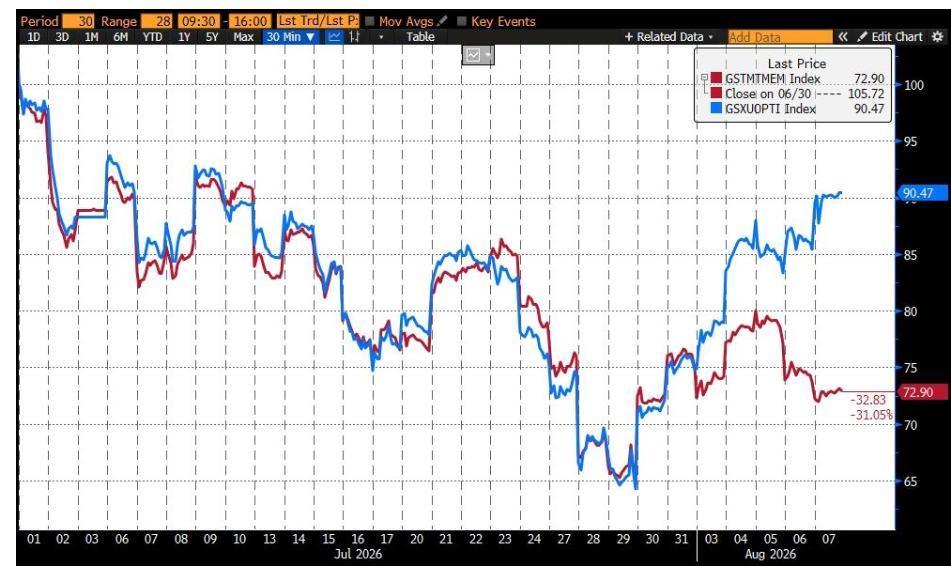
After AI models migrate from training to large-scale inference, MoE and Agentic AI, collective communication, KV/cache migration, and model parallel communication between computing nodes will amplify east-west traffic; at the same time, 800G is being upgraded to 1.6T and continues to evolve towards 3.2T, while high-speed SerDes face insertion loss, power consumption, and signal integrity limits at higher data rates and longer distances, making some scale-up connections carried by copper cables gradually become photochemical economical. Nvidia has integrated silicon light directly into Spectrum-X/Quantum-X switches, and claims that 1.6Tb/s photonic switching architectures can achieve higher bandwidth density, lower power consumption, and higher network reliability. At the same time, Lumentum is accelerating the promotion of VCSEL scale-up solutions directly co-packaged with host ASICs.
The data center storage industry chain has experienced extreme price increases and profit explosions, and the market seems to be starting to trade ASP growth will slow down in the future; however, AI optical interconnection is moving from 800G to 1.6T and further from scale-out to scale-up/CPO, so profit forecasts are still being accelerated. In other words, as the number of GPUs, model parallelism, and data center spans continue to expand, network bandwidth, lasers, optical modules, and CPO are becoming new marginal bottlenecks. Instead of thinking that memory chips are becoming unimportant, the market is trading “which supply bottleneck is becoming more tight”. This logic is particularly suitable for explaining the recent “short storage and more optical” trading trend.