
- PRICING
- LIVE QUOTES
- LEARN
- HELP


EN
The big five giants extorted $48 billion in the second quarter, which is impressive! Trump bombarded “making too much money,” and the oil industry is once again overshadowed by excessive profits and taxes
The Zhitong Finance App noticed that large oil companies experienced explosive huge profits in the second quarter. A key question today is whether the industry will use this cash windfall to return shareholders, strengthen balance sheets, or invest in the future—all while trying to avoid a growing political backlash.
Thanks to rising fossil fuel prices in the US-Iran hostilities, the five major oil giants comprised of ExxonMobil (XOM.US), Chevron (CVX.US), British Petroleum (BP.US), Shell (SHEL.US), and TTE.US (TTE.US) generated profits of up to 48 billion US dollars between April and June.
During the same period, their cash generation also reached nearly $90 billion, a record high — even higher than the level after the Russian-Ukrainian conflict in early 2022.
This huge profit has aroused anger among environmental activists, who have once again called for a profiteering tax on the industry's excess profits; at the same time, it has also sparked dissatisfaction with US President Trump.
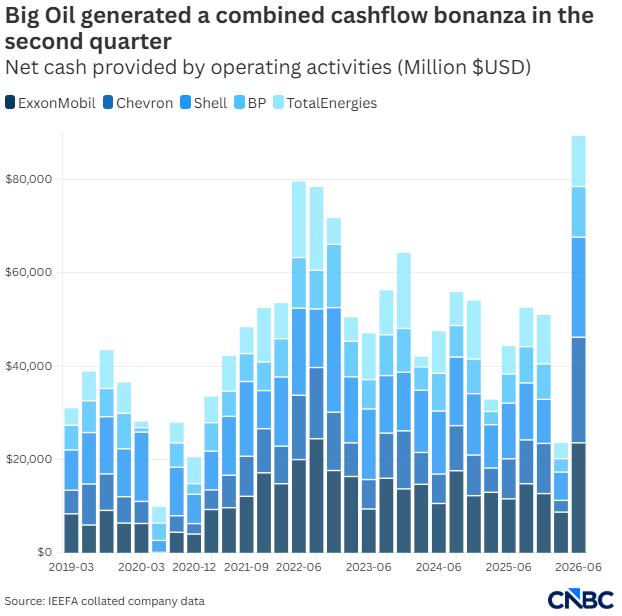
The US president bombarded US oil giants ExxonMobil and Chevron last week, accusing them of using the rise in oil prices during the Iran war to “make too much money” and once again called for lower fuel prices at gas stations.
Clark Williams-Delhi, an energy finance analyst at the non-profit organization Institute for Energy Economics and Financial Analysis (IEEFA), said, “The Big Five enjoyed an unprecedented cash windfall last quarter,”
But Williams-Derry notes that they are not using this cash to “drill baby drills” (drill baby drills) — this refers to Trump's policy of maximizing energy production. For example, he noted that large oil companies' capital expenses, dividends, and share buybacks have all remained stable.
“So this raises the question: if they aren't allocating more money to shareholders, then what are these oil giants doing with this cash windfall?”
Where did all the money go?
IEEFA's Williams-Derry said that to a large extent, oil companies have been seeking to hoard cash reserves and repay debts to improve their balance sheets. In fact, the cash reserves of the world's five giants increased by more than $17 billion month-on-month.
Williams Derry said, “To describe the oil industry's financial routine in a cynical way is to 'pray for war'. These oil giants require regular price spikes — such as the crises in Ukraine and Iran — simply to bolster their finances.”
“For oil giants, intense consumer suffering and global fuel shortages act as a financial antidote to long-term sluggish and stable oil prices, as long-term low oil prices erode their financial position. From the perspective of oil giants, price spikes are a normal feature rather than a systemic flaw,” he added.
The oil and gas giant's management told the media that during the Middle East conflict, they are trying to double down on business areas they can control, such as operational performance, trading, and optimization.
British Petroleum CEO Meg O'Neill said in an interview on August 4, “What BP is doing is making sure we focus on things that can work to help resolve the current situation. We are vastly improving reliability, both in our upstream assets where we produce crude oil and in our refining assets.”
O'Neill said that the company has adjusted the refining operation settings to maximize the supply of products that consumers need most at any point in time, using aviation kerosene and diesel as examples.
Meanwhile, Shell CEO Wael Sawan described volatility as the “new normal,” and said that the macroeconomic environment enabled rising commodity prices to provide a very strong tailwind support for its performance.
The explosion in profits and cash flow “may be unsustainable”
AJ Bell investment director Ross Molde said the oil and gas giants have shown how they plan to use these huge profits and cash flows.
“The full range of options covers mergers and acquisitions, maintenance capital expenditure, investment in new projects (renewable energy or hydrocarbons), debt reduction, and final dividends and share buybacks,” Molde said.
Molde said that the exact scope and extent of these options varies from company to company. For example, BP is in a “debt reduction model,” while Shell has carried out an acquisition in Canada, showing more expansionality.
“What is clear, however, is that hydrocarbon giants are taking a cautious approach when investing in new oil and gas fields, given that overall capital expenditure budgets are still tightly controlled,” Molde said.
“This may be because people feel that the current explosion of profits and cash flow may be unsustainable, particularly if the US and Iran reach a lasting peace agreement, or because of concerns about new taxes, or in the face of ongoing environmental pressure from public, political, and advocacy groups,” he added.
API: Profiteering taxes “won't lower consumer prices”
In addition to Trump's criticism, political pressure on the oil and gas industry's wartime profits has continued to increase in recent weeks.
Advocates are calling on policymakers to levy higher taxes on energy giants to help fund climate-resilient infrastructure, such as fire and flood protection facilities.
The Portuguese government said last week that it has approved a windfall tax on extraordinary profits made by oil and refining companies in 2026.
The American Petroleum Institute (API), an industry pressure group representing about 600 drilling companies, refineries, and other stakeholders, describes the oil and gas industry as a cyclical industry that should be measured in decades (not several quarters), and warned against levying profiteering on excess profits.
An API spokesperson said, “During one of the worst global energy upheavals in decades, the US oil and gas industry is providing record production and world-leading refining capacity, while continuing to invest in supply, infrastructure, and resilience that will enhance America's long-term energy security.”
As for the profiteering tax, the API says it is impossible to obtain greater energy security through taxation. “Profiteering taxes don't lower prices for consumers — they instead hurt the long-term investments needed to strengthen supply, infrastructure, and more resilient energy systems,” the organization added.