- PRICING
- LIVE QUOTES
- LEARN
- HELP


EN
Financial Report Preview | Revenue feared to “fall short” and gross margin “exploded” ultra-micro computer (SMCI.US) Q4 earnings report will test the “success” of the AI computing power chain
The Zhitong Finance App learned that AI server manufacturer Ultra Micro Computer (SMCI.US) will release financial results for the fourth quarter of the 2026 fiscal year after the US stock market on August 11 (Tuesday). This financial report will not only determine the short-term stock price trend of ultra-microcomputers, but will also be an important weather vane for the market to determine whether the AI computing power chain can continue to thrive.
The initial Q4 results revealed by Ultramicrocomputer at the end of July once ignited market sentiment: new orders surpassed 60 billion US dollars, backlog orders reached a record high, and gross margin guidelines nearly doubled, driving its stock price to rise by 18%. However, the company admits that Q4 revenue may fall at the lower end of the guidance range. This “imperfect” initial performance makes the upcoming official quarterly report full of interest.
Q4 Earnings Preview: Revenue Fears “Not Meeting the Standard” vs. Gross Profit Margin “Exploding”
According to the preliminary results released by Ultramicrocomputer at the end of July, the gross margin for the fiscal quarter ending June 30 is expected to be between 15% and 17%, far exceeding the 8.2%-8.4% guidance previously given, mainly due to favorable changes in customer structure and product portfolio; revenue for the fourth fiscal quarter will fall at the lower end of the previous guidance range of 11 billion to 12.5 billion US dollars (median value of the range is 11.75 billion US dollars). The backlog of orders reached a record high as new orders for the quarter surpassed $60 billion.
Although the company has indicated that revenue will fall at the lower end of the guidance range, market expectations are generally still relatively optimistic. Currently, analysts generally expect Ultra Micro Computer's Q4 revenue to be US$11.56 billion, an increase of 101% year on year; earnings per share of 0.96 US dollars, an increase of 134% year on year.
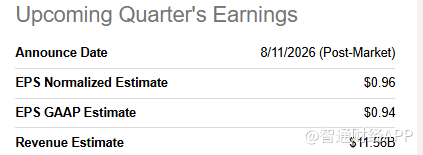
In the past three months, analysts' expectations for ultra-microcomputer revenue have been raised 11 times and lowered by 4 times. Notably, the company's Q3 revenue fell short of market expectations. Furthermore, in the financial reports for the past five quarters, there were four cases where revenue fell short of expectations.
In contrast, over the past three months, analysts' earnings per share expectations were raised 16 times, while the number of revisions was zero, indicating that market concerns about the company's profit margin and profitability have clearly abated. It should be pointed out that in its third-quarter earnings report, the company only predicted a 76% increase in earnings per share and hinted at a decline in profit margins. Currently, analysts expect profit margins to increase, which is in line with the company's initial Q4 results.
Analyst In-depth Interpretation: Why did gross margin explode? Industry prosperity has been cross-verified
Revenue falls at the low end, yet gross margin almost doubles — this seemingly contradictory data combination actually points to the same logic: the pattern of AI computing power being in short supply is reshaping the distribution of profits in the industrial chain.
Wedbush analyst Matt Bryson said bluntly after the initial results were released that he had not predicted such a sharp increase in gross margin before. He sorted out the three core motivations:
First, supply is in short supply. From June to July, AI motherboards (Nvidia Grace Blackwell, Blackwell, Hopper series), computing power hardware, memory and other products continued to be in short supply, and high-profit AI server shipments were unable to meet strong demand.
Second, pricing advantages. The shortage of hardware supply allowed ultra-micro computers to take control of pricing in the whole machine process. At the same time, the company guided customers to purchase high-value-added models and equipped with more self-developed supporting solutions, and optimized the profit structure.
Third, structural optimization. Revenue fell at the low end of the guidelines, partly due to the postponement of data center construction projects for some major customers, while project delays have indirectly increased the sales share of high-margin products.
Bryson further pointed out that if the trend of insufficient supply due to the shortage of parts continues, “the gross profit margin and earnings per share of ultra-microcomputers for the third quarter of the natural year 2026 and beyond are expected to be significantly higher than previously anticipated.”
More importantly, favorable signals are not limited to ultra-microcomputers. Bryson emphasized that the shortage of server components is beneficial to the wider supply chain (such as CPU, GPU, memory, etc.), and Dell (DELL.US), HPE Technology (HPE.US), and Nvidia (NVDA.US) are also expected to benefit.
Seekingalpha contributor Bay Area Ideas emphasizes that profit margins are far higher than previously anticipated, which means ultra-microcomputers have recently achieved quite good results in terms of differentiation. For example, the company's partnership with Arm (ARM.US) appears to be bearing fruit.
Ultramicrocomputer claims previously that after deploying Arm AGI CPUs in its solution platform, each rack's performance could be more than doubled compared to traditional architectures. According to Arm estimates, this will help enterprises save up to $10 billion in capital expenses per gigawatt of AI data center capacity.
Bay Area Ideas said this performance advantage helps attract server demand and supports gross margins. At this stage, infrastructure deployers are looking for high-performance and energy-efficient solutions, so ultra-microcomputers may be gaining more pricing power than ever before.
Valuation has fallen to a multi-year low, and multiple risks have peaked: are ultra-microcomputers a “golden pit” or a “value trap”?
Since this year, the stock price of ultra-microcomputers has risen by 6%, and its performance is far inferior to the general market. In terms of valuation, the forward price-earnings ratio of ultra-microcomputers is only 9.3 times, close to a multi-year low, and far below the overall valuation level of the IT sector. Is this discount excessive for an AI server vendor whose gross margin is soaring and has new orders of $60 billion?
Ultramicrocomputer valuations are close to multi-year lows
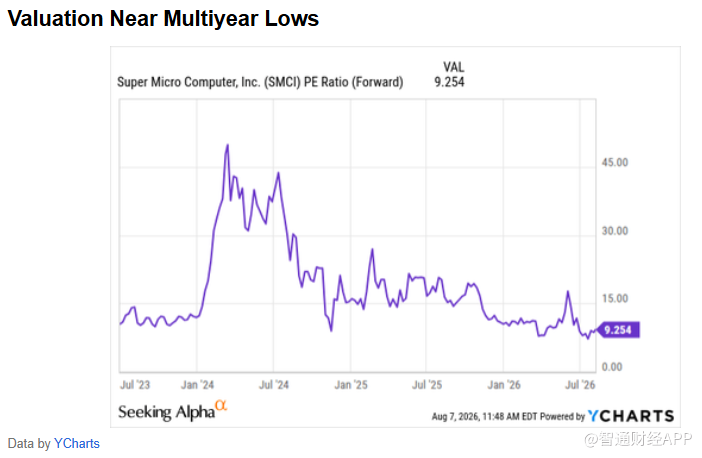
Is such a low valuation a good opportunity to be killed by mistake, or is the risk a trap where the risk is not fully priced? The following dimensions are worth examining:
Compliance risk. In the context of the US government tightening export controls on advanced chips, ultra-microcomputers are facing serious compliance challenges. Since ultra-microcomputer products are equipped with Nvidia chips, their business is deeply subject to the US export control framework.
Equity dilution risk. In June of this year, the company issued approximately 45.45 million shares of common stock at a price of $27.50 per share for financing. After the initial results were released at the end of July, Mizuho analyst Vijay Rakesh pointed out that considering that new orders exceeded 60 billion US dollars and the company's cash account was only about 1.3 billion US dollars, “ultra-microcomputers may face further capital raising needs in the short term.” If this does happen, existing shareholders will face a new round of dilution pressure.
Risk of placing repeated orders. Wedbush analysts warned that in the context of tight parts supply, the entire AI server industry may experience widespread repeated orders. Customers place overorders to lock in scarce production capacity. Once supply bottlenecks ease or demand expectations are lowered, the “moisture” in the backlog of orders may be exposed, causing a reverse impact on the upstream supply chain.
Competition in the industry has intensified. Traditional server vendors such as Dell and HPE are increasing their AI server production capacity layout, and it remains to be seen whether the long-term gross margin of ultra-microcomputers can continue to improve.
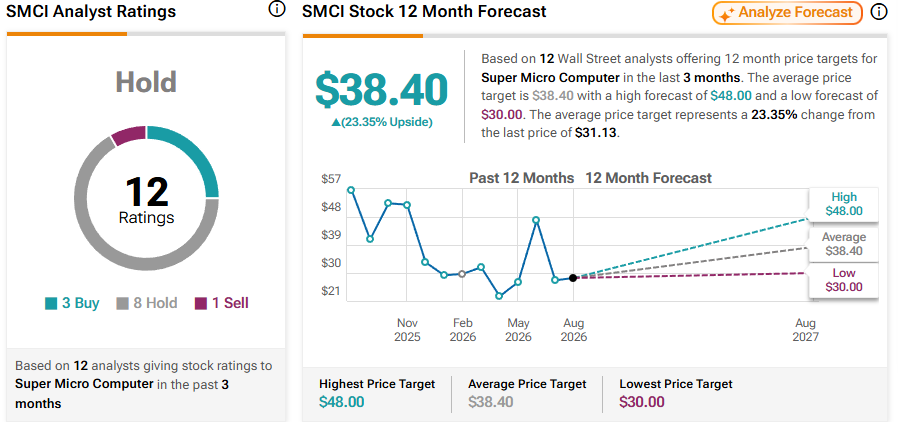
According to Tipranks data, Wall Street analysts have mixed opinions on ultra-microcomputers. 3 analysts gave a “buy” rating, 8 gave a “hold” rating, 1 gave a “sell” rating, and a consensus rating was “hold”. The average target price was 38.40 US dollars, which is 23% higher than the current level.