
- PRICING
- LIVE QUOTES
- LEARN
- HELP


EN
Will Comcast’s Enterprise Connectivity And Ad Tech Push Reshape Its Earnings Narrative (CMCSA)?
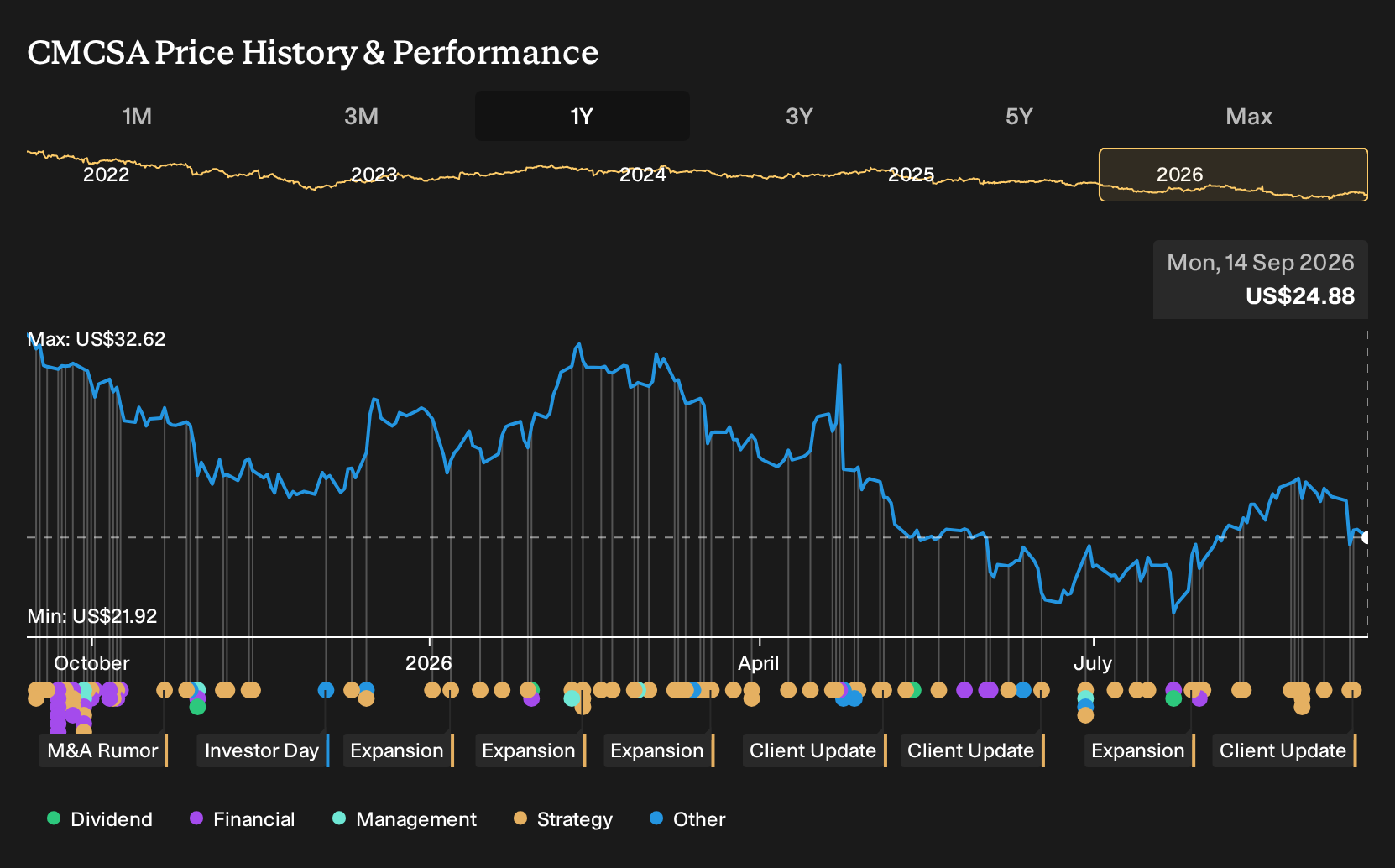
- In recent weeks, Comcast completed a network expansion in Waterbury to deliver high-speed, symmetrical Internet and business services, advanced its Xfinity buildout to more than 3,200 homes and businesses in Northwood, and continued rolling out private wireless solutions such as the deployment at Smartlink’s Annapolis headquarters.
- At the same time, Comcast-owned Universal Ads expanded its Business Partners Program with new Audience and Mobile Measurement partner categories, tightening the link between premium TV advertising and the data and attribution tools marketers already use across digital channels.
- We’ll now examine how Comcast’s push into enterprise connectivity and premium TV ad tooling could refine the existing investment narrative around connectivity earnings power.
Uncover the next big thing with 20 elite penny stocks that balance risk and reward.
Comcast Investment Narrative Recap
To own Comcast, you need to believe its connectivity and content businesses can keep generating solid cash flows despite competitive and cost pressures. The key near term swing factor is how broadband competition and pricing changes affect margins, while heavy content and capex spending remain a major risk. The latest network buildouts and enterprise wireless deals are directionally positive but do not, on their own, materially shift these core debates yet.
The Universal Ads expansion is most relevant here, because it ties Comcast’s premium TV inventory more tightly to digital style targeting and measurement. If marketers steadily embrace this, it could help stabilize or improve advertising economics at a time when legacy TV ad trends and content costs are a concern, complementing connectivity driven earnings power rather than replacing it.
Yet for all the promise in new ad tools and network upgrades, investors should still be aware of how rising content costs and regulatory scrutiny could...
Read the full narrative on Comcast (it's free!)
Comcast's narrative projects $122.5 billion revenue and $11.1 billion earnings by 2029. This assumes fairly flat yearly revenue growth and a $7.7 billion earnings decrease from $18.8 billion today.
Uncover how Comcast's forecasts yield a $31.90 fair value, a 26% upside to its current price.
Exploring Other Perspectives
Some analysts are far more optimistic, assuming roughly US$129 billion of revenue and US$11.8 billion of earnings by 2029, and treating today’s network and ad tech moves as potential proof points for a faster growth, higher margin Comcast than consensus expects.
Explore 9 other fair value estimates on Comcast - why the stock might be worth 17% less than the current price!
Reach Your Own Conclusion
Disagree with existing narratives? Extraordinary investment returns rarely come from following the herd, so go with your instincts.
- A great starting point for your Comcast research is our analysis highlighting 3 key rewards and 2 important warning signs that could impact your investment decision.
- Our free Comcast research report provides a comprehensive fundamental analysis summarized in a single visual - the Snowflake - making it easy to evaluate Comcast's overall financial health at a glance.
Seeking Other Investments?
Our daily scans reveal stocks with breakout potential. Don't miss this chance:
- Find 52 companies with promising cash flow potential yet trading below their fair value.
- AI is about to change healthcare. These 43 stocks are working on everything from early diagnostics to drug discovery. The best part - they are all under $10b in market cap - there's still time to get in early.
- The best AI stocks today may lie beyond giants like Nvidia and Microsoft. Find the next big opportunity with these 16 smaller AI-focused companies with strong growth potential through early-stage innovation in machine learning, automation, and data intelligence that could fund your retirement.
This article by Simply Wall St is general in nature. We provide commentary based on historical data and analyst forecasts only using an unbiased methodology and our articles are not intended to be financial advice. It does not constitute a recommendation to buy or sell any stock, and does not take account of your objectives, or your financial situation. We aim to bring you long-term focused analysis driven by fundamental data. Note that our analysis may not factor in the latest price-sensitive company announcements or qualitative material. Simply Wall St has no position in any stocks mentioned.
Have feedback on this article? Concerned about the content? Get in touch with us directly. Alternatively, email editorial-team@simplywallst.com