
- PRICING
- LIVE QUOTES
- LEARN
- HELP


EN
Under Armour (NYSE:UAA) Misses Q2 CY2026 Revenue Estimates

Athletic apparel company Under Armour (NYSE:UAA) missed Wall Street’s revenue expectations in Q2 CY2026, with sales falling 3.2% year on year to $1.10 billion. Its non-GAAP profit of $0.05 per share was significantly above analysts’ consensus estimates.
Is now the time to buy Under Armour? Find out by accessing our full research report, it’s free.
Under Armour (UAA) Q2 CY2026 Highlights:
- Revenue: $1.10 billion vs analyst estimates of $1.11 billion (3.2% year-on-year decline, 1.1% miss)
- Adjusted EPS: $0.05 vs analyst estimates of $0.02 (significant beat)
- Adjusted Operating Income: $52.39 million vs analyst estimates of $35.58 million (4.8% margin, 47.2% beat)
- Management reiterated its full-year Adjusted EPS guidance of $0.10 at the midpoint
- Operating Margin: 4.3%, up from 0.3% in the same quarter last year
- Free Cash Flow Margin: 8.6%, up from 1.2% in the same quarter last year
- Constant Currency Revenue fell 4.4% year on year, in line with the same quarter last year
- Market Capitalization: $2.70 billion
Company Overview
Founded in 1996 by a former University of Maryland football player, Under Armour (NYSE:UAA) is an apparel brand specializing in sportswear designed to improve athletic performance.
Revenue Growth
Examining a company’s long-term performance can provide clues about its quality. Any business can put up a good quarter or two, but the best consistently grow over the long haul. Under Armour struggled to consistently generate demand over the last five years as its sales dropped at a 2% annual rate. This was below our standards and is a sign of poor business quality.
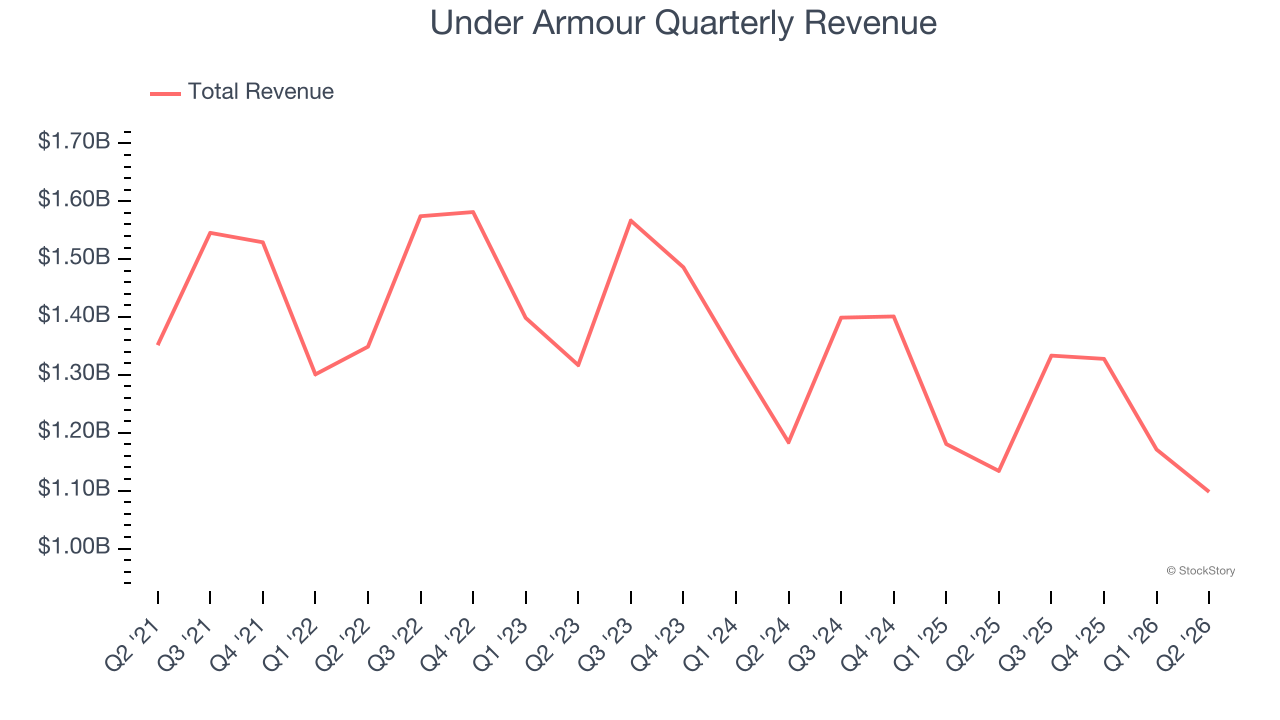
We at StockStory place the most emphasis on long-term growth, but within consumer discretionary, a stretched historical view may miss a company riding a successful new product or trend. Under Armour’s recent performance shows its demand remained suppressed as its revenue has declined by 5.9% annually over the last two years. 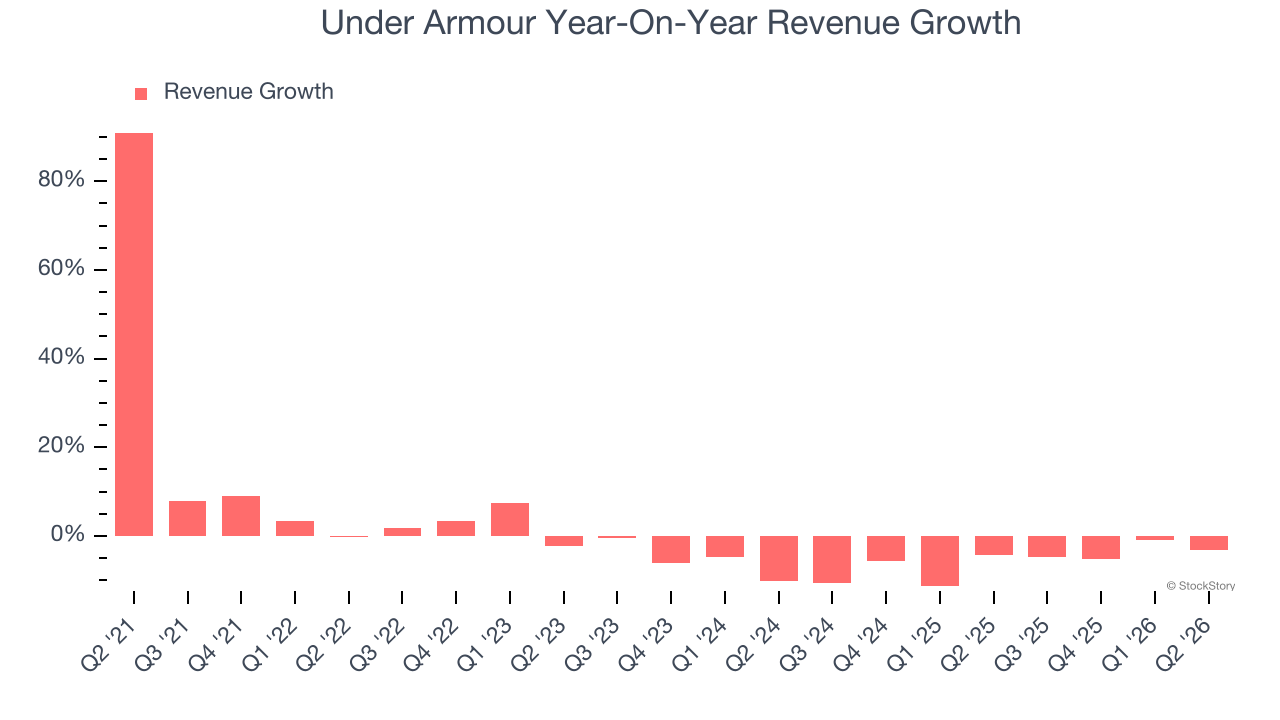
We can better understand the company’s sales dynamics by analyzing its constant currency revenue, which excludes currency movements that are outside their control and not indicative of demand. Over the last two years, its constant currency sales averaged 6.3% year-on-year declines. Because this number aligns with its reported revenue growth, we can see that foreign exchange has not had a meaningful impact on topline. 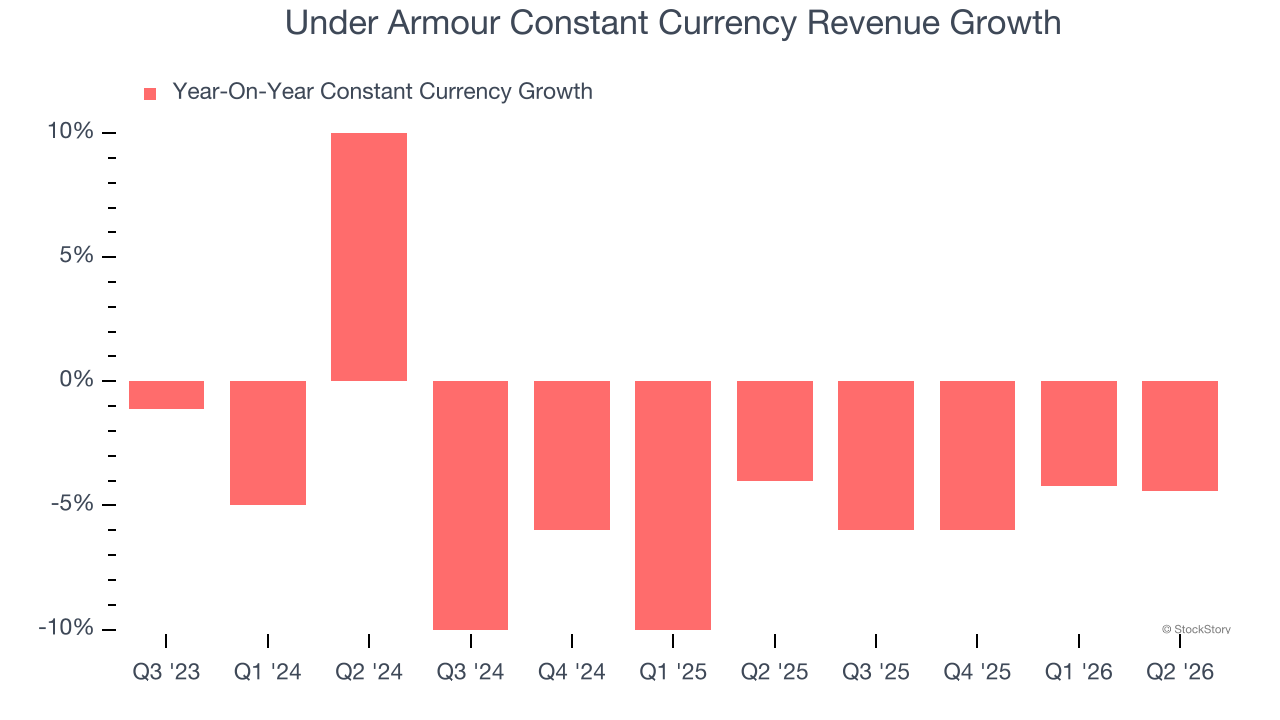
This quarter, Under Armour missed Wall Street’s estimates and reported a rather uninspiring 3.2% year-on-year revenue decline, generating $1.10 billion of revenue.
Looking ahead, sell-side analysts expect revenue to remain flat over the next 12 months. Although this projection suggests its newer products and services will spur better top-line performance, it is still below average for the sector.
ONE MORE THING: 3 Hidden Platforms Growing 3X Faster than Amazon, Google, and PayPal. Amazon, Google, and Meta all followed the same playbook: Dominate an ignored market. Build an unbeatable moat. Scale until you’re unstoppable.
These three platforms are running that exact playbook right now. The early investors in Amazon made fortunes. The early investors in these could do the same. Get All 3 Stocks Here for FREE.
Operating Margin
Operating margin is an important measure of profitability as it shows the portion of revenue left after accounting for all core expenses — everything from the cost of goods sold to advertising and wages. It’s also useful for comparing profitability across companies with different levels of debt and tax rates because it excludes interest and taxes.
Under Armour’s operating margin has been trending down over the last 12 months, and it ended up breaking even over the last two years. The company’s performance was inadequate, showing its operating expenses were rising and it couldn’t pass those costs onto its customers.
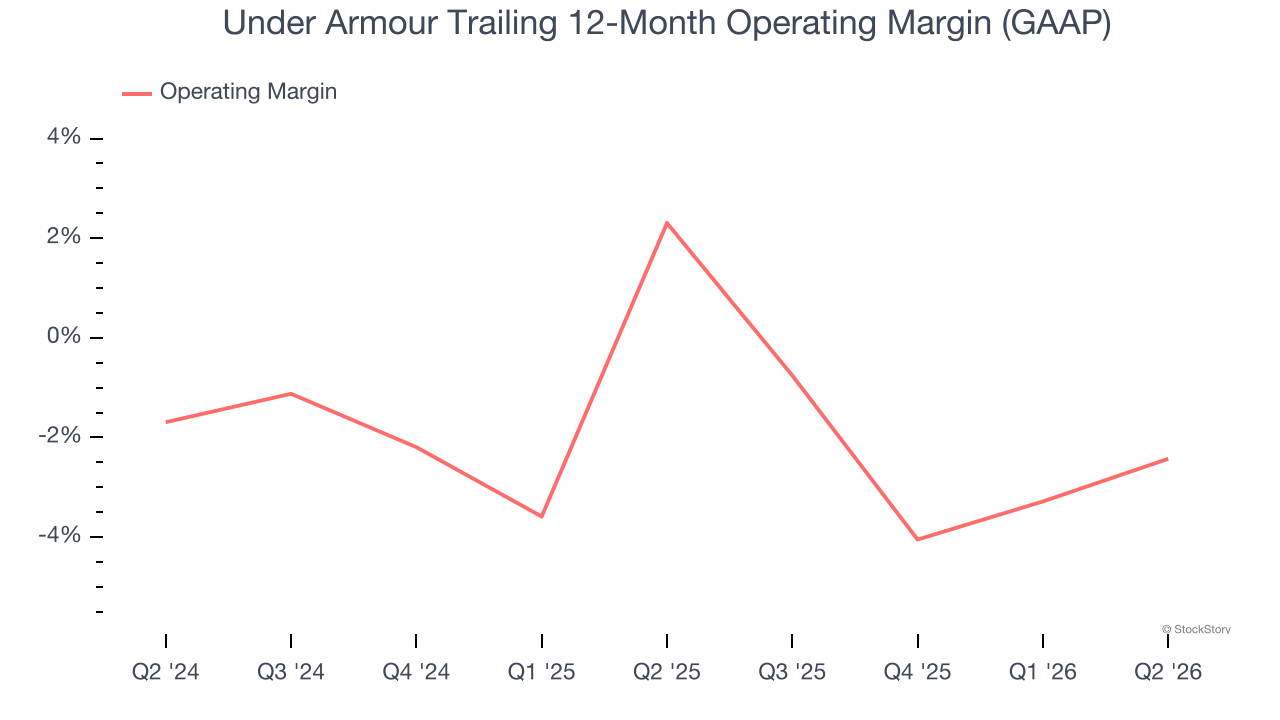
In Q2, Under Armour generated an operating margin profit margin of 4.3%, up 4 percentage points year on year. This increase was a welcome development, especially since its revenue fell, showing it was more efficient because it scaled down its expenses.
Earnings Per Share
We track the long-term change in earnings per share (EPS) for the same reason as long-term revenue growth. Compared to revenue, however, EPS highlights whether a company’s growth is profitable.
Sadly for Under Armour, its EPS declined by 28.1% annually over the last five years, more than its revenue. This tells us the company struggled because its fixed cost base made it difficult to adjust to shrinking demand.
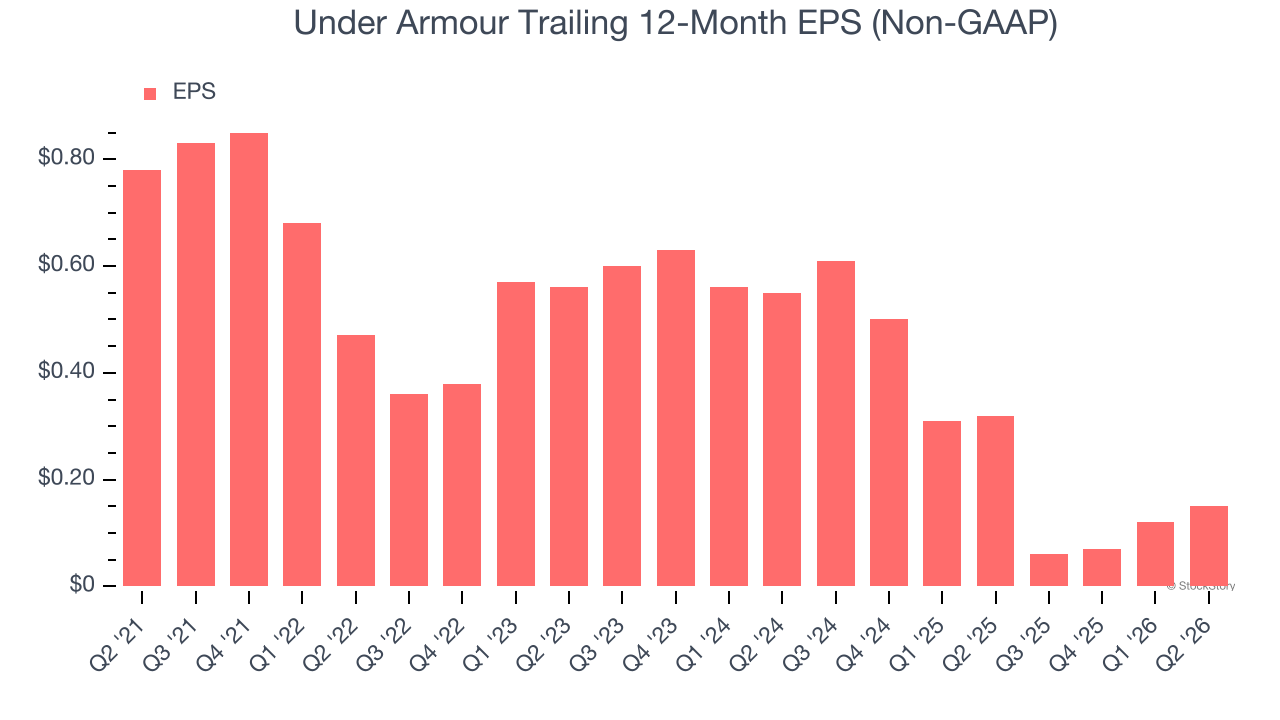
In Q2, Under Armour reported adjusted EPS of $0.05, up from $0.02 in the same quarter last year. This print easily cleared analysts’ estimates, and shareholders should be content with the results. Over the next 12 months, Wall Street expects Under Armour’s full-year EPS to shrink by 19.7% from $0.15 to $0.12.
Key Takeaways from Under Armour’s Q2 Results
It was good to see Under Armour beat analysts’ EPS expectations this quarter. We were also excited its adjusted operating income outperformed Wall Street’s estimates by a wide margin. On the other hand, its full-year EPS guidance missed and its revenue fell slightly short of Wall Street’s estimates. Overall, this print was mixed but still had some key positives. The market seemed to be hoping for more, and the stock traded down 1.8% to $6.27 immediately after reporting.
Should you buy the stock or not? If you’re making that decision, you should consider the bigger picture of valuation, business qualities, as well as the latest earnings. We cover that in our actionable full research report which you can read here (it’s free).