
- PRICING
- LIVE QUOTES
- LEARN
- HELP


EN
Is Aflac’s (AFL) Community Leadership Push Hinting at a Deeper U.S. Premium Strategy Shift?
- Aflac recently supported the United Way of the Chattahoochee Valley by providing a customized leadership development workshop, while analysts also highlighted that its second-quarter results were expected to benefit from growth in net earned premiums in the U.S. segment driven by higher sales.
- Beyond underscoring anticipated strength in its U.S. premium base, Aflac’s outreach shows how its internal leadership capabilities are being applied to strengthen community organizations.
- Next, we’ll examine how expectations for stronger U.S. net earned premiums might influence Aflac’s existing investment narrative and risk profile.
Capitalize on the AI infrastructure supercycle with our selection of the 56 best 'picks and shovels' of the AI gold rush converting record-breaking demand into massive cash flow.
Aflac Investment Narrative Recap
To own Aflac, you have to be comfortable with a mature insurer that leans heavily on Japan while trying to reinvigorate growth in the U.S. The recent leadership workshop with United Way does not materially change the near term earnings catalyst around stronger U.S. net earned premiums, nor does it reduce the key risks tied to Japanese premium pressure, cost inflation and currency exposure.
More relevant for the near term is the expectation that Aflac’s second quarter results would be supported by higher U.S. net earned premiums. That view lines up with Aflac’s broader push into expanded accident and cancer offerings, new distribution partnerships and digital tools, all of which tie directly into whether the U.S. segment can offset headwinds in Japan.
Yet, against this backdrop of U.S. premium momentum, investors still need to watch the persistent drag from declining Japan net earned premiums and...
Read the full narrative on Aflac (it's free!)
Aflac’s narrative projects $17.5 billion revenue and $3.6 billion earnings by 2029. This implies a 1.1% yearly revenue decline and a $1.0 billion earnings decrease from $4.6 billion today.
Uncover how Aflac's forecasts yield a $117.71 fair value, a 7% downside to its current price.
Exploring Other Perspectives
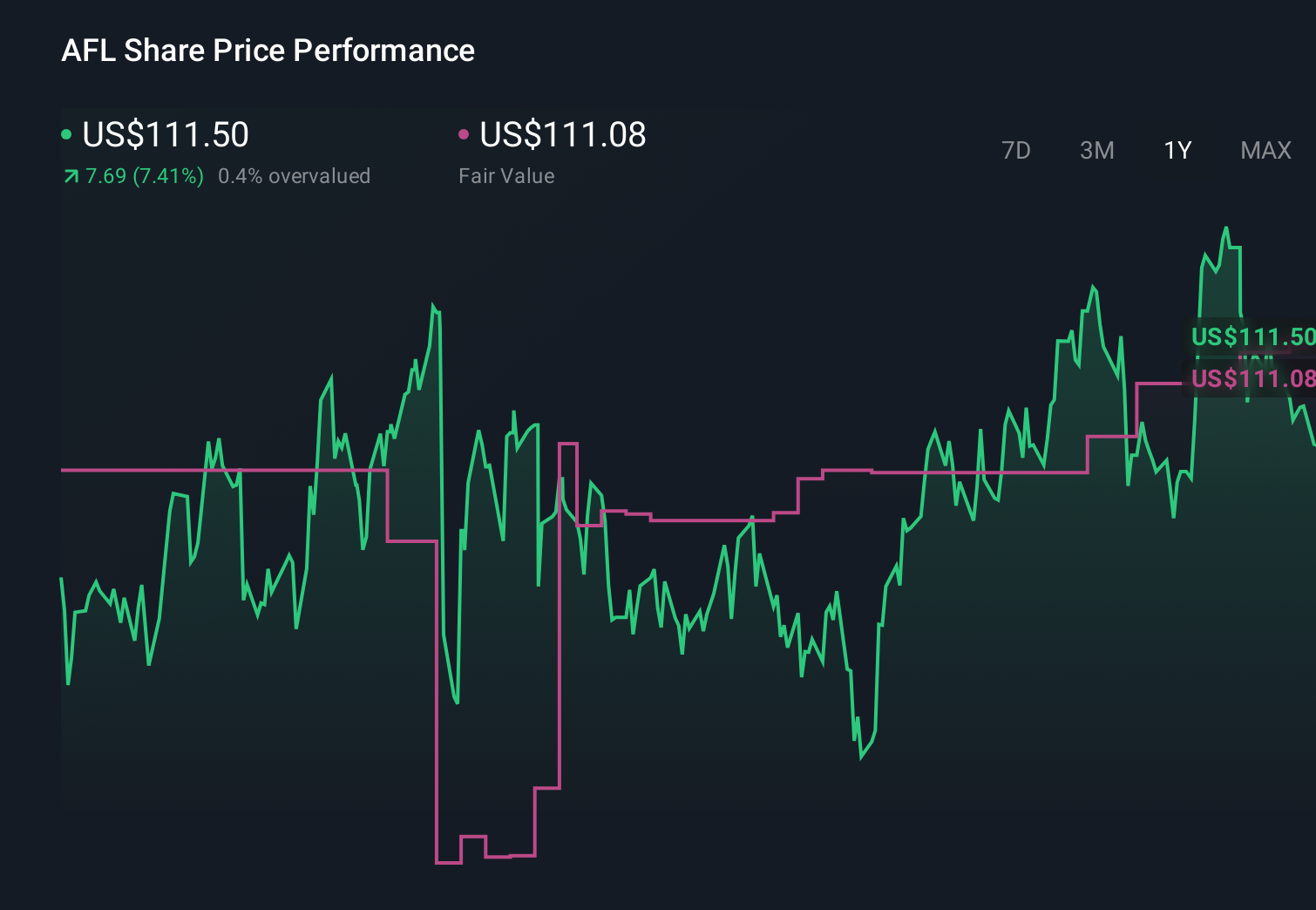
Simply Wall St Community members have only 2 fair value estimates for Aflac, ranging from US$117.71 to US$167.24 per share, showing wide disagreement. You should weigh these views against the ongoing risk that Japan premiums keep shrinking, which could matter more to long term performance than short term U.S. strength.
Explore 2 other fair value estimates on Aflac - why the stock might be worth as much as 32% more than the current price!
Reach Your Own Conclusion
Don't just follow the ticker - dig into the data and build a conviction that's truly your own.
- A great starting point for your Aflac research is our analysis highlighting 2 key rewards and 1 important warning sign that could impact your investment decision.
- Our free Aflac research report provides a comprehensive fundamental analysis summarized in a single visual - the Snowflake - making it easy to evaluate Aflac's overall financial health at a glance.
Ready For A Different Approach?
Our daily scans reveal stocks with breakout potential. Don't miss this chance:
- Invest in the nuclear renaissance through our list of 89 elite nuclear energy infrastructure plays powering the global AI revolution.
- We've uncovered the 9 dividend fortresses yielding 5%+ that don't just survive market storms, but thrive in them.
- This technology could replace computers: discover 26 stocks that are working to make quantum computing a reality.
This article by Simply Wall St is general in nature. We provide commentary based on historical data and analyst forecasts only using an unbiased methodology and our articles are not intended to be financial advice. It does not constitute a recommendation to buy or sell any stock, and does not take account of your objectives, or your financial situation. We aim to bring you long-term focused analysis driven by fundamental data. Note that our analysis may not factor in the latest price-sensitive company announcements or qualitative material. Simply Wall St has no position in any stocks mentioned.
Have feedback on this article? Concerned about the content? Get in touch with us directly. Alternatively, email editorial-team@simplywallst.com