
- PRICING
- LIVE QUOTES
- LEARN
- HELP


EN
The crude oil supply crisis escalated into a “shortage of refined oil products”! Cracking spreads are running at historically high levels, and the global refining bull market is moving towards 2027
The Zhitong Finance App learned that Phillips 66 (PSX.US) executives, one of the US oil and gas giants, recently said that refined fuel producers, which are enjoying a sharp rise in profits, are likely to continue to obtain unusually strong profit margins in the next quarter and beyond. Currently, the global refining boom is still on an upward trajectory. Its essence is a “supply gap for refined oil products” rather than simply a high crude oil price-driven boom. Refinery utilization, cracking price differences, energy export demand, and cash flow growth rates are simultaneously strengthening, and the operating performance of individual energy companies has exceeded expectations by chance.
Brian Mandel, executive vice president in charge of marketing and commercial business at Phillips 66 (Phillips 66 mentioned above), said in a performance conference call on Wednesday that supply disruptions caused by the Iran war are expected to continue to affect the global refining business, especially the refined fuel market such as gasoline and diesel until 2027.
“The fundamentals of refining are very tight, and they are getting more tense,” Mandel said. He added that the Middle East and Asian markets have a daily shortage of 7 million barrels of refined oil products, and the Russian market also has a daily supply gap of 1.4 million barrels. “This really lays the foundation for stronger profit margins that are likely to occur in the third quarter and the rest of next year.” Mandel emphasized.
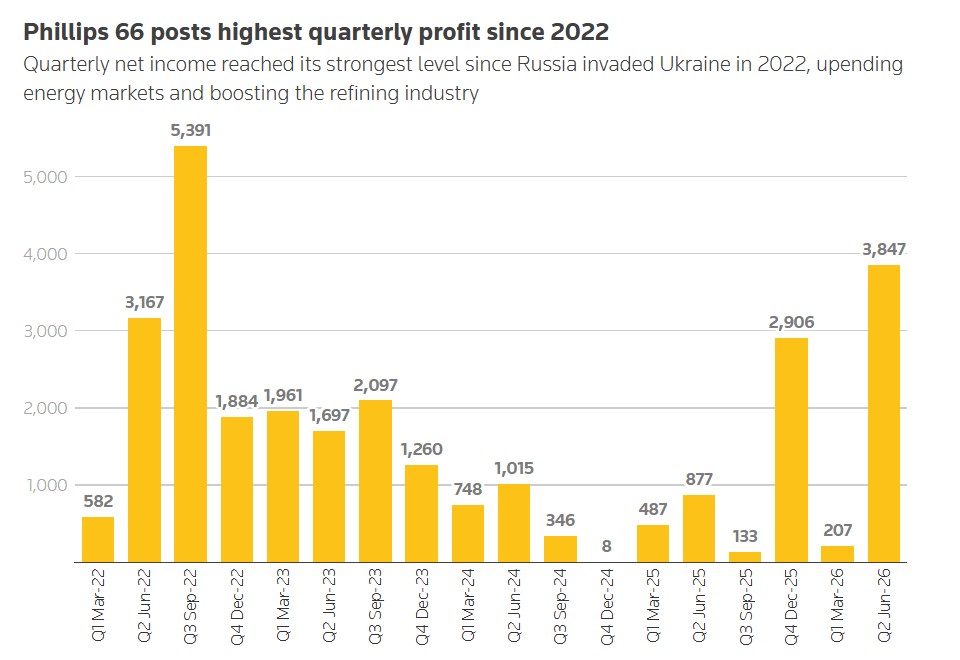
According to the latest performance data, the US independent refiner's second-quarter adjusted earnings per share reached $9.14, the highest since the company's initial public offering in 2012. The company's real profit margin in the second quarter more than doubled from the same period last year to $24.08 per barrel. The company's net profit was around $3.85 billion, up from $877 million in the same period last year, the highest quarterly profit since 2022. At that time, the war between Russia and Ukraine disrupted the global supply chain and boosted refiners' earnings.
In the months after the US and Israel attacked Iran, the profit margins of the refining business generally soared sharply, whether it was refiners or oil and gas giants such as ExxonMobil. The loss of supply in the Middle East and the shutdown of refineries caused by Ukraine's attack on Russia have further tightened the global supply of refined petroleum products.
As of this Thursday (August 6, 2026), the geopolitical situation in the Middle East showed a two-way trend where “the Strait of Hormuz mitigates rising expectations, and the risk in the Red Sea continues to spread.”
Iran and Oman said that the agreement on the Strait of Hormuz route has entered the final stage of drafting. The potential arrangement may give Iran control over ships entering the Persian Gulf and make it conditional on the US lifting the blockade of Iranian ports, but the US has yet to accept this core provision. Meanwhile, the Houthis claimed to have attacked two Saudi oil tankers near the Saudi Red Sea port of Yanbu and in the Gulf of Aden, which have not yet been confirmed by Saudi Arabia; Israel has also resumed air raids on southern Lebanon, causing local cease-fire negotiations to end early. Therefore, the latest geopolitical events in the Middle East cannot be characterized as confirmed large-scale additional production cuts, but they have extended the risk from Hormuz to the Bab Mand Strait and alternative export channels in the Red Sea, limiting the market's optimism about the peace agreement.
Refining profits are at an all-time high: Phillips 66 bets that high oil price spreads will continue until 2027
As the geopolitical conflict in the Middle East continues to unfold, operators of strategic oil reserves in various countries continue to release stocks of refined oil products to cope with the shortage of supply in the Middle East. Today, these reserves need to be restocked to further strengthen demand prospects. Mandel said that this geopolitical war may also prompt countries to establish new reserves to “prevent such geopolitical issues.”
Phillips 66 CEO Mark Rahill said in an interview with the media on Wednesday: “We have heard that relevant discussions are ongoing. Some countries are considering building their own reserves, including both crude oil and refined refined oil products.” “But these countries are also seeing the US as a more reliable supplier of refined oil products and crude oil,” he added.
Although the release of reserves buffered the supply-side impact on the energy market, some refiners were also able to reduce their dependence on Middle Eastern petroleum products and popular crude oil varieties in the region. Rahill said that less than 1% of the crude oil processed by the Phillips 66 refinery comes from the Middle East.
As global crude oil prices soared during the geopolitical conflict in the Middle East, the company delivered light crude oil made in the US on a large scale to a refinery on the east coast of the United States to replace imported crude oil. Referring to the Bewell refinery in Linden, New Jersey, in an interview, Rahill said, “If we had to process those crude oil varieties at the price at the time, we could only shut down the Bayway refinery.”
Phillips 66 has also been looking for alternative crude oil supplies in Latin America. Mandel said during an analysts' conference call that the company has now become the third-largest buyer of Venezuelan crude oil in the world.
Mandel said that the company's major refineries are delaying maintenance to obtain high profits, and continuing delays in maintenance may result in unplanned long-term shutdowns. Related facilities will also require extensive maintenance work in 2027 and 2028. At that time, more suppliers of refined petroleum products will withdraw from the market around 2027.
Mandel said the refined fuel market is still facing structural constraints. The reopening of the Strait of Hormuz will increase the supply of crude oil, but will not significantly increase the supply of refined oil products in the short term; at the same time, the net increase in global refining capacity will not be sufficient to meet the expected increase in demand.
US refineries take over global marginal supply, and refining profits enter the supercycle
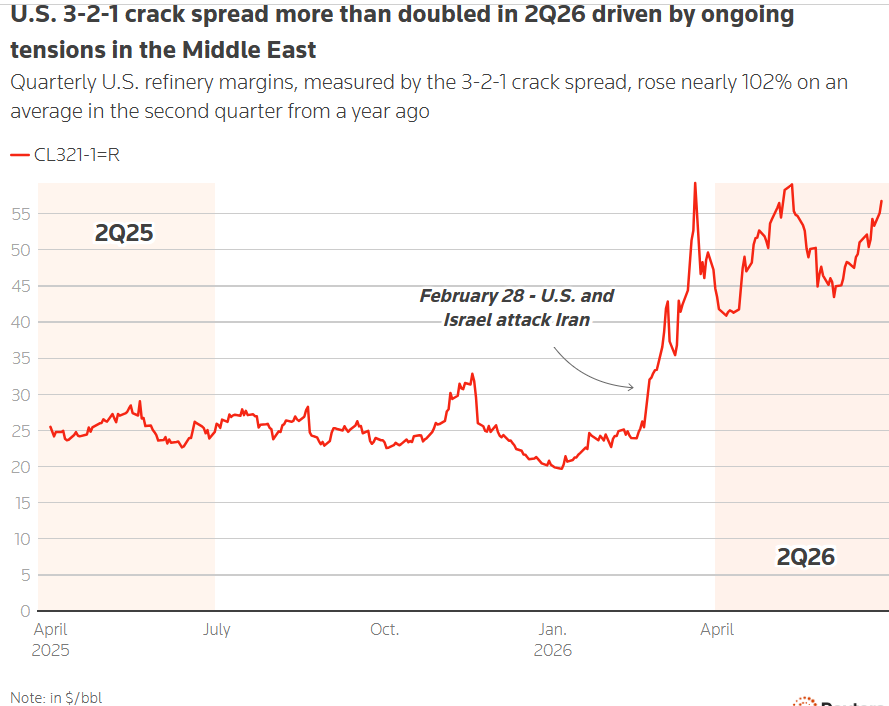
A refiner's profit indicator, known as the “3-2-1 cracking spread,” hit a record high in July. The price difference is calculated by calculating the average profit margin obtained per barrel when processing three barrels of crude oil into two barrels of gasoline and one barrel of diesel.
As of Wednesday, the indicator was around $57 per barrel, close to its highest level in history.
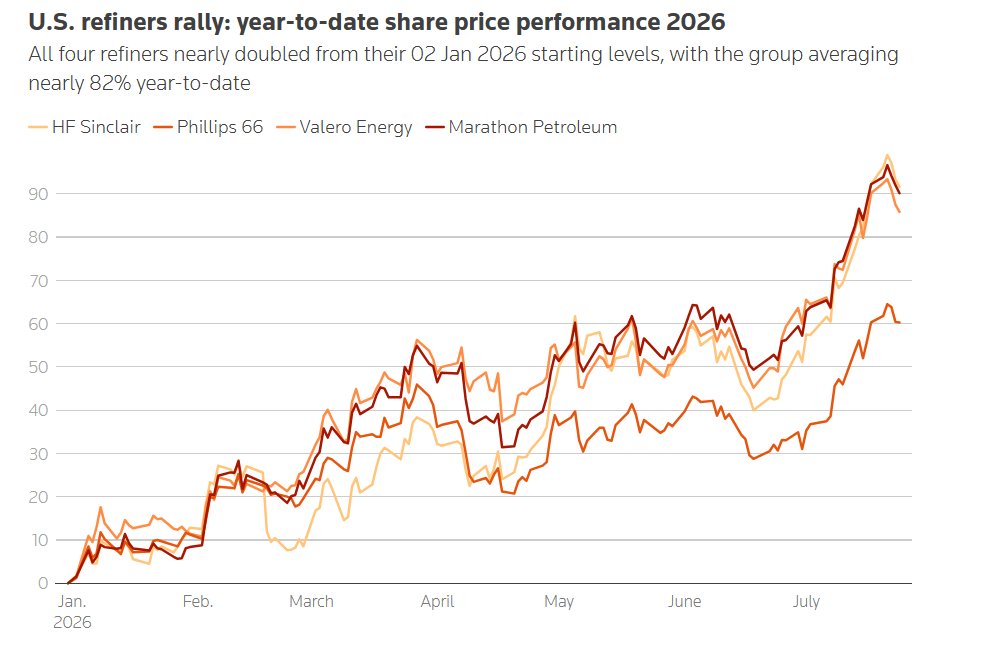
However, the good days can't last forever. “These refining stocks are like stepping on stilts right now,” said Ben Cook, portfolio manager at Hennessy Funds, who manages two energy-themed funds. He said that if the conflict between the US and Iran ends clearly, the stock prices of Phillips 66 and major US refiners such as Marathon Crude Oil and Valero Energy are likely to drop sharply.
Speaking about unusually high refining profit margins, Cook said, “These numbers are surprisingly high, but they are also easy to fall back quickly.”
Phillips 66's second-quarter adjusted refining profit jumped from 392 million US dollars to 3.09 billion US dollars, and the actual refining profit margin surged to $24.08 per barrel, more than doubling year on year; US oil and gas giant ExxonMobil's adjusted energy products business profit rose to 4.099 billion US dollars month-on-month and set a second-quarter diesel production record; Chevron's downstream profit reached 4.9 billion US dollars, the highest level since the 1920s. For the first time since the 1920s, the processing volume of US refineries exceeded 1 million barrels per day.
Saudi Aramco, a state-owned energy giant headquartered in Saudi Arabia, increased 44% year-on-year to US$32.69 billion in the second quarter. It also benefited from rising prices for refined oil products and chemicals, and warned that global refineries were close to maximum load and that there was little room for systems to withstand new unexpected shutdowns. There is no doubt that the financial reports of these energy giants are highly consistent: refinery utilization, cracking price differences, export demand, and cash flow are simultaneously strengthening, rather than individual companies' coincidences exceeding expectations.
The reason why this cycle is likely to continue until 2027 is because the global shortage has evolved from a “shortage of crude oil” to a “lack of refining capacity and qualified refined oil products” that are more difficult to fix quickly. Even if the Strait of Hormuz were to be reopened, the first increase was the supply of crude oil, which would not immediately be able to make up for diesel, aviation kerosene, and gasoline; at the same time, attacks on Russian refineries, restrictions on exports of refined oil products from China, falling global inventories, and blockages in Middle Eastern refineries and shipping have all combined to reduce scheduled supply.
In order to capture high profits, the refinery is delaying maintenance, but operating the equipment under extreme load increases the probability of unplanned shutdown, and production capacity will be actively withdrawn when the 2027-2028 backlog of maintenance is released centrally. As a result, large US refiners with complex refineries, flexible raw material structures, and complete export terminals along the US Gulf Coast are becoming marginal suppliers to the global refined oil market; Phillips 66 plans to operate at a high load of about 95% in the third quarter, which is a direct reflection of this tight balance.
However, none of this means that a risk-free long-term refining stock compounding market is coming; rather, it is a super cycle where profits are strong and reverse switches are highly concentrated, supported by the scarcity of refined oil products. Refining stocks still have strong profit growth, free cash flow, and a catalyst for deleveraging. Large refiners such as Phillips 66 (Phillips 66), Valero Energy, and Marathon Petroleum usually have higher cracking price flexibility than integrated energy giants; but this is also a transaction with a high geopolitical beta and strong average return attributes. Brent crude fell back to about $79.08 on Thursday due to progress in Iran-Oman negotiations alone, indicating that the market is extremely sensitive to the cease-fire signal in the Middle East.
If Hormuz resumes flights steadily, refineries in the Middle East and Russia resume, and inventory replenishment is completed, the price spread and refining stock valuation may fall rapidly ahead of earnings reports. Conversely, if the Red Sea route continues to be attacked, the maintenance backlog begins, and Middle Eastern oil and gas producers unexpectedly stop production again, the probability that high refining profits will continue until 2027 will increase significantly.