
- PRICING
- LIVE QUOTES
- LEARN
- HELP


EN
Has the “ultimate restraint” been lifted? Bank of America: The yen is expected to rebound by about 6% within the year after the joint intervention
The Zhitong Finance App learned that the Bank of America released its latest exchange rate forecast on Wednesday, drastically raising the target price of the yen against the US dollar at the end of the year. It is expected that under the combined effects of the coordinated intervention of the US and Japanese governments and the Bank of Japan's interest rate hike in the coming months, the yen will appreciate by about 6% from the current level of about 158 to reach 149 to 1 US dollar by the end of the year. The previous forecast was 152.
A team of Bank of America analysts, represented by Yamada Shusuke, Izumi Devalier, and Yamashita Tomonobu, pointed out that this round of joint intervention has significantly raised the threshold of success or failure in the Japanese “defensive war,” and to maintain the results, macroeconomic policies must be followed up and coordinated — specifically, to speed up the pace of interest rate hikes. They wrote in the report: “If the Bank of Japan takes action in September rather than October, it will have an opportunity to show the market its determination to proactively address the risk of rising inflation.”
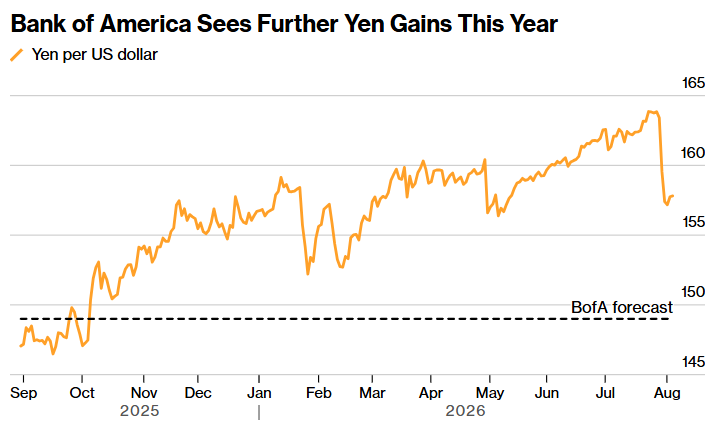
Looking back, the huge spread of interest rates between the US and Japan once pushed the yen to a 40-year low of nearly 164. However, after the two countries initiated their first joint purchase of yen intervention since 1998, the yen quickly rebounded to close to 155 and rose for four consecutive trading days. Although some gains were later taken back, the US and Japanese governments have both stated that they are ready to join forces again if necessary. Bank of America analysts believe that this political signal is significant: “When unilateral intervention supports the local currency, the size of foreign exchange reserves can be viewed as an upper limit; however, with US participation, the final restraint on intervention has actually been lifted.”
Meanwhile, Bank of America slightly raised its forecast for yen this quarter from 154 to 153. Analysts stressed that the coordination between the US and Japan reflects the shared goal of long-term stability of the Japanese yen. “There is now even more reason to believe that in addition to foreign exchange intervention, Japan will introduce a broader policy package to support the yen in the medium to long term.”