
- PRICING
- LIVE QUOTES
- LEARN
- HELP


EN
The trend of diet pills is divided! Strong sales fuel LLY.US (LLY.US)'s Q2 performance exceeding expectations
The Zhitong Finance App learned that the second-quarter results announced by LLY.US (LLY.US) ahead of the market on Wednesday were better than market expectations, mainly due to strong sales of its injectable GLP-1 drug and the newly marketed oral diet drug FoundAyo. As of press time, the company was up 5%.
Although rival Novo Nordisk (NVO.US) also handed over a quarterly report that exceeded expectations and raised full-year guidance on Tuesday, its stock price still fell, and its much-publicized oral diet drug sales fell short of Wall Street expectations.
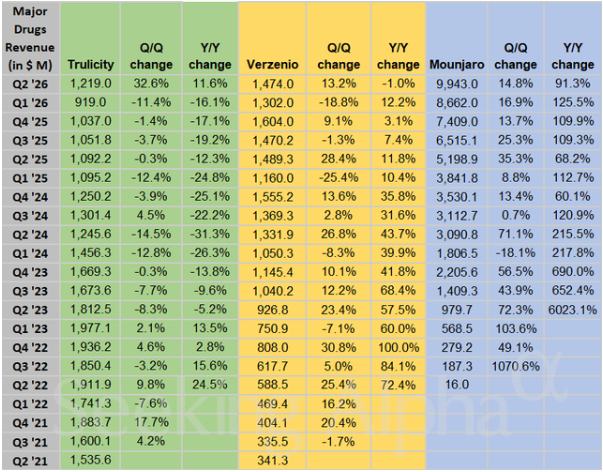
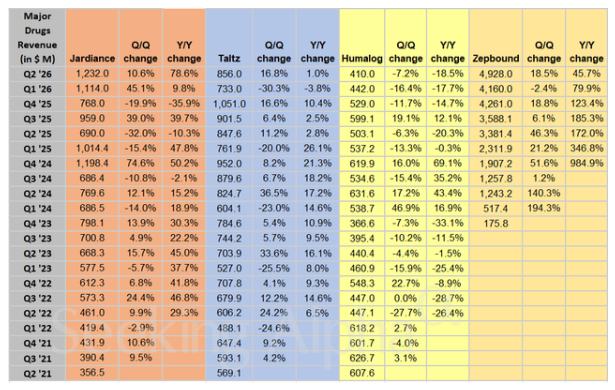
Eli Lilly, headquartered in Indiana, achieved revenue of 23 billion US dollars in the second quarter, an increase of about 48% year over year, which was 2.3 billion US dollars higher than the agreed market forecast. On the profit side, the company's adjusted earnings per share increased by about 33% year over year to 8.38 US dollars; gross margin increased 130 basis points year over year to 86.3%, mainly due to lower sales costs and product portfolio optimization.
By product, Zepbound, an injectable diet drug, contributed 4.9 billion US dollars in revenue, and Mounjaro, a drug indicated for diabetes, contributed 9.9 billion US dollars, higher than analysts' expectations of 4.6 billion and 8.8 billion US dollars, respectively.
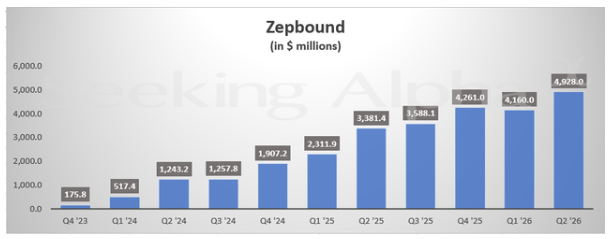
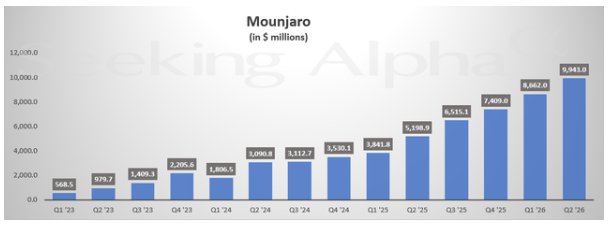
The newly launched oral diet drug Foundayo recorded sales of $98 million, which also exceeded expectations of $92 million.
Behind strong performance, Eli Lilly promoted mergers and acquisitions in the second quarter, successively completing acquisitions of Orna Therapeutics, Ajax Therapeutics, Centessa Pharmaceuticals, and Kelonia Therapeutics.
After the quarterly report was released, the company also agreed to buy clinical-stage company AtaiBeckley with an advance payment of about 2.8 billion US dollars, which focuses on developing psychedelic therapies for treating mental illnesses such as intractable depression. Eli Lilly also announced the completion of three additional acquisitions to build an infectious disease product portfolio.
In terms of pipeline progress, Eli Lilly said that the phase III positive data for retatrutide, the next-generation weight loss candidate, is now sufficient to support global registration reports, covering indications such as obesity, obstructive sleep apnea, and knee osteoarthritis pain. The company plans to submit a biological product licensing application (BLA) to the FDA in the first quarter of 2027.
In terms of outlook, Lilly raised its full-year results guidance. The estimated revenue range is 85 billion to 87 billion US dollars, which is slightly lower than the market's agreed forecast of US$85.4 billion (basically flat); the adjusted earnings per share forecast is 35.50 to 36.50 US dollars, which exceeds analysts' forecasts of US$34.54, but it is important to note that business development activities in the second quarter had a negative impact of about US$3.03 per share.
Edmund Ingham, head of Haggerston BioHealth, said in a review that Eli Lilly's revenue for the full year of 2020 was only 24 billion US dollars, while the company's revenue in the first half of 2026 had already exceeded 42 billion US dollars.
He notes, “Eli Lilly's growth, driven by Zepbound/Mounjaro, a diet drug/ type 2 diabetes drug, is amazing.” He added that the company's next-generation diet drug, retatrutide, has released three positive key research data in the second quarter, and approval for the third “superbombshell” drug now seems almost certain.