
- PRICING
- LIVE QUOTES
- LEARN
- HELP


EN
Established European tech stocks bucked the trend and “old money” unexpectedly became the AI winner during the earnings season
The Zhitong Finance App learned that the AI wave was initially widely viewed as a new opportunity for model developers, but recent financial reports show that a number of large European mature technology groups are bucking the trend and becoming actual beneficiaries of artificial intelligence dividends. From SAP (SAP.US), Capgemini, Sopra Steria to OVHcloud, many European tech giants have reported stronger demand, faster growth, or higher performance guidelines. The common driving force behind this is that companies are moving from AI testing to full deployment.
However, these companies have also discovered that it is far more difficult for AI to actually produce productivity within complex organizations than to acquire the technology itself.
Large organizations are unlikely to rely on a single AI vendor and will choose different models based on task attributes, performance, security levels, and compliance requirements. The challenge now is no longer “which model to choose,” but how to make AI work smoothly with the organization's existing software, data, and business processes.
In a recent report, UBS stated, “AI applications are the real battleground and the core of value creation.” This is in line with the traditional advantages of established European technology companies. Long before the advent of generative AI, they were deeply involved in the service field of helping large organizations integrate complex technology.
Most large organizations didn't start on a “technical whiteboard.” AI systems must be compatible with decades of accumulated software stacks, fragmented databases, custom applications, and increasingly stringent governance requirements; at the same time, they also need to access real-time enterprise data, balance rights management, audit tracking and retention, and embed common employee workflows.
Task complexity is becoming one of the biggest bottlenecks limiting the implementation of AI. The Boston Consulting Group notes that deployment is faster than the management capabilities of enterprises, and more than 70% of investors are concerned about whether the organization has the technology and operational capabilities required for AI success.
As enterprises move from testing to actual application, AI implementation, integration, and governance expenses are becoming an increasingly critical component of the value chain.
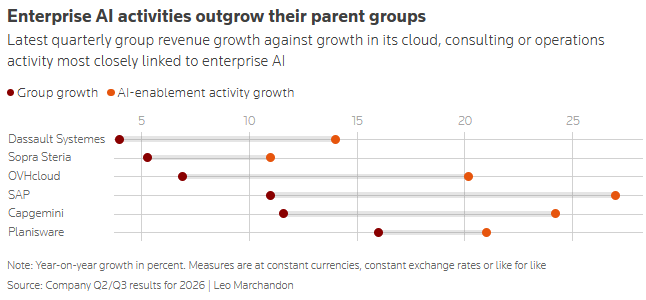
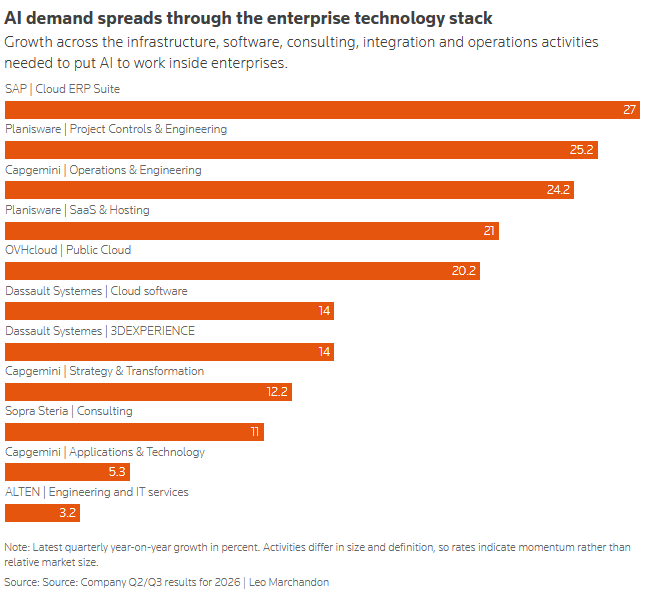
SAP's cloud backlog of orders increased 26% at a fixed exchange rate to 22.9 billion euros. As companies continue to migrate core systems such as finance, procurement, supply chain, and human resources to their cloud platforms, these platforms are increasingly becoming the foundation for AI deployment. The company's recent acquisition of data specialist Dremio and AI company Prior Labs highlights the growing importance of making enterprise data accessible to AI applications.
Capgemini raised its full-year growth target after order bookings increased by 9.2%; Sopra Steria raised its performance outlook after organic growth accelerated to 5.3%. These two Parisian listed companies benefit from follow-up work after AI adoption: integrating models into workflows, managing data, and building governance systems.
This type of work is particularly valuable in fields such as defense, aerospace, healthcare, and critical infrastructure, where AI must be embedded in specialized software and highly controlled operational processes.
Another trend has further strengthened the position of established European companies: companies are increasingly demanding control over AI deployments.
Publicis CEO Arthur Sadoun said that customers increasingly want to run advanced AI models in an environment where they can control technology and data independently. This preference is particularly prevalent in the fields of defense, aerospace, and critical infrastructure, where sovereignty, security and compliance concerns are particularly prominent.
Airbus's decision to deploy sensitive industrial and defense applications on the Scaleway cloud platform under the French telecom group Iliad, while also using AI tools jointly developed with Mistral, is the epitome of this trend. Airbus expects around 70 key applications to run on Scaleway by the end of 2028.
OVHcloud's public cloud revenue increased by 20.2% in the third quarter, which initially indicates that Europe's demand for autonomous and controlled AI infrastructure (not affected by extraterritorial laws such as the US Cloud Act) is beginning to be transformed into commercial growth.
Of course, established European tech companies still need to prove that AI-driven demand is sustainable while ensuring that profit margins can withstand the pressure of low-value consulting and software automation.
However, recent results have revealed a sign: the biggest beneficiaries of AI may not be limited to model builders; companies that can truly “use” models within large global organizations are at the center of this transformation.