
- PRICING
- LIVE QUOTES
- LEARN
- HELP


EN
Automobile industry sales volume in July: mixed feelings, explosive growth in domestic production overseas
Entering August, major car manufacturers announced sales for July one after another. Overall growth was relatively weak compared to June, but there are still some brands that are showing strong performance, bucking the trend, and taking the lead in the market.
The Zhitong Finance App learned that the pattern of the automobile industry was basically stable in July. Both traditional car companies and new car builders took the lead. The former, BYD (01211), was at the leading level in the industry with sales of 419,200 vehicles, while the latter Zero Run (09863) continued to dominate the list of new forces with 101,300 vehicles. Among them, Zero Run became a new domestic force that sold more than 100,000 in the first month, and greatly widened the gap between other new forces.
In fact, the car market was in the traditional low season in July. Coupled with natural disasters such as frequent typhoons, curtailing offline passenger flow and demand for car purchases, inventories were not optimistic. According to the China Automobile Association, the inventory warning index for car dealers was 61.1%, up 3.9 percentage points year on year and month on month, above the boom and bust line. Competition at the price level is still fierce. 37.3% of dealers experienced sharp price cuts in July, and terminal profit margins continue to be under pressure.
Currently, the penetration rate of new energy vehicles in China is close to 60%. Market stocks have replaced upward compression. Going overseas has become a new battleground for major car companies to compete, and the overseas penetration rate is low “enough to manage”, and most overseas car companies have recorded good growth results. In addition, major car companies are also investing in humanoid robot projects in an attempt to create new growth points. The industry knockout tournament has reached the finals. Which car company can have the last laugh?
The leader is still strong, and the monthly sales of Zero Run broke 100,000 for the first time
The Zhitong Finance App learned that judging from sales in July, there were mixed feelings, but the situation of the strongest players, Hengqiang, was further stabilized. Among traditional car companies, the top five were BYD, SAIC, Chery, Geely and Changan, with sales volumes of 419,200 units, 338,600 units, 261,900 units, 252,200 units and 2071,000 units respectively. Among them, Chery's sales increased by 24.1%. All five of its major brands achieved growth, and the volume of the smart world increased by 227.7%.
In the first seven months, domestic brands represented by Chery and Geely achieved contrarian sales growth of 1,537 million units and 1.673 million units respectively, up 10.3% and 2% year-on-year respectively. In addition, domestic brands showed strong overseas performance. In July and July, Chery exported 202,500 vehicles and 1,146,400 vehicles, up 70.1% and 71.2% year on year, respectively, while Geely exported 107,000 units and 589,900 units, up 202% and 165% year on year, respectively; BYD exported 180,500 vehicles and 972,800 vehicles, up 123.6% and 78.5% year on year, respectively.
In comparison, SAIC Motor, an old leader, did not perform well, but its own brands maintained high growth, and the export volume trend was consistent with domestic brands, mainly dragged down by joint venture brands. In the first 7 months, SAIC Volkswagen and SAIC-GM sales declined by 32.7% and 7.45% respectively, and Toyota and Honda joint ventures also showed a downward trend. The rise of domestic brands is inseparable from the strategic advancement of new energy sources. At the same time, the addition of new car builders has brought prosperity to the industry.
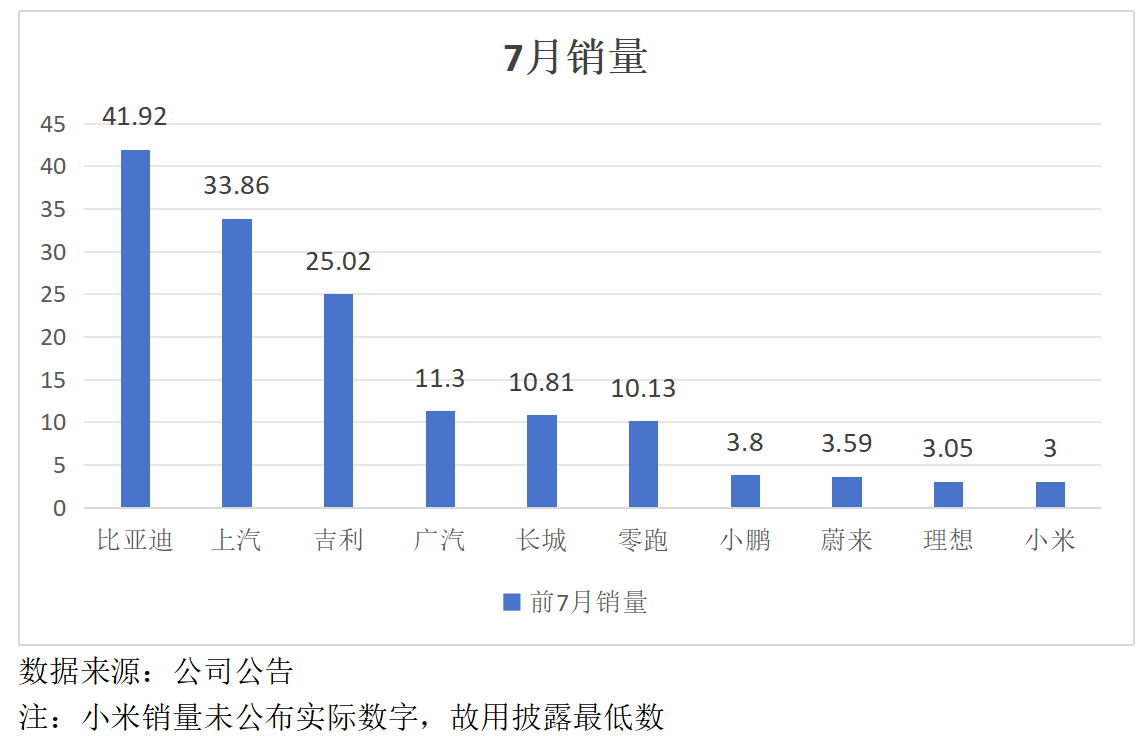
In the new car building forces, there is serious differentiation. Zeros sold 101,300 units in July, not only was it in an absolute leading position, but it also grew as high as 102%, far higher than other new forces. This was also the first brand of new car builders to squeeze in sales of 100,000 units per month; Xiaopeng ranked second, but growth was relatively weak; NIO exhausted its suffering, and its sales volume began to expand. Sales increased 71%, and sales in the first 7 months were second only to zero; sales in the first 7 months were slightly insufficient, and Xiaomi's sales volume fell year-on-year in that month; The performance is stable, with monthly sales of the two models stabilizing above 30,000.
The situation of industry powerhouse Hengqiang is basically locked in, and it is difficult to reverse it in the short term. On the one hand, under high competition, brands with higher sales have higher market recognition, while brands with lower sales are driven away from consumption due to concerns about being eliminated, leading brands have a siphon effect; on the other hand, competitive competition among leading brands is not simply about price, but comprehensive strength such as product strength, market, and ability to develop new businesses.
The final round competes for comprehensive strength, and the sector may re-enter the upward channel
If you carefully study the leading car companies that have done a good job, it is easy to find that they all have the same characteristics. They all continue to work hard on the product side and the market side, and roll prices are not the main means; use BYD and Zero Run as typical examples.
In the case of BYD, on the product side, the five major passenger car brands cover the needs of high- and low-end users. Dynasty and Ocean focus on the mass market. Equation Panther and Tension cover personalized and middle- and high-end markets, looking forward to entering the luxury market. Self-developed technology in the industrial chain brings competitive barriers, such as electrification and platform technology. Pure electric models can achieve 10% to 70% fast charging in 5 minutes, and second-generation blade battery switching is accelerated. It is expected that all models will be switched by the end of 2026; Eye of Tenjin covers all models, and intelligent driving capabilities are at the cutting edge of the industry.
On the market side, exports became the second growth curve. Sales reached a new high of 180,500 vehicles in July, accounting for 43% of total sales, becoming the core driving force. Overseas vehicles are expected to be 1.8 to 1.9 million vehicles for the whole year, an increase of 75% over the previous year. The Brazilian market is one of the company's most prominent overseas markets. The first phase of the Brazilian production base has an annual production capacity of 150,000 units and a long-term planned annual production capacity of 600,000 units. In the first half of this year, the company's cumulative sales volume in the Brazilian market was nearly 100,000 vehicles, an increase of 107% over the previous year.
In contrast, the Zero Run product side creates popular models with large single products in segments. The company's main models, the C series and B series models, are all SUVs. The main target audience is young people. The price range is concentrated, focusing on the 10-200,000 yuan market, and every model hits the market. The first MPV model in the D series moved up the price to 200,000 to 300,000 yuan, but it had more configurations in the same price product, making it really “good but not expensive”.
Under the “big single product hit model,” Zero Run has embarked on a different path of success from BYD. Monthly sales broke 100,000 units for the first time in July, and can also stand on the same level as traditional brands. It is worth noting that Zero Run's business has covered more than 40 countries and regions around the world, with more than 2,000 global channel outlets, including nearly 1,000 overseas networks, maintaining the top monthly export volume. The first half of this year has accumulated overseas exports of nearly 100,000 units, exceeding the total export volume of last year.
The success of BYD and Zero Run is worth learning from peers. Although Zero Run's business size is small, it has adopted a model of deep binding cooperation with international multinational car companies and jointly developed the market through localized production and operation. Xiaopeng is also promoting this model and is deeply linked and cooperating with Volkswagen. The sales network has covered 65 countries and regions, with more than 1,200 stores. According to He Xiaopeng's disclosure, overseas sales volume totaled 100,000 vehicles during the period.
Furthermore, while expanding in overseas markets, major car companies are also looking for new growth support, such as using R&D and manufacturing advantages to cooperate with third-party platforms to expand application scenarios for intelligent driving from private cars to unmanned taxis, while promoting the development and application of humanoid robots. Embodied intelligence has the potential to reshape the automotive industry chain, but at present, commercialization of this business is still in its early stages, and the prospects for contribution are weak.
Overall, the industry's sales volume in July was mixed. The traditional and new two leading forces, Hengqiang, also saw a sharp increase in domestic brands, and the low penetration rate of new energy from overseas. Coupled with the urgency of overseas countries to develop new energy vehicles under the US-Iran conflict, it brought market opportunities to domestic brands. However, as typical examples of success, BYD and Zero Run have embarked on a different path of success, or have become examples for domestic brands to learn from and develop.
After a year of deep correction in the Hong Kong stock auto sector, this also basically realized the impact of the slowing growth rate of the industry. During this period, a number of companies maintained market confidence through “increase in holdings” and “repurchases”. For example, Geely repurchased 108 million shares this year, ideally repurchased a total of 44 million shares, Xiaomi bought back 368 million shares, and Zero Run received continuous increases in holdings from founder Zhu Jiangming and management.
Since the end of June this year, the automotive sector has bottomed out and rebounded by more than 20%, but the slowdown in the industry's growth rate still suppresses the rise in valuations. However, high growth in overseas markets and the emergence of new growth points, combined with a wave of deep pullbacks, caused some individual stocks to “fall back on the back of the market,” bringing the market an opportunity to pick up the “cabbage price” high quality target. The sector may re-enter an upward channel, and the leading sector is expected to be favored by institutions.