
- PRICING
- LIVE QUOTES
- LEARN
- HELP


EN
IPO outlook | Consumer electronics optical module leaders are performing briskly, and Yu's unconcealed standpoint innovation conceals multiple discount factors
As the IPO process in Hong Kong continues to advance, Lijing Innovation Technology Co., Ltd. (hereinafter: Lijing Innovation) is expected to become the Wang family's second listing platform.
In 2018, Lixun Precision (002475.SZ), controlled by brothers and sisters Wang Laichun and Wang Laisheng, increased its AirPods OEM share to about 50% and broke into the three new Apple modules of LCP antennas, wireless charging receivers, and linear motors. The performance growth rate hit a high level since its launch, establishing its “fruit chain module leader” position.
Also in this year, Wang Laixi (Wang Laichun's brother), who worked at Lixun Precision for 14 years and was the general manager, left the job to found Lijing Innovation, and Wang Laichun (Chairman of Lixun Precision) personally became the non-executive director and chairman of Lijing Innovation.
Lijing Innovation, founded by Wang Laixi, focuses on camera modules, optical lenses, and XR optical tracks, and forms a misaligned division of labor at the business level with Lixun Precision, which assembles connectors, acoustics, and complete machines.
Relying on Lixun's sophisticated supply chain and management genes, the Wang family separately capitalized the “Fruit Chain Optics” asset and promoted Lijing Innovation to the Hong Kong Stock Exchange in November 2025.
The Zhitong Finance App learned that after submitting the Hong Kong Stock Exchange for the first time on November 28, 2025, Lijing Innovation submitted a listing application to the main board of the Hong Kong Stock Exchange for the second time on July 31, 2026. CITIC Securities and CICC (CICC Hong Kong) were co-sponsors.
According to Frost & Sullivan data, according to 2025 revenue, Lijing Innovation ranked second in the world in the global consumer electronics camera module field, middle and high-end smartphone camera module field, number one in China, and number one in the world in the field of laptop and tablet camera modules.
Leading market share has been transformed into a driving force for continued growth. According to the prospectus, from 2023 to 2025, Lijing Innovation's revenue was approximately 15.248 billion yuan, 27.914 billion yuan, and 34.755 billion yuan respectively, with a compound annual growth rate of 50.97%; net profit for the same period was 588 million yuan, 1,052 million yuan, and 1,690 billion yuan, with a compound annual growth rate of 69.53%. As of the first five months of 2026, Lijing Innovation's revenue was about 13.624 billion yuan, up 14.67% year on year. Net profit for the period was 776 million yuan, up 48.5% year on year, and continued to grow rapidly.
Consumer electronics has become the core growth engine, and the automotive electronics business continues to shrink
The development history of Lijing Innovation is essentially a merger and acquisition expansion line replicated by the Wang family using the “Lixun style of play” on the optical circuit. In March 2018, Wang Laixi founded Lijing Innovation in Huangpu, Guangzhou. In the month of establishment, he transferred the Guangbao Technology Camera Module (CCM) division and 10% of Guangbao's shares in reverse through a business concession of 360 million US dollars, obtained mature production lines, patents and customer resources in one fell swoop, and established the first smartphone three-camera module in the mobile industry that year, and completed a jump from 0 to 1.
The real inflection point came from Apple's breakthrough — in December 2020, Lijing Innovation acquired 44.87% of Gaowei Electronics' shares for HK$2,196 billion. By June 2022, its shareholding had risen to about 73.88%, using Gaowei Electronics' role as an Apple front camera supplier to enter the core supply chain of iPhone camera modules to achieve dual coverage of the Android+iOS ecosystem.
By December 2022, Lijing Innovation acquired the imaging division of Guangbao Group to complete smart office optical components such as printers and scanners; completed the acquisition of Konica Minolta's Shanghai factory in 2025, extended upstream high-end optical lenses and automotive lenses, and established a joint venture with Suteng Juchuang to establish a Liten Dongguan mass production lidar module.
Through endogenous independent R&D and organizational growth, combined with epitaxial mergers and acquisitions and strategic cooperation, Lijing Innovation has rapidly grown from a manufacturer with a single camera module and a single mobile scenario to a cross-sector precision optical solution provider covering diverse scenarios such as consumer electronics, automotive electronics, smart offices and intelligent robots, XR smart terminals, smart glasses, new displays, smart homes, and new industries.
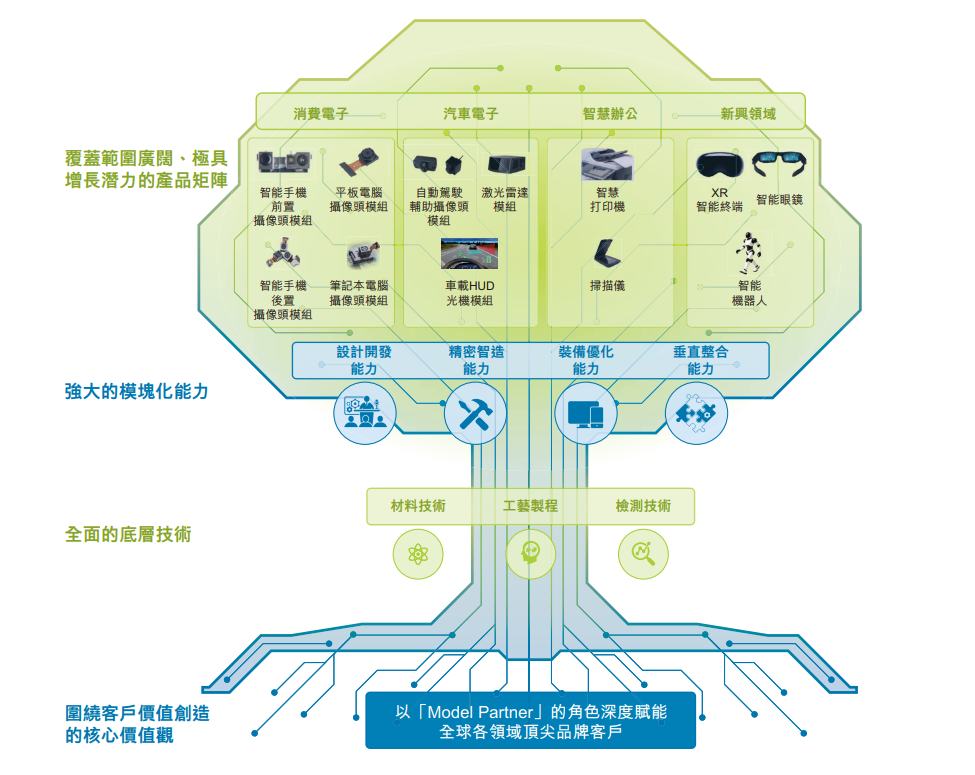
According to the prospectus, there are two main reasons for the continuous growth of Lijing Innovation's revenue side from 2023 to 2025. The first is that the consumer electronics business, as the company's “ballast stone”, achieved leapfrog growth, driven by a “sharp rise in volume and price”. During the period, revenue increased from 11.919 billion yuan to 31,276 billion yuan, accounting for a share of total revenue from 78.2% to 90%, becoming the absolute main force driving overall revenue.
Second, although emerging sectors and other businesses still account for only about 3%, revenue rapidly increased from 578 million yuan to 1,061 billion yuan, effectively complementing overall growth with a high growth rate. In contrast, the revenue of these two major businesses is volatile due to “volume increase and price reduction,” and smart office applications due to “volume reduction and price change.”
Entering the first five months of 2026, the company's revenue growth logic switched to multi-business resonance. Consumer electronics continues to act as a growth engine under the double advantage of “volume increase and price increase”. Although smart office applications are facing a decline in average product prices, they have achieved year-on-year revenue growth through sales expansion. Emerging fields and other businesses have also recorded increases with the accelerated penetration of products. However, the automotive electronics business showed a pattern of “volume increase and price decline”. Weakening unit prices offset the increase in shipments, causing the sector's revenue to decline year-on-year, causing a slight drag on overall performance. It can be seen from this that Lijing Innovation's current automotive electronics business faces the potential challenge of continuing to weaken product prices.
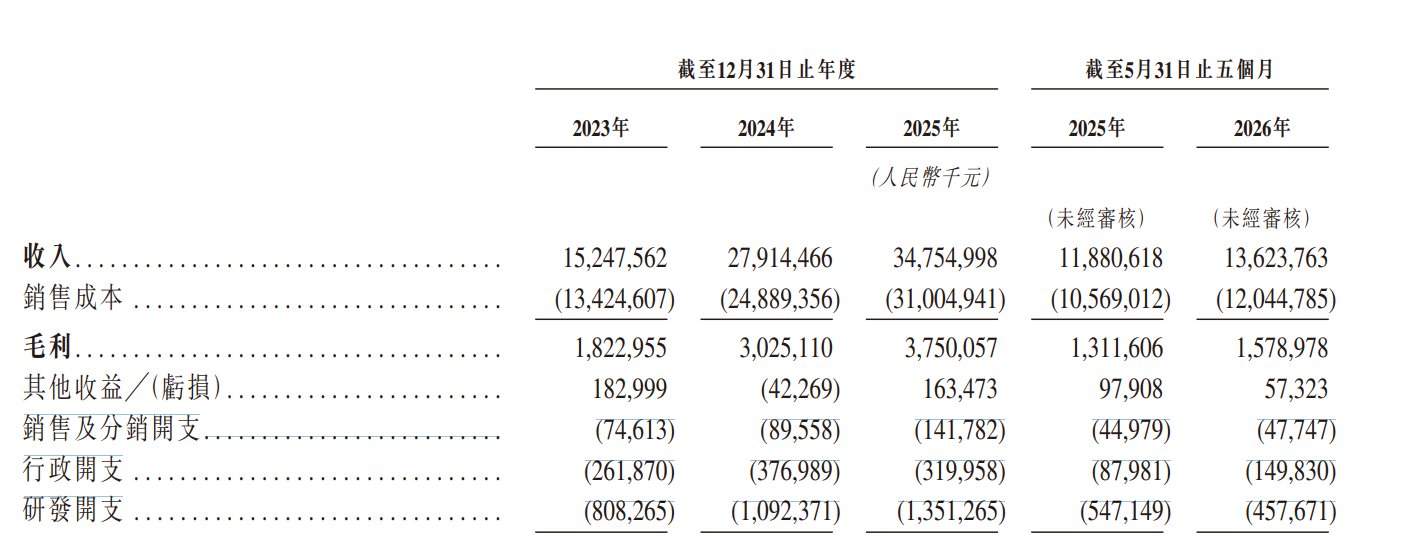
It is worth noting that during the period from 2023 to 2025 and the first five months of 2026, the profit side growth rate of Lijing Innovation continued to outperform the revenue side. The core driver was the systematic increase in management efficiency.
Looking at the cost side, the share of the company's three-fee expenses in revenue was gradually reduced from 7.51% in 2023 to 4.81% in the first five months of 2026, and the downward trend is clear. This optimization is mainly due to the simultaneous convergence of the share of administrative expenses and the share of R&D expenses. The improvement in the cost ratio directly amplified operating leverage and accelerated the release of the profit side.
However, R&D intensity has been low in the industry for a long time, and this is also a potential risk that cannot be ignored in stand-up innovation. During the reporting period, the company's R&D expenditure fell from 5.30% to 3.36% of revenue. Although profit performance was smoothed out and enhanced in the short term, the horizontal comparison with peers was still weak. Looking at it from a long-term perspective, low R&D investment or limiting the pace of technology iteration weakens the company's future product competitiveness and growth ceiling.
Leading premiums are superimposed on industry beta as a bonus item, and multiple discount factors cannot be ignored
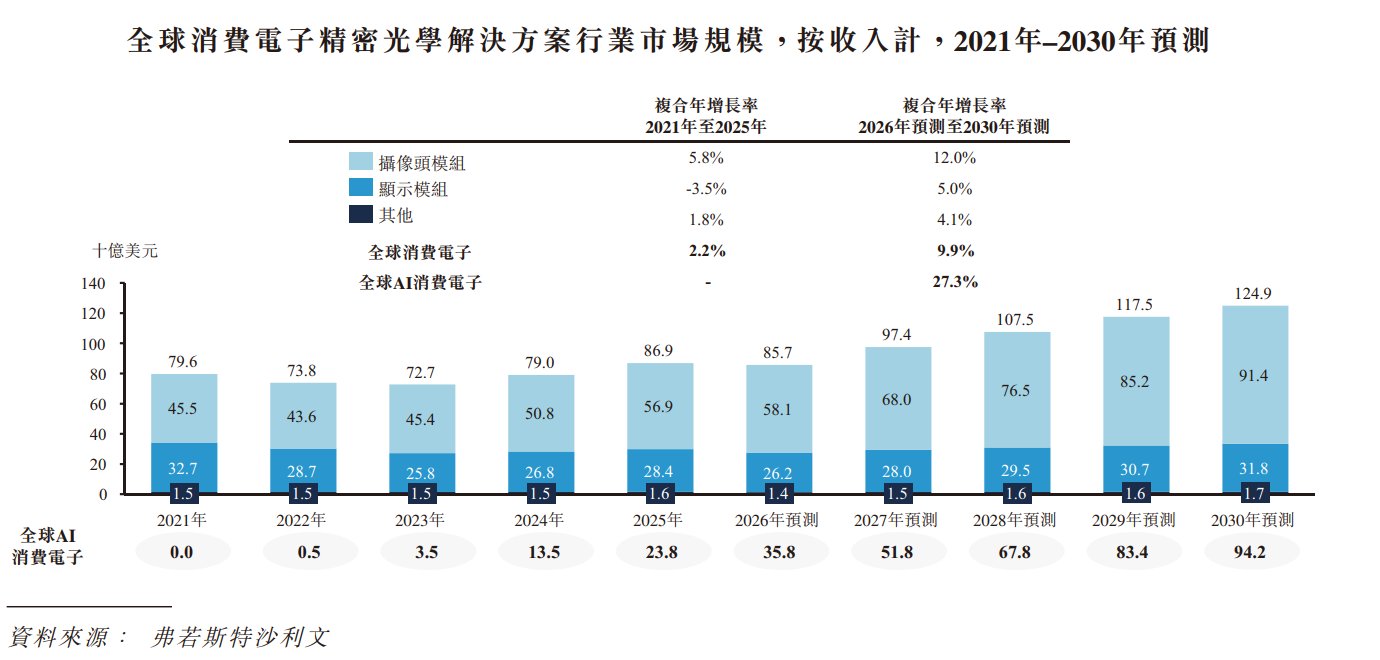
From an industrial perspective, the global consumer electronics precision optical solutions market is expected to accelerate growth. According to Frost & Sullivan data, the global consumer electronics precision optical solutions market increased from 79.6 billion to US$86.9 billion from 2021 to 2025, with a compound annual growth rate of 2.2%.
Driven by the upgrading of consumer electronics smart device imaging experiences and the expansion of innovative optical applications, Frost & Sullivan expects the market to reach 124.9 billion US dollars by 2030, and the compound growth rate between 2026 and 2030 will reach 9.9%, which will greatly increase the industry's growth rate in the previous five years.
Among them, AI has become the core driving force for the growth of the global consumer electronics precision optical solutions market. Along with the rapid increase in shipments of smart terminals such as AI smartphones, AI tablets, and AI notebook computers, optical modules have been given more computational photography, intelligent sensing, and immersive interaction functions, driving the simultaneous increase in the market value and technical complexity of optical demand.
Based on this, Frost & Sullivan anticipates that the global market for precision optical solutions for AI consumer electronics will reach approximately US$94.2 billion from 2026 to 2030, with a CAGR of 27.3% between 2026 and 2030.
As a global leader in consumer electronics camera modules, Lijing Innovation naturally takes on the dividends of the industry's accelerated expansion, and is expected to further consolidate its leading position while continuing to deliver results — this combination of leading premium and industry beta is a significant plus point for Lijing Innovation.
But even so, investors should not ignore the potential risks and challenges faced by Lijing Innovation's business operations. The first is the two-way concentration of customers and suppliers. This is the most obvious structural risk of Lijing Innovation.
In the first five months from 2023 to 2026, Lijing Innovation's top five customers accounted for revenue of 77.9%, 88.7%, 90%, and 90.1%, respectively, and customer concentration continued to increase; among them, revenue from the largest customers accounted for 39.9%, 61.6%, 71%, and 68.2%, respectively, and the dependence on a single major customer (generally expected to be Apple in the market) became more concentrated.
Meanwhile, during the same period, Lijing Innovation accounted for 41.9%, 56.5%, 62.1% and 62.5% of the procurement amount from the top five suppliers, respectively, and the procurement amount from the largest supplier (which is generally expected to be Apple by the market) was about 20.7%, 36.5%, 48.5%, and 47.3%, respectively.
This kind of double-edged sword of “customer and supply” means that order pricing power and purchase bargaining power are being held by the same hand: customers cut orders directly impact revenue, customers adjust supply policies directly impact costs, and there is a risk that performance fluctuations will fluctuate greatly under the resonance of the two.
Second, the company's business structure showed significant unipolar dependency. Although Lijing Innovation has expanded to many tracks such as automotive electronics, smart offices, and emerging fields, consumer electronics revenue still accounts for 90% as of 2025. The remaining sectors combined are less than 10%, and the new business has yet to be effectively taken over. Under this “one industry alone” pattern, any cyclical decline in consumer electronics demand, customer order adjustments, or price declines will directly amplify into sharp fluctuations in overall performance through high weight.
Furthermore, the hidden quality risk on the asset side is also an unavoidable challenge of standing up for innovation. The root cause is loss of efficiency and capital accumulation under the asset-heavy expansion model. In terms of fixed assets, the company's production capacity utilization rate has been unsaturated for a long time — the highest utilization rate of only 73.7% was recorded in the consumer electronics production line, and automotive electronics hovered around 40% for a long time. Idle production capacity directly led to a one-time loss of 351 million yuan in property, plant and equipment in 2024 due to a decrease in expected orders.
What is even more difficult is the goodwill scale of nearly 2 billion yuan left over from historical mergers and acquisitions. Once the performance of the merged and acquired business unit falls short of expectations, the impairment calculation will directly impact the current profit statement. At the level of working capital, the sales structure dominated by major customers has led to high accounts receivable. Trade accounts receivable (net of provisions) reached 7.5 billion yuan by the end of 2025, and there will still be 6 billion yuan left until the first five months of 2026. This huge balance of accounts receivable not only conceals the risk of bad debts, but is also a direct reflection of weak bargaining power in the company's industrial chain: once major customers delay payments, it will directly squeeze the company's cash flow turnover.
Taken together, the continued release of industry dividends, and the steady implementation of the global leader's card position advantages and performance together form the underlying narrative support for Lijing Innovation's listing in Hong Kong; however, the two-way lock-up of customers and suppliers and the unipolar dependence of the revenue structure on consumer electronics, compounded by nearly 2 billion yuan of goodwill and hidden asset quality concerns implied by high trade receivables, may constitute a key discounting factor suppressing its issuance valuation.