
- PRICING
- LIVE QUOTES
- LEARN
- HELP


EN
Novo Nordisk (NVO.US)'s Q2 results exceeded expectations, and the annual guidance was raised, but it was difficult to hide hidden worries! Wegovy's weak oral drug sales are still overshadowed by the return to growth
The Zhitong Finance App learned that although Novo Nordisk (NVO.US) announced results for the second quarter of 2026 that exceeded expectations and raised full-year guidance, it did not address Wall Street's biggest concern — can the Danish pharmaceutical giant find a clear path back to sustainable growth as competition in the weight loss drug market intensifies.
Financial reports show that based on fixed exchange rates, Novo Nordisk's second-quarter adjusted sales increased 7% year on year to 78.488 billion Danish kroner (about US$12.09 billion), better than market expectations of 11.35 billion US dollars; adjusted operating profit increased 11% year over year to 33.389 billion Danish kroner, which was also better than market expectations.
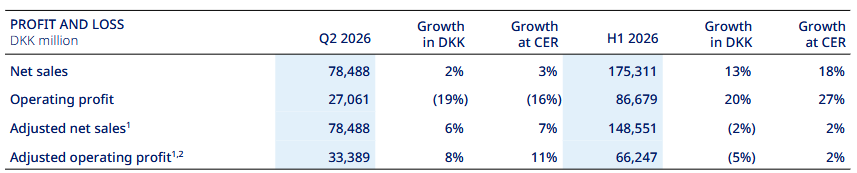
In the second quarter, sales of Wegovy injections were DKK 19.48 billion. Although sales in the US market were still growing, sales fell 22% year over year due to price factors; Ozempic's sales were 31.38 billion Danish kroner.
It is worth mentioning that the much-publicized sales volume of Wegovy's oral medicine in the second quarter was DKK 3.22 billion, slightly lower than the market's forecast of DKK 3.27 billion. At a time when Novo Nordisk is trying to take back the share of the obesity drug market from LLY.US (LLY.US), the rapid growth in the early days of Wegovy's oral drug marketing made investors expect it to lead to explosive growth. However, the latest results have raised market concerns about the company's long-term competitiveness.
Novo Nordisk CEO Mike Doustdar explained that the increase in demand for Wegovy's oral medications was offset by lower prices. He pointed out that since the launch of Wegovy oral medicine in January of this year, the total number of prescriptions has exceeded 5 million; as of July 17, the total number of prescriptions in the US for the entire week has exceeded 265,000. He also said that the next marketing market for Wegovy Oral Medicine will be Germany, the largest pharmaceutical market in Europe.
Mike Doustd said in a statement: “The Wegovy product portfolio remains Novo Nordisk's key growth driver in 2026. The rapid adoption of Wegovy's oral medication in the US market was a major driving factor. At the same time, early promotion performance in markets outside the US is encouraging. The launch of a high-dose version of Wegovy will further drive growth.”
But at the same time, Novo Nordisk warned that the US business would face a decline in sales. The company attributed this to a combination of factors, including a slowing trend in the prescription of GLP-1 injections, continued intensification of competition, narrowing Medicaid coverage for obesity, and lower actual sales prices in the US market — the latter partly due to the “most-favoured-nation” drug pricing agreement reached between the company and the Trump administration.
Looking ahead, Novo Nordisk raised its 2026 full-year performance forecast. Currently, adjusted sales and operating profit are expected to fall 6% to the same level at a fixed exchange rate, which is an improvement from the previous forecast of 4% to 12% for both indicators. Novo Nordisk said that the improved performance outlook is mainly due to increased sales growth expectations for GLP-1 products.
However, the market was not excited by Novo Nordisk's increase in its full-year results guidance. “Overall, there's nothing exciting,” Citibank analysts said. Jefferies said that after this increase in performance guidelines, there is little room for further increases in market consensus sales expectations. Jared Holz, a medical industry strategist at Mizuho Securities, said that this guidance increase “is clearly not exciting.” He pointed out that compared with market expectations, “Wegovy oral medicine lacks room to rise” is putting pressure on stock prices.
Novo Nordisk is competing fiercely with US competitor Eli Lilly for market share in diet pills. It is estimated that the obesity drug market will reach 120 billion US dollars per year by 2030. Eli Lilly took the lead in market share with Zepbound and Mounjaro injections. Novo Nordisk's launch of Wegovy oral medicine and higher dose injectable versions is seen as its core move to re-compete for market position.
One sign of growing competition between the two pharmaceutical giants is Novo Nord's lawsuit against Eli Lilly on July 21, accusing the US company of misleading advertising of its Zepbound and Mounjaro injectable drugs. Eli Lilly has denied the allegations.
With the exception of marketable weight loss drugs that are not as popular as Eli Lilly's similar products, Novo Nordisk's experimental drug Cagrisema failed to achieve the same blood sugar control effect as ZepBound in a large-scale trial. This is the second time this year that the new drug has failed to match Lilly's star products. Claus Henrik Johansen, CEO of Global Health Invest, wrote that this has once again become “a scratch on the CaGrisema case.”
In addition, Novo Nordisk also experienced major setbacks in the development of other drug pipelines. The company announced on Friday that its research on the cardiovascular disease drug ziltivekimab failed to reach a major end in a large-scale late-stage clinical trial and failed to prove that it could reduce the risk of patients experiencing major cardiovascular events. While this failure highlights Novo Nordisk's high dependence on the GLP-1 diet medicine business, it also increases uncertainty about future growth.