
- PRICING
- LIVE QUOTES
- LEARN
- HELP


EN
“Buyer mentality” joined the Ministry of Finance! Using the Euro, Bessent revealed his notepad to use hedge funds to restructure the US exchange rate intervention strategy
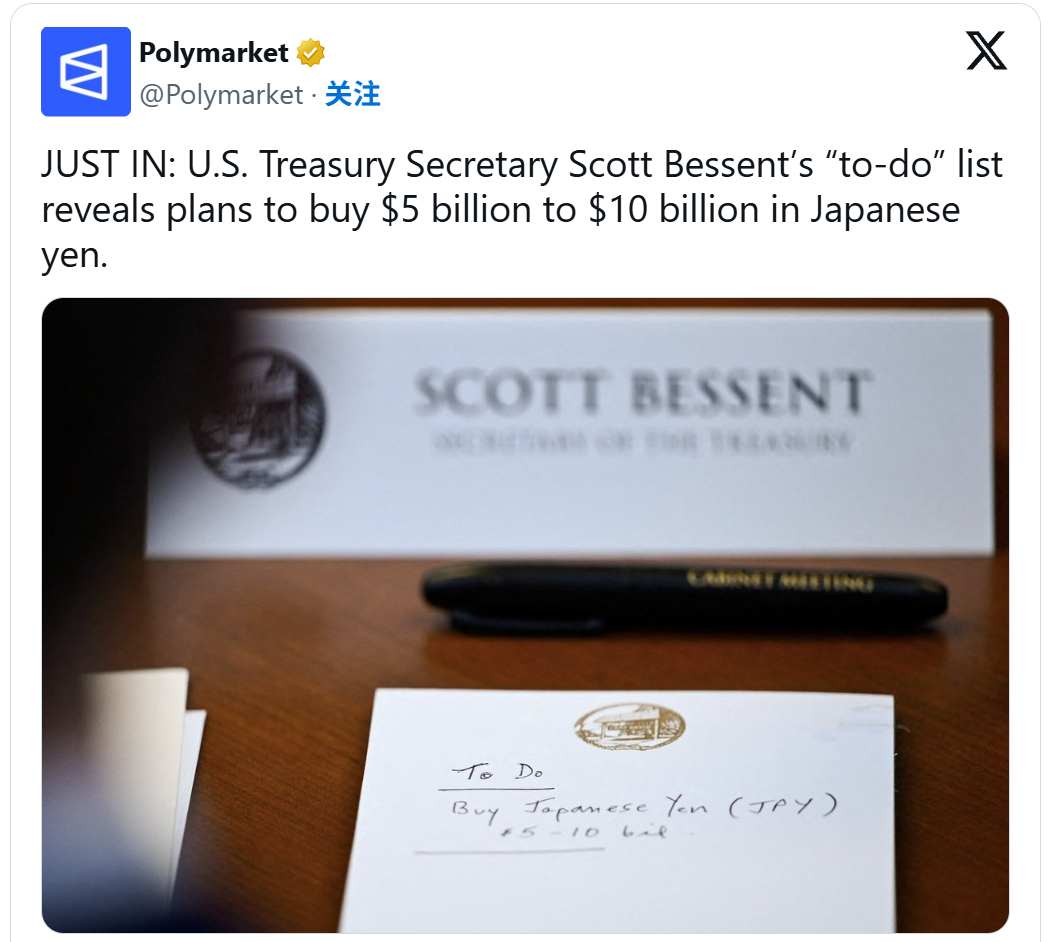
Bezent wants to help Japan raise its national currency. As a result, he decided to have the media “scan” his notepad, and one of his to-do items clearly read: buy up to 10 billion US dollars in yen.
The Zhitong Finance App noticed that this was an extraordinary strategy, but it has become Bezent's signature style. In his early career on Wall Street, he earned $1 billion by gambling on exchange rates while playing for George Soros. As Trump's Treasury Secretary, he launched a high-risk rescue plan for Argentina. Today, he's helping to save another American ally.
This is the first time in nearly 30 years that Washington and Tokyo have carried out a joint operation to boost the yen. In addition to the “notepad strategy,” Bezent also used various tools that surprised some Treasury observers, such as using the euro held by the US and promoting a Federal Reserve mechanism that Japan could use.
Stephen Milo, managing partner of Beacon Policy Advisors and a former Treasury official during the George W. Bush administration, said, “I think his way of thinking was more like: 'Well, if I were a trader, this would be a good approach, '” “He feels very comfortable with operating across borders because his boundaries are not traditional Treasury boundaries. What he values is market credibility.”
The initial results are encouraging, and the intervention helped the Japanese currency to bounce back from a four-decade low. However, as traders focused their attention on the continuation of this rebound, Bezent signaled on Tuesday that further action would be taken. He said that the weak yen has increased the risk of wider currency depreciation across Asia.
If these strategies presage a more proactive approach to economic diplomacy, this may be the result of the finance chief's professional background. Most recent finance ministers, such as Henry Paulson and Robert Rubin, former Goldman Sachs Group executives, have come from so-called financial sellers, where risk management is a core concern.
Bezent, who has spent decades as a hedge fund, is quite different.
Milo said, “We've never had a real buyer,” and “he acted more like a macro trader than a traditional finance minister.”
In a speech to the New York Economic Club in June, Bessent explained his philosophy of economic governance. In practice, part of this involves supporting countries that are willing to “cooperate” with Washington.
The US benefits
Commenting on the yen intervention on Sunday, Trump said the US would receive “economic benefits,” but did not specify what that would be. Bessent, on the other hand, expressed concern about the spillover effects of the Japanese market into the US Treasury bond market. Both also cited the importance of the US-Japan alliance.
In a post confirming a joint intervention to assist the yen on the X platform on Sunday, Bessent wrote, “The Trump administration is fulfilling its promises to America's trusted partners.” Prior to this intervention, he actually showed reporters his notepad at a cabinet meeting on Friday, which listed the purchase of yen as a “pending” matter.
Bessent told the media on Tuesday, “I just want to make sure that all the reporters who have crossed my shoulder are aware of the code name 'JPY' representing the Japanese yen.” He also confirmed that the US used the euro. Analysts suspected that the move was aimed at limiting the downward pressure on the US dollar.
Hedge fund traders enjoy the luxury of closing their positions immediately after a successful bet, which does not necessarily apply to the Minister of Finance. Last year's bet on Argentina paid off after President Javier Millay, Trump's ally, won a surprise victory in the legislative election.
Today, Bezent has tied some of its credibility to the yen, which until now has been extremely vulnerable to investors' concerns about Japan's fiscal policy and the slow pace of interest rate hikes by the Bank of Japan.
Chris Turner, head of global markets at ING (ING), said in connection with the Treasury's Exchange Stabilization Fund (ESF) mobilized by Bezent: “Looking at the events in Argentina and Japan, this shows that the Ministry of Finance is increasingly willing to use ESF to support broader economic and geopolitical goals.”
Turner said, “This marks a significant shift from the relatively passive state that has shaped US foreign exchange policy for most of the past 20 years.”
Bezent was able to gain strength and take risks within the Trump administration. Tuesday provided a potential example: Trump watched as Bezent presided over the swearing-in ceremony of new director of national intelligence Jay Clayton. On Wednesday, the treasurer is scheduled to visit Arizona with Speaker of the House Mike Johnson to promote the current administration's political achievements before the midterm elections.
Although Beisent and Howard Lutnick were previously rivals in the battle for the position of finance minister, according to sources familiar with the matter, after Lutnick failed to attend Friday's cabinet meeting, Basent briefed the Secretary of Commerce on the situation regarding US intervention in the yen discussions.
Bezent has made it clear that he sees a shadow of wider leverage in Argentina and Japan's bets. Taking Argentina as an example, he emphasized last year that Millet's victory in the election would help consolidate Latin America's trend of leaning towards center-right parties. In fact, conservative leaders subsequently won successive presidential elections in Colombia and Peru.
As for Japan, Basent said on Tuesday that the weak yen not only challenges the country's “problem” with inflation, but also challenges many other Asian currencies. “If the yen depreciates sharply, then other currencies will depreciate as well,” he said.
“Nihondori”
Bezent has extensive experience in Japan. He has visited the country more than 50 times, including three as Minister of Finance, and traveled back and forth every month in the early 2010s to better grasp the situation on the ground. His former boss, Soros, earned more than $1 billion by betting on a sharp fall in the yen when former Prime Minister Shinzo Abe implemented reforms aimed at reshaping inflation in the Japanese economy.
Beisent maintains a keen interest in Japan's economic affairs and maintains close coordination with his country's peers, including Finance Minister Katayama Satsuki and Bank of Japan Governor Ueda Kazuo. Beisent said the latter was his old friend for many years.
While working for Soros, Basent worked with famous hedge fund trader Stanley Druckenmiller, who later became a mentor to current Federal Reserve Chairman Kevin Walsh.
At the Senate confirmation hearing in April, Walsh endorsed the current administration's “Economic Governance Strategy Agenda,” but did not explain what role he anticipated the Federal Reserve would play at the time.
Bessent didn't reserve it that way. On Sunday and Tuesday, he once again highlighted a tool from the US Central Bank that could potentially help Japan intervene to support the yen without immediately selling off a significant portion of its treasury reserves of up to $1 trillion or more.
Bessent said that the Federal Reserve's “FIMA Repo Facility” (FIMA Repo Facility) “is a very powerful facility, and it was set up to deal with such situations.”