
- PRICING
- LIVE QUOTES
- LEARN
- HELP


EN
Wells Fargo: AI spending is “spilling over” to the real economy, industrial stocks are the biggest beneficiaries, but we need to be wary of political resistance
The Zhitong Finance App learned that Wells Fargo strategist Ohsung Kwon recently pointed out that tech giants' AI spending is “trickling out” to the wider real economy, and industrial stocks will be the main beneficiaries. This judgment is not an empty optimistic expectation — judging from the three dimensions of macroeconomic data, corporate financial reports, and policy games, the spillover effects of AI investment are actually occurring, but they are also facing increasingly severe political resistance.
The spillover effect is not a slogan: the data is being verified
Kwon's judgment is supported by solid data. According to Wells Fargo estimates, manufacturing activity expanded at the fastest rate in more than four years in July. Non-AI-related capital expenditure increased 10% year-on-year, and the growth rate of commercial and industrial loans also accelerated markedly. The industrial sector of the S&P 500 index has accumulated a total increase of 20% this year, second only to energy and information technology.
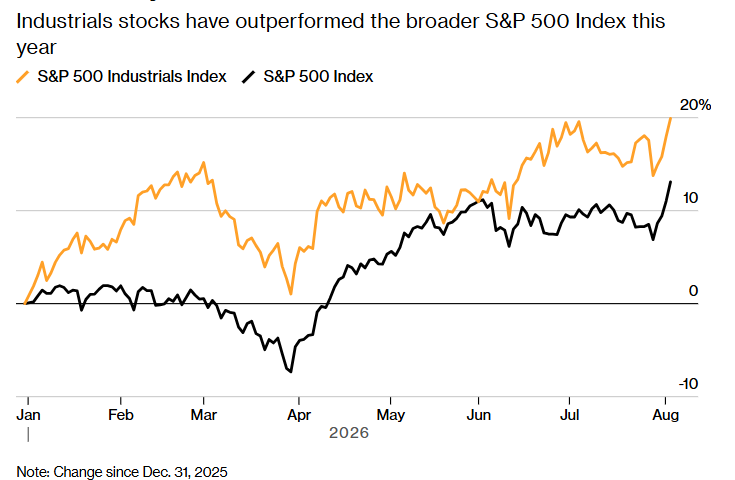
A broader perspective confirms this trend. According to ConstructConnect data, the initial spending for data center construction in the first five months of 2026 reached 58.1 billion US dollars, more than four times that of the same period in 2025; the initial expenditure for the first quarter was 46.5 billion US dollars, an increase of more than 500% over the previous year. The AI boom has completely transformed the US economy, and the capital expenditure of hyperscale cloud service providers reached about 750 billion US dollars this year. IDC expects global AI infrastructure spending to reach US$497 billion in 2026, an increase of approximately 56% over the previous year.
Who is benefiting? Order blowout from Caterpillar to Verti
Companies that “sell shovels” were the first to taste the sweet taste. Caterpillar announced earnings on Tuesday. Due to demand for power generation equipment and construction machinery driven by data center construction, revenue in a single quarter broke at $20 billion for the first time, an increase of 24% over the previous year, and sales in the construction industry sector surged 35%. The company immediately raised its annual revenue growth guidelines.
Data center infrastructure vendors are also benefiting. Vertiv's backlog of orders surpassed $15 billion, and fourth-quarter orders increased 252% year over year; Eaton (Eaton) Electric's data center revenue in the first quarter increased by about 50% year over year. Wells Fargo itself estimates that the capital expenditure of hyperscale cloud service providers will reach $1.1 trillion by 2027, which is about 25% higher than market consensus. Kwon estimates that around 40 very large data centers are currently under construction across the US, with more than 100 being planned, concentrated in Texas, Georgia, Virginia, and Pennsylvania.
Concern: Political resistance is becoming the biggest variable
However, Kwon clearly warned: “The biggest risk in data center construction is a political backlash, especially as the midterm elections approach.”
This risk is rapidly becoming apparent. According to a Gallup survey, 71% of Americans oppose building AI data centers in their region; 77% are concerned that AI will push up electricity prices. In July of this year, opponents launched 142 protests in 42 states across the US. In just one quarter, local groups have blocked or delayed 75 projects involving around $130 billion in investment.
Pressure is greater at the policy level. New York State signed a one-year moratorium on the nation's first large-scale AI data center in July; gubernatorial candidates from at least 12 states in the US expressed support for suspending data center construction in the midterm elections. Tax benefits are also rapidly fading away — four states have already lifted or suspended data center tax benefits, and another Kyushu is studying it. Based on 7% sales tax, the procurement cost of single-seat 1GW data center equipment will increase by about 3 billion US dollars.
Although the Trump administration introduced the “Electricity Bill Payer Protection Pledge,” inviting tech giants to sign and not pass on the cost of grid upgrades to residents, the promise is not binding, and it is still unknown whether it can mitigate the backlash in public opinion.
Wells Fargo's judgment reveals an unfolding fact: the dividends of AI spending are spreading outward from semiconductor and cloud service providers, injecting growth momentum into the traditional industrial sector. But the sustainability of this narrative increasingly depends not on technology or capital, but on politics — how the November midterm elections reshape the data center regulatory landscape will be a key variable in determining how far the “trickle down effect” can go. As Kwon said, we're probably still “in the very, very early stages” — but the early stages are also often the most variable stages.