
- PRICING
- LIVE QUOTES
- LEARN
- HELP


EN
A $1.4 Billion Reason GameStop Stock Is Down Today
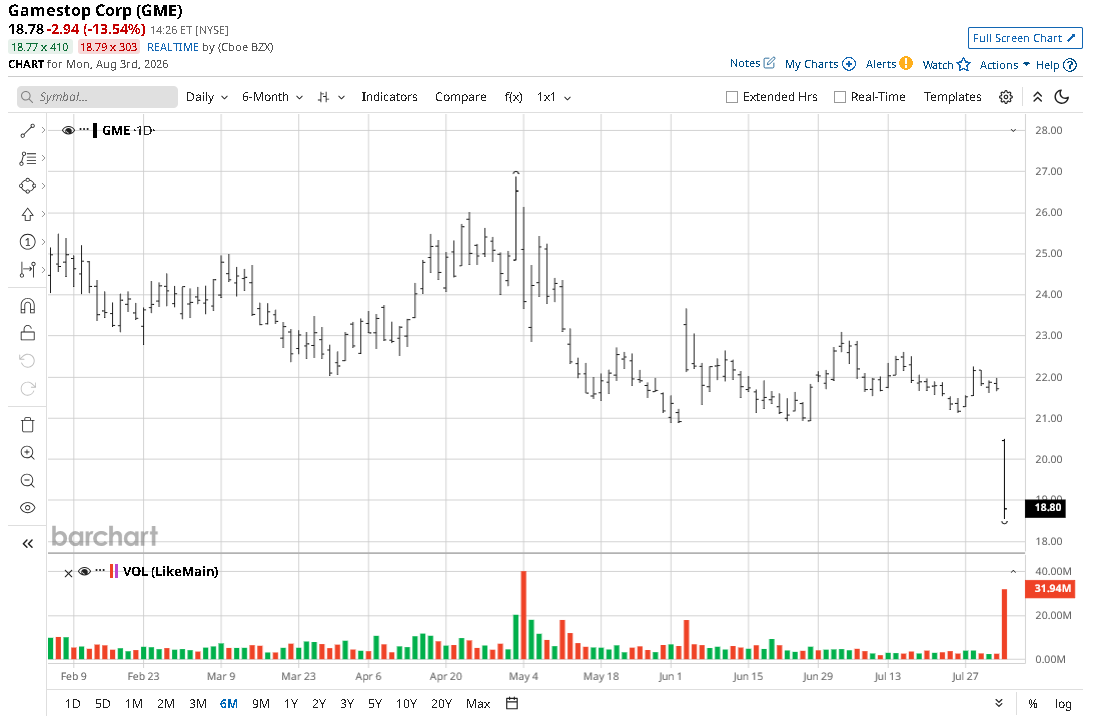
GameStop (GME) stock is under immense pressure on Monday after the company entered private agreements to exchange $1.4 billion of zero-coupon convertible senior notes due in 2030 and 2032 for its Class A shares.
Because no cash will be raised, investors are bailing on GME mostly due to dilution concerns. The stock crashed through its 20-day moving average (MA) today, indicating the bearish momentum could sustain in the near term.
GameStop shares have been a major disappointment for shareholders in recent months, currently down nearly 30% versus its May high.
Why GameStop Stock Slipped on the Announcement
Management is opting for the said debt-for-equity swap because it will enable the company to cut a substantial portion of its outstanding long-term liabilities without spending cash.
However, executing this corporate maneuver will see GME issue a massive block of new common stock to noteholders based on a 35-day volume-weighted average price calculation.
For existing shareholders, this signals significant dilution risk for the near term, especially since participating noteholders are expected to hedge or unwind their positions through open-market sales or derivative transactions.
Note that Barchart holds an “88% SELL” opinion on GME stock, suggesting technical momentum also currently favors continued downside ahead.
Should You Buy the Dip in GME Shares Today?
Beyond near-term dilution, GameStop shares continue to struggle with a reliable fundamental case.
The firm’s core video game business remains under relentless pressure amid a shift toward digital downloads and subscription platforms.
While management has eliminated long-term debt and tried various strategic pivots, including cost cuts and store optimization efforts to stabilize operations, recurring sales growth from traditional brick-and-mortar stores continues to erode.
Additionally, the company’s Bitcoin (BTCUSD) treasury strategy has not been a savior either, as the largest crypto continues to fail at sustainably breaking above the $70,000 level.
GameStop Doesn’t Receive Wall Street Coverage
Another major red flag for GME stock is the absence of Wall Street coverage.
This means investors are on their own in valuing the company, evaluating its prospects, and making an investment decision.
On the date of publication, Wajeeh Khan did not have (either directly or indirectly) positions in any of the securities mentioned in this article. All information and data in this article is solely for informational purposes. For more information please view the Barchart Disclosure Policy here.