
- PRICING
- LIVE QUOTES
- LEARN
- HELP


EN
Counterpoint: Q2 global smartphone revenue increased 7% year over year, Apple (AAPL.US)'s revenue share reached a record high
The Zhitong Finance App learned that Counterpoint Research published an article stating that global smartphone revenue increased 7% year-on-year in the second quarter of 2026, driven by continued price increases from OEMs and the increase in the share of high-end models. Driven by strong demand for high-end models and general price increases from OEMs, the average smartphone sales price (ASP) increased 17% year over year in the second quarter of 2026. Among major brands, Apple (AAPL.US) had the fastest revenue growth rate, up 22% year over year, setting the highest second-quarter revenue record in history; it achieved this performance despite strong demand and no price increase strategy. Samsung ranked second in the world in the second quarter of 2026 with a 16% revenue share. Driven by strong growth in the North American (NAM) and Middle East and Africa (MEA) markets, its revenue increased 9% year over year.
According to Counterpoint Research's latest market monitoring report, global smartphone market revenue increased 7% year-on-year in the second quarter of 2026, reaching a record $109 billion. Despite a decline in global smartphone shipments during the same period, market revenue still hit a record high in the second quarter. The divergence between revenue and shipment volume is mainly due to an increase in average selling price (ASP). Supported by the continued shift of consumers to the high-end market segment, ASP grew 17% year over year to reach a record high of $400 in the second quarter. In addition, rising storage costs are driving Android OEMs to generally increase product prices, which is also one of the reasons for the growth of ASP.
Shilpi Jain, senior analyst at Counterpoint Research, said, “The global smartphone market has entered a new phase. Shipments are no longer the main driver of growth. Value growth has become the core of market growth, and rising component costs have further accelerated this trend. As the entry-level market shrinks and faces cost pressure, most OEMs are gradually moving away from sales-oriented strategies, passing on higher bill of materials (BOM) costs to consumers, while actively promoting sales of products with higher storage and higher configuration, and focusing on high-end market segments. OEMs are also expanding product accessibility through installment payments and trade-in offers, particularly in emerging markets, to lower the threshold for consumers to buy high-end devices.”
Global smartphone market by revenue share, average sales price, and shipment share, second quarter 2026
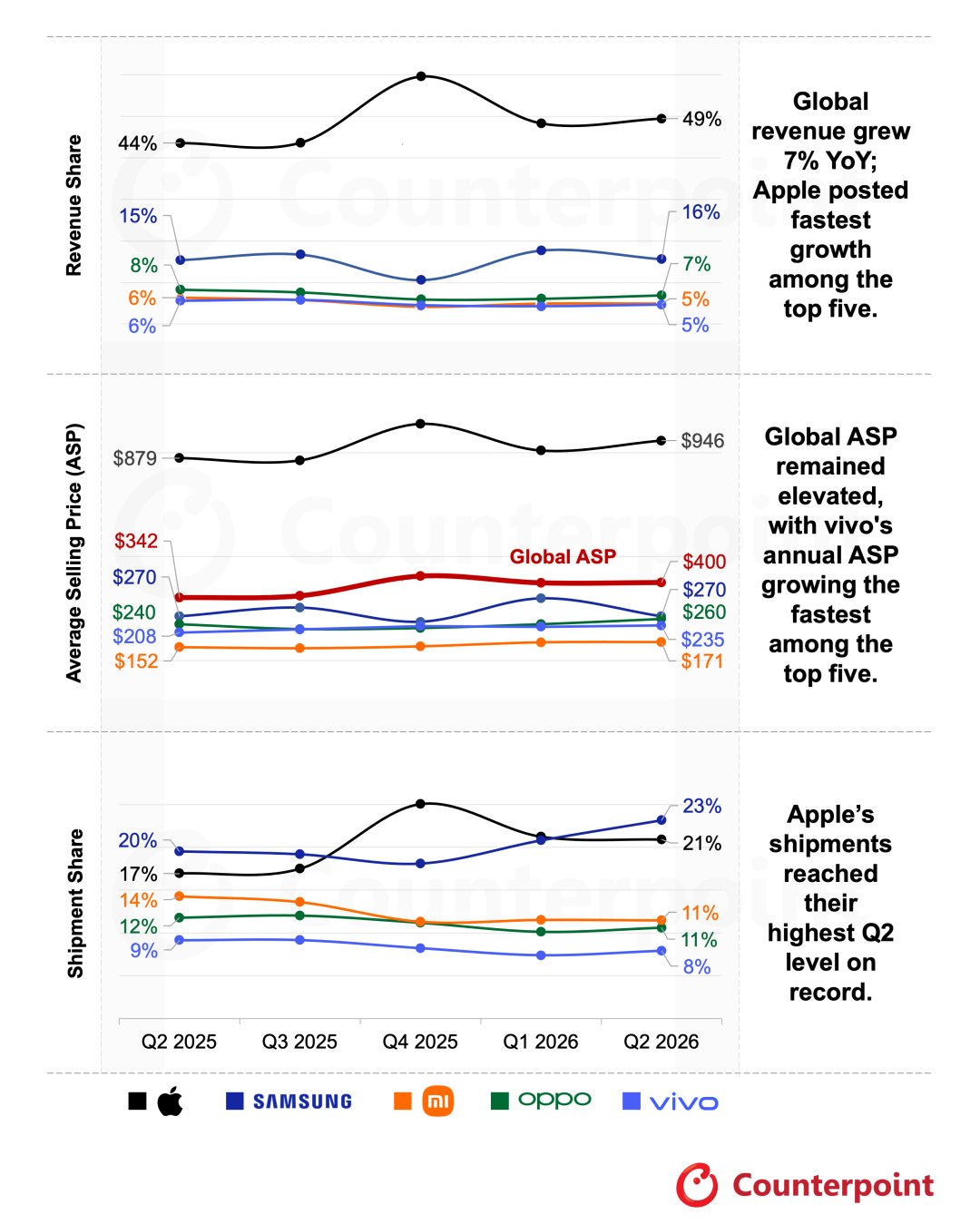
Source: Counterpoint Research Market Monitoring Service Preliminary Data
* OPPO data for all quarters includes OnePlus and Realme. ASP (average selling price) is calculated based on wholesale prices.
In the second quarter of 2026, Apple's revenue share reached 49%, the highest in history for the second quarter. The brand's quarterly revenue increased 22% year over year, mainly due to a 13% year-over-year increase in shipment volume and an 8% year-over-year increase in ASP.
Referring to Apple's market performance, Counterpoint Research Director Tarun Pathak said, “Apple's growth is mainly due to continued strong market demand for the iPhone 17 series, particularly the basic iPhone 17 and iPhone 17 Pro Max, which further tilts the brand's product portfolio towards the high-end. Unlike most competitors, Apple has maintained a relatively stable price as a whole, which shows that it can absorb rising BOM costs and maintain a strong cost tolerance in the current environment where storage supply is tight. However, Apple is likely to increase product prices in the next few quarters. This strategic restraint has enhanced Apple's competitive advantage, enabling it to achieve double growth in revenue and shipment volume against the backdrop of an overall market decline. From a regional perspective, China, Europe and emerging markets have performed well, because in the context of general price increases for Android phones, Apple's stable pricing has further enhanced the cost performance advantage of its products.”
Samsung ranked second in the market, accounting for 16% of revenue share in the second quarter of 2026, benefiting from strong growth in revenue and shipments. Both increased 9% year over year, while ASP remained stable. Stable demand for the Galaxy A series supported the increase in shipments, while the continued strong momentum of the Galaxy S26 series strengthened the brand's performance in the high-end market. In terms of the regional market, growth was mainly led by a sharp increase in shipments from the Middle East and Africa, as well as double-digit growth in North America, which helped Samsung achieve a double increase in revenue and shipments this quarter. Furthermore, Samsung's vertical integration capabilities and greater ability to control the parts supply chain have also helped it control rising investment costs and maintain competitive pricing. Despite selective price increases in its product portfolio, it has maintained the stability of ASP.
Since entry-level and mid-range products account for a relatively high share, Xiaomi is more clearly affected by this round of rising storage costs. Cost-driven product price increases have led to a faster decline in demand than the benefits brought by ASP increases. In response, Xiaomi is improving the overall product structure by increasing product prices, streamlining the product portfolio, paying more attention to profitability rather than market size, and continuing to increase the layout of high-end and mid-to-high-end products.
OPPO and vivo's revenue decreased by 10% and 11%, respectively. Although ASP increased by 9% and 13%, respectively, Vivo became the fastest growing ASP manufacturer among the top five global brands. Due to the relatively high share of the two manufacturers in the price-sensitive market and a marked decline in shipments at the same time, the benefits brought about by product price increases have been offset to a certain extent. Despite declining shipments, OPPO and vivo's ASP continued to grow, benefiting from weak demand for entry-level products, increased overall product prices, and continuous product portfolio optimization, driving their sales structure towards high-value models.
Looking ahead, as storage supply is tight and cost increases are difficult to mitigate in the short term, it is expected that OEMs will continue to raise prices and further optimize product portfolios to increase the proportion of high-value products. Supply is gradually becoming a key factor limiting the development of the industry, and the smartphone industry is likely to face a more severe decline in shipments in the second half of 2026. As a result, it is expected that ASP will continue to rise in the next few quarters.