
- PRICING
- LIVE QUOTES
- LEARN
- HELP


EN
Trade credit doubts collided with black demand cooling down! Iron ore fell below $95 and fell below the “bottom of trust” in a year
The Zhitong Finance App learned that iron ore prices fell to their lowest level in more than a year due to severe market concerns about a major iron ore physical trader and the further intensification of existing market weakness caused by severe demand prospects. The latest price and industry data, such as iron ore and rebar, all point to weakening demand for black commodities and a downward shift in the price center. Black products are currently closer to the demand-led downturn and bottoming out phase. In the short term, if Asia introduces infrastructure, real estate, or equipment renewal incentives, compounded by easing trade credit events, prices may rebound technologically.
The Singapore Futures Exchange price of iron ore, a raw material for steelmaking, once fell 1.9% to 94.10 US dollars per ton, the lowest intraday level since early July 2025. On China's Dalian Commodity Exchange, the most actively traded contracts fell by nearly 3%.
Some media reported on Friday that commodity trading giants Victoria Group and Cargill have stopped commodity trading business with private company Radiant World due to concerns about false invoices. Additionally, Italy's Bank of San Paolo and Wall Street financial giant Jefferies Financial Group's Point Bonita Fund are reviewing risk exposure to the company's business. Radiant World, which has developed into one of the major players in this market in recent years, said these situations were “completely untrue.”
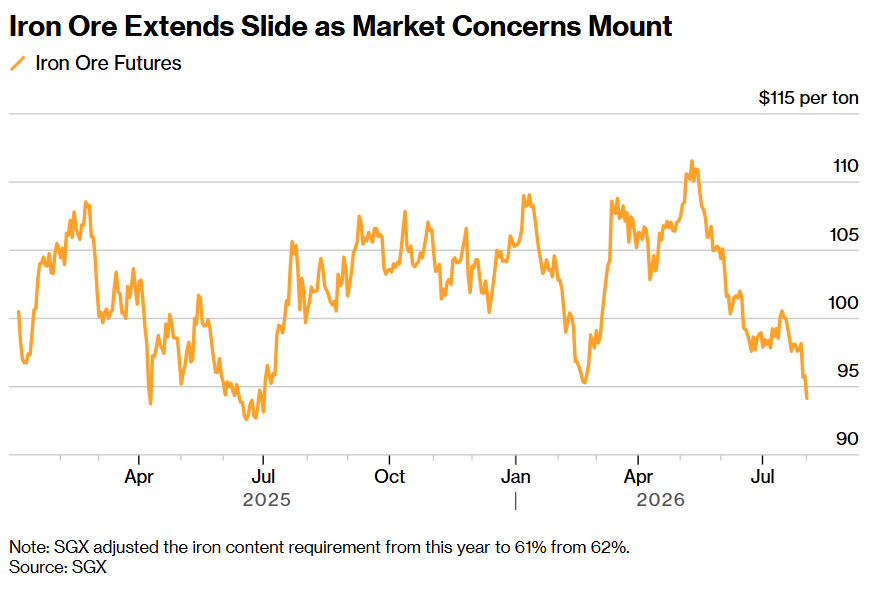
As shown in the chart above, market concerns are heating up, and iron ore continues to decline. Note: The Singapore Futures Exchange adjusted the iron content requirement for iron ore from 62% to 61% starting this year.
Black commodities such as iron ore were already under pressure due to market concerns about deteriorating fundamentals in the steel industry. Last week, the profit margins of Chinese steel mills weakened further, while blast furnace iron and water production declined for the fourth week in a row. In Asia's largest economy, commercial construction activity has fallen to its lowest level since the COVID-19 outbreak, while factory activity contracted for the first time in five months in July.
The production of molten iron is the most important high-frequency indicator of the actual demand for iron ore and coke in blast furnaces. Its continued decline means that steel mills are controlling losses through maintenance, reduced utilization of blast furnaces, and reduced procurement of raw materials. The typical black negative feedback chain is as follows: construction and manufacturing demand cools down — steel prices fall — steel mill profits shrink — blast furnace production cuts, iron water falls — demand for iron ore and coke decreases — raw material prices continue to fall.
Horizon Insights analyst Bancy Bai said that after media reports on Radiant World are released, traders may be closely wary of any negative significant changes in ferrous metal liquidity. “Up to now, no significant abnormalities have been observed in the spot market,” she said.
At 10:41 a.m. local time, Singapore's benchmark iron ore futures with 61% iron content fell 1.6% to $94.35 per ton. Previously, the futures had been falling for three consecutive months, the longest continuous monthly decline in more than a year. Steel futures contracts denominated in RMB have also declined in the Shanghai market.
Black commodities are experiencing a round of negative feedback driven by shrinking terminal demand, deteriorating steel mill profits, and loose raw material supply. The Radiant World trade credit incident was only a liquidity shock that accelerated the decline; it was not the root cause. The weakness of iron ore and construction steel is most obvious, while coking coal and coke may briefly reverse the trend due to mine safety inspections, import disturbances, or phased inventory replenishment.
While iron ore supply is growing faster than steel demand, the supply side of black commodities seems to continue to increase. Global iron ore supply is expected to increase by about 2.5% in 2026. New low-cost production capacity such as Simandou in Guinea is gradually entering the market, and Australian miners have not significantly cut long-term shipping plans. A downward shift in the demand center and an increase in shipping supply will make it easier for iron ore to shift from a “tight balance” to a “continuous surplus.”
Currently, the core of the weak black series is not a single macro data, but three important cycles are simultaneously downward: the demand cycle is downward, the steel mill profit cycle is downward, and the black inventory and supply cycle is downward.
The Radiant World incident affected spot trade credit, financing, and liquidity. Vittoria and Cargill stop trading with them, and Glennon can suspend new business. Italy's Bank of San Paolo and Jefferies funds review related exposures, which will enable banks, traders, and shippers to increase margins, reduce credit, and reduce inventory risk. Commodity trade is highly dependent on letters of credit, invoice financing, and inventory pledges. Once the market doubts the authenticity of transaction documents, some participants will sell spot or futures to reduce risk, thereby amplifying the decline in iron ore in the short term. Radiant World denied the allegations.
But if steel mill profits, iron production, and construction demand are already strong, a trader's credit concerns usually only cause brief fluctuations. Prices fell to a one-year low because the credit incident happened against the backdrop of weak demand, high inventories, and increased supply, and the two pressures were mutually reinforcing.