
- PRICING
- LIVE QUOTES
- LEARN
- HELP


EN
International oil prices are skyrocketing! Trump halts attacks on Iran and starts negotiations OPEC+ announcement to increase production fueling the situation
The Zhitong Finance App learned that international oil prices dived sharply in early Asian trading on Monday. Earlier, US President Trump announced the cancellation of a large-scale military attack on Iran and said that negotiations aimed at reopening the Strait of Hormuz will soon resume. Meanwhile, OPEC+ approved a slight increase in production of about 188,000 b/d starting in September, officially completing a round of gradual retracement of voluntary production cuts since last year. Under the dual expectations of geographical easing and supply-side normalization, market panic suddenly cooled down.
At the beginning of the Asian trading session, the Brent crude oil contract fell by up to 7.3% in October, and WTI fell as low as below $79, then the decline narrowed. European gas prices also fell 6.3% at one point. Last month, due to the sharp escalation of the Middle East conflict, Brent oil prices experienced a huge shock in the broad range of about 32 US dollars. The cumulative increase for the whole month was nearly a quarter, the biggest monthly increase since March.
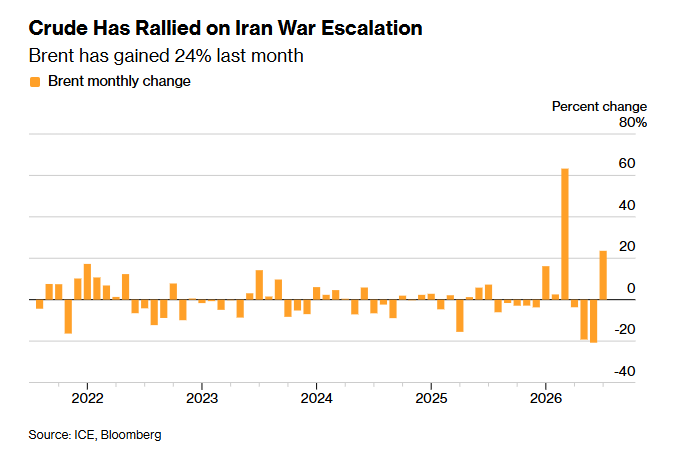
Trump said on Sunday that after Middle Eastern allies, including Saudi Arabia, requested an agreement to seek an agreement, he had agreed to cancel the attack plan against Iran “provided an agreement can be reached quickly” to reopen the Strait of Hormuz as soon as possible. He also added that new negotiations between the US and Iran will begin on Monday.
Iranian Foreign Minister Abbas Alagzi revealed on social media on the same day that negotiations between Iran and Oman have reached the final stage, and the two countries are discussing a new route through the strait. However, Iran's official television station quoted a department spokesperson as saying that the relevant discussions did not involve the opening or closing of the waterway itself.
Since the US and Israel launched an attack on Iran at the end of February this year, the conflict, which has continued for more than five months, has caused a large number of oil tankers to be trapped in the Persian Gulf, and transportation of crude oil and liquefied natural gas through the Strait of Hormuz has been interrupted several times, pushing international oil prices to break through $100 per barrel several times in spring. High oil prices have rapidly penetrated into the field of refined oil products. Prices of gasoline, aviation coal, and diesel have risen in many parts of the world, the fuel burden on car owners has increased, air ticket prices have risen, and fuel supply is even tight in some countries, causing limited allocations and temporary closure of schools and government agencies. Refiners and oil and gas producers, on the other hand, enjoyed the dividends of high oil prices and recorded huge profits in the spring.
Despite the early dawn of peace talks, the risk of navigation in the Strait of Hormuz has not dissipated. The British Maritime Trade Action Office reported on Sunday that an oil tanker near Oman was bombed at close range. In addition, a liquefied natural gas ship was hit by flying objects last week, showing that this main channel, which normally carries about one-fifth of the world's crude oil and liquefied natural gas, is still full of variables.
Meanwhile, Gulf oil producers are actively seeking alternative export channels. Iraq's Ministry of Petroleum said that Turkey and Iraq have agreed to extend an expired oil pipeline agreement for one year, which can export up to 750,000 barrels of crude oil per day. On the Kazakh side, the country's Ministry of Energy announced that the Caspian Sea Pipeline Union has resumed normal operation since August 1, and the daily intake of crude oil has remained at 100,000 tons. The impact of the previous temporary suspension has gradually subsided. However, the actual pace of exports still depends on whether tankers dare to sail into the waters of facilities related to the Black Sea where there is a risk of attack. A series of previous attacks on tankers loaded nearby have seriously disrupted this key Kazakh crude oil export channel.
On the supply side, another OPEC+ decision on Sunday also affected market nerves. Core member states Saudi Arabia, Russia, Iraq, Kuwait, Algeria, Kazakhstan, and Oman approved production quotas of nearly 188,000 b/d in September, which means that the 1.65 million b/d voluntary production reduction plan initially agreed in 2023 has completed a gradual rollback. Since the UAE withdrew from OPEC in May, this adjustment was only made jointly by the seven countries mentioned above. Due to the interruption of exports to the Persian Gulf due to the war in Iran and the restrictions on exports from Russia and Kazakhstan due to the Russian-Ukrainian conflict, most of the nominal increases in production over the past few months have remained on paper, and the impact on actual supply is limited.
The statement after the OPEC+ meeting did not provide clear guidance on the production policy for the fourth quarter of this year, and the market generally expects that the pause button may be pressed in the future.
Jorge Leon, analyst at energy consulting agency Rystad, believes that OPEC+ has completed a reversal of voluntary production cuts, and the next challenge is the oversupply that may occur after export flows are normalized. “After the recovery operation is complete, there is little reason for OPEC+ to push for a one-step supply adjustment. Our basic judgment is to suspend production increases in the fourth quarter while preparing for 2027 production quota negotiations.”
Currently, the alliance still has a layer of measures to reduce production by about 2 million b/d, which will be implemented from 2022, involving most member countries. This part will be implemented at least until the end of this year. OPEC+ is re-examining the production capacity of member countries as a basis for setting production baselines and quotas for 2027. Some countries, such as Iraq, have indicated that they want higher individual quotas to match their actual production capacity, and negotiations on new quotas are expected to be particularly difficult. The next Core 7 meeting is scheduled to be held on September 6.