
- PRICING
- LIVE QUOTES
- LEARN
- HELP


EN
Reshape the global pharmaceutical industry landscape! AstraZeneca (AZN.US) plans to buy Bristol-Myers Squibb (BMY.US), or create the largest pharmaceutical merger and acquisition in history
The Zhitong Finance App learned that, according to people familiar with the matter, AstraZeneca (AZN.US) has begun discussions on the acquisition of BMY.US (BMY.US). If this super deal is reached, it will create one of the largest pharmaceutical companies in the world.
The person familiar with the matter mentioned above added that the two companies have already held early-stage negotiations on the merger and are unwilling to be named because the matter has not yet been disclosed.
These people familiar with the matter warned that it is still unclear whether negotiations will continue, and it is uncertain whether they will turn into an actual deal.
With a market capitalization of $133.4 billion, Bristol-Myers Squibb can provide AstraZeneca with a larger foothold in the US market. AstraZeneca's market capitalization is around £195.9 billion ($264.4 billion).
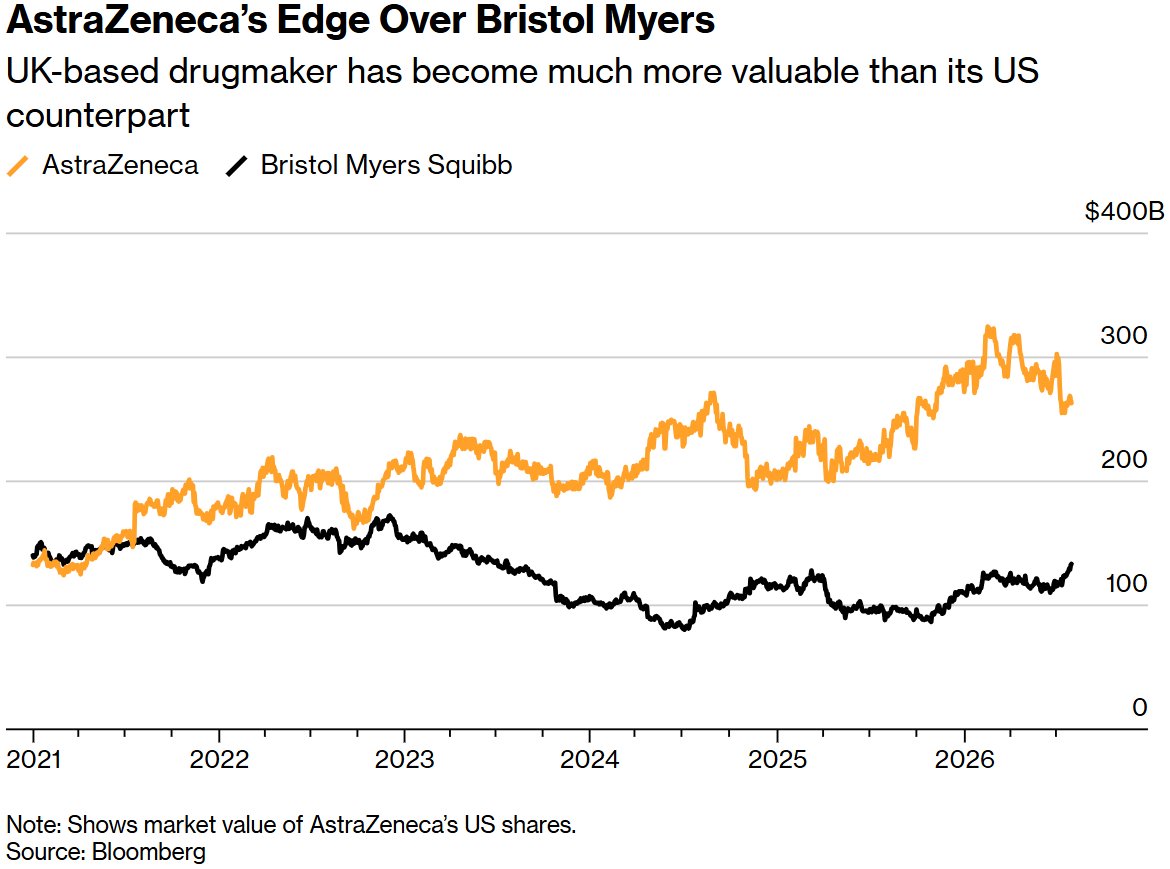
AstraZeneca's market capitalization exceeds Bristol-Myers Squibb
Bristol-Myers Squibb is preparing to face the expiration of patent protection for some of its most core products, including the anticoagulant drug Eliquis (Eliquis) and the cancer drug Opdivo (Opdivo). Together, the two products account for about half of Bristol-Myers Squibb's sales.
Last week, Bristol-Myers Squibb reported quarterly sales of $13 billion, the highest in history. The increase was mainly due to newer products — hematologic tumor therapy Breyanzi, skin cancer drug Opdualag, and heart disease drug Camzyos.
Under the leadership of CEO Pascal Solliot, AstraZeneca has become a giant in the field of cancer medicine with a series of blockbuster drugs. Soon after Solliot took over as CEO in 2012, it repulsed a takeover attempt by Pfizer, which prompted the UK government to step in due to concerns about losing a key British company.
AstraZeneca is currently the second-largest company by market capitalization on the London Stock Exchange. The company is increasingly leaning towards the US. Last year, it upgraded its US stock listing from NASDAQ's American Depositary Receipt (ADR) to the New York Stock Exchange, while retaining its headquarters and main listing position in London.
The pharmaceutical company is moving towards an ambitious goal of $80 billion in sales by 2030 and hopes to enter the lucrative weight loss market with a variety of drugs under development.
Solliot previously told the media that when someone pitches disease programs outside of the company's core area to him, “I always say no, because once you go beyond your field of expertise, the risk of making a wrong bet quickly rises.”
A Mizuho analyst believes that investors may object to the merger scenario because AstraZeneca's earnings per share are expected to grow by 10% or more over the next five years, while Bristol-Myers Squibb's earnings per share may decline for the rest of the decade.
“Investors would argue that AstraZeneca doesn't need Bristol-Myers Squibb; the opposite is true; unless there is a large-scale transaction synergy that can offset the decline in revenue/profit, this merger will hardly hold up,” Mizuho healthcare industry expert Jared Holtz wrote in a Sunday report.
However, Holtz said that his first reaction was, “If there was a time in history suitable for this kind of deal, then it is probably now,” he cited the Trump administration's rather relaxed stance on mergers and acquisitions as a basis.
If the deal is reached, it will become the largest pharmaceutical deal in history, surpassing Bristol-Myers Squibb's 2019 deal to acquire Celgene (Celgene) for $74 billion.