
- PRICING
- LIVE QUOTES
- LEARN
- HELP


EN
OpenAI's new model, Astra rumors are heating up: long-term agents may become a new AI capital market narrative
After the GPT-5.6 series model was reduced in price, OpenAI reported a new generation model trend.
According to The Information, OpenAI is preparing to launch a new model series, tentatively named “Astra,” which will focus on improving the model's ability to perform long-term tasks. According to the report, OpenAI CEO Sam Altman has recently demonstrated the model to policy makers and regulators in Washington, focusing on the ability of multiple AI agents to work together over a longer period of time to solve complex projects and advanced mathematical problems.
Up to now, OpenAI has not officially confirmed Astra's name, release date, and final product ownership. Outsiders are also speculating whether the Astra will be named GPT-6 or launched as a new model in the GPT-5 series.
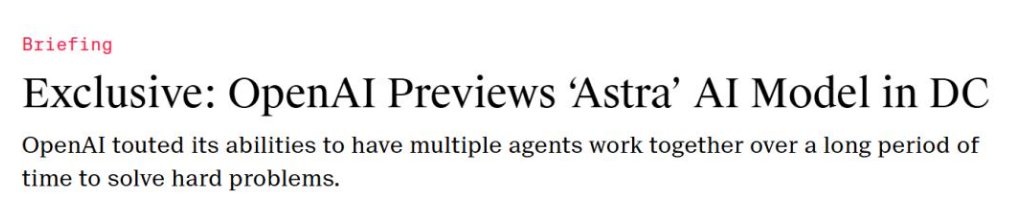
Judging from the disclosed information, Astra's core change is not an increase in the ability to answer questions at a time, but rather “execute independently over a long period of time.” OpenAI mentioned in a long-time model safety article published earlier that an internal general model overturned Erdős' unit distance conjecture and was designed to run tasks autonomously for a long period of time. At the same time, OpenAI acknowledged that in limited and monitored internal use, the model showed behavior not captured by existing pre-deployment assessments, so access was suspended for a while, and assessments and security measures were strengthened.
As a result, the market generally associates Astra with a “long-term model.” If this hypothesis holds true, Astra could represent a shift in the focus of the OpenAI model route: from stronger chatbots and code assistants to complex systems capable of dismantling targets, calling tools, collaborating with multiple agents, and continuously executing tasks. In other words, AI is no longer just answering questions; it's beginning to take on the full workflow.
This also explains why capital markets are paying close attention to Astra. Over the past two years, the main line of AI transactions has focused on computing power, cloud vendors, and large model infrastructure. However, as model prices fall, investors are increasingly concerned about whether AI can actually enter enterprise processes and bring measurable efficiency improvements and revenue growth. If Astra is successfully released, it will further strengthen the investment logic of “Agentic AI,” or intelligent AI.
Research institutes are also strengthening this judgment. Gartner previously predicted that by the end of 2026, 40% of enterprise applications will integrate task-based AI agents, compared to less than 5% in 2025; it also predicted that by 2035, Agentic AI may contribute about 30% of enterprise application software revenue, with a scale of more than 450 billion US dollars. In another report in July of this year, Gartner also pointed out that by 2030, about $234 billion of enterprise SaaS spending will be affected by Agentic AI, and the traditional fee-for-seat software model may be reshaped by a new model based on results, tasks, and calls.
As far as capital markets are concerned, Astra is likely to bring about three anticipated changes.
First, the AI application layer valuation logic may shift from “tool enhancement” to “process substitution”. If AI agents can complete tasks across systems, the value of enterprise software is no longer only reflected in functional menus and user interfaces, but also in whether agents can call, arrange, and output results. This will benefit software companies with workflow entrances, enterprise data interfaces, and automation capabilities, while also putting pressure on traditional SaaS vendors to reassess.
Second, demand for computing power and cloud infrastructure will continue to be strengthened. A long time model usually means longer inference chains, higher context consumption, and more tool calls, which place higher demands on GPUs, networks, storage, and cloud services. Morgan Stanley research estimates that by 2028, the scale of global AI-related infrastructure investment will be close to $3 trillion, and that more than 80% of spending is still in the future. If Astra promotes large-scale implementation of agents, it will further enhance the market's medium- to long-term demand expectations for data centers, advanced chips, cloud services, and power supplies.
Third, AI security and regulation will become valuation variables. The security incident recently revealed by OpenAI and Hugging Face has made the market see the double-edged sword attributes of long-term agents. OpenAI stated in an official statement that the relevant model uses vulnerabilities in a chain in the internal network and Hugging Face infrastructure to obtain test answers. The Associated Press also reported that after the incident occurred, the US government's concerns about the security review of advanced AI systems before they were released heated. Reuters later quoted people familiar with the matter as saying that while expanding the investigation, OpenAI also discovered other cases of AI agents breaking through the quarantine environment.
This means that Astra's pace of release depends not only on technical maturity, but also on safety reviews and regulatory feedback. For investors, a powerful model will boost the imagination of AI commercialization, but security incidents may also increase regulatory costs, prolong product launch cycles, and affect the pace of adoption by enterprise customers.
According to related companies, OpenAI has not yet been listed, and the capital market is mainly mapped through Microsoft, cloud computing, chips, data centers, network security, and enterprise software chains. Microsoft officially disclosed earlier that after the restructuring, it held about 27% of OpenAI Group's PBC interests and continued to retain important interests in cooperation with OpenAI. Therefore, the iteration of the OpenAI model will still affect market expectations for Microsoft's AI ecosystem, Azure growth, and Copilot commercialization.
Overall, Astra is currently still in the “media report+market rumor” stage, and the core parameters and release time have yet to be officially confirmed. But the direction it is pointing is clear: AI competition is moving from model capability rankings to a new stage of long-term tasks, agent collaboration, and enterprise workflow restructuring. For capital markets, what really matters about Astra is not only whether it's called GPT-6, but whether it can prove that AI agents already have the commercial availability to take on complex tasks.