
- PRICING
- LIVE QUOTES
- LEARN
- HELP


EN
Record-breaking gamble! SpaceX (SPCX.US) bear bets soar to $24.6 billion, the first earnings report and the “double heist” of the 100 billion ban will strike next week
The Zhitong Finance App learned that on the eve of the release of the first earnings report after the launch of SpaceX (SPCX.US) and the upcoming lifting of the largest restricted share ban in history, Wall Street bears are pouring into Musk's most high-profile listed company at an unprecedented rate. According to the latest data from S3 Partners, as of July 29, SpaceX short positions had soared to 219.3 million shares, accounting for about 34% of publicly traded shares, with a nominal value of 24.6 billion US dollars. This size has surpassed Tesla's short position, making SpaceX one of the most heavily shorted large companies in the US market.
Short positions surged nearly tenfold in more than a month from 23.3 million shares at the beginning of the IPO. What is behind this is a triple game surrounding financial data, the lifting of the flood peak, and the valuation bubble. Sam Pierson, head of research at S3, said bluntly: “The biggest bet right now is to lift the ban on restricted stocks — the market believes there will be no news in the financial report that will offset the influx of unbanned stocks into the market.”
The core logic of the bears: betting on 100 billion dollars to lift the ban “flood” to knock down valuations
The short sellers are aggressively laying out SpaceX, and their core logic is simple and cruel—they are betting on next week's impending supply shock.
SpaceX will release its first quarterly earnings report as a listed company after the US stock market on August 4 (Tuesday). However, just two days later, on August 6, according to the company's phased lockdown schedule, as many as 9115 million shares will meet the conditions for lifting the ban and may pour into the open market.
What does this scale of lifting the ban mean? SpaceX currently has only about 640 million shares available for trading, accounting for about 5% of the total share capital. The lifting of the first batch of bans will more than double the proportion of tradable shares to about 12%. But this is just the beginning — prospectus shows that the total number of tradable shares may increase more than seven-fold from the current 639 million shares to 5.33 billion shares by the end of the year.
Sam Pierson, head of research at S3 Partners, put it bluntly: “The biggest bet right now is to bet on lifting the ban — in fact, there won't be any news from the financial report that will offset the influx of unbanned stocks into the market.”
What is even more worrisome is that the 9115 million shares that were unbanned on August 6 are only the first batch. After that, an additional 7% of the shares will be unlocked on nodes such as August 20 and September 9. In addition, up to 455.8 million shares are subject to early lifting of the ban, but the previously set stock price threshold (which remained above $175.50 for 5 days out of 10 consecutive trading days) could no longer be triggered due to a sharp drop in stock prices.
Morgan Stanley warned in its latest report that SpaceX is about to enter the “most dangerous moment” — stocks with a market value of around $100 billion may flow into the market in the next few weeks. The cost of shorting SpaceX has risen due to the overcrowding of bears, but Pierson expects that it will be less difficult to borrow after the ban is lifted.
Morgan Stanley called this financial report the “most dangerous moment” SpaceX has faced since its launch. The bank expects SpaceX's second-quarter revenue of about US$6.75 billion, with an adjusted loss of $0.35 per share; Starlink is expected to reach 12 million global consumer users, with an ARPU of about US$65.5.
Damo pointed out that what really affects market sentiment is not necessarily financial figures, but management's comments on the future development direction of AI, Starlink, and Starship. Investors are particularly concerned about the Starship development schedule, the speed of AI computing power deployment, and the overall progress of the Grok and Cursor models. However, since the Cursor acquisition is expected to be completed later in the quarter, the Q2 earnings report will not disclose the transaction's specific financial contribution.
As bears gather on a large scale, the cost of borrowing SpaceX shares to go short is also rising. However, S3's Pierson pointed out, “There will be some resistance for those who want to keep their positions short until next week, but the cost of borrowing is likely to return to a level where it is easy to borrow later.”
Musk's wealth is “cut short”: more than 600 billion US dollars evaporated in a month
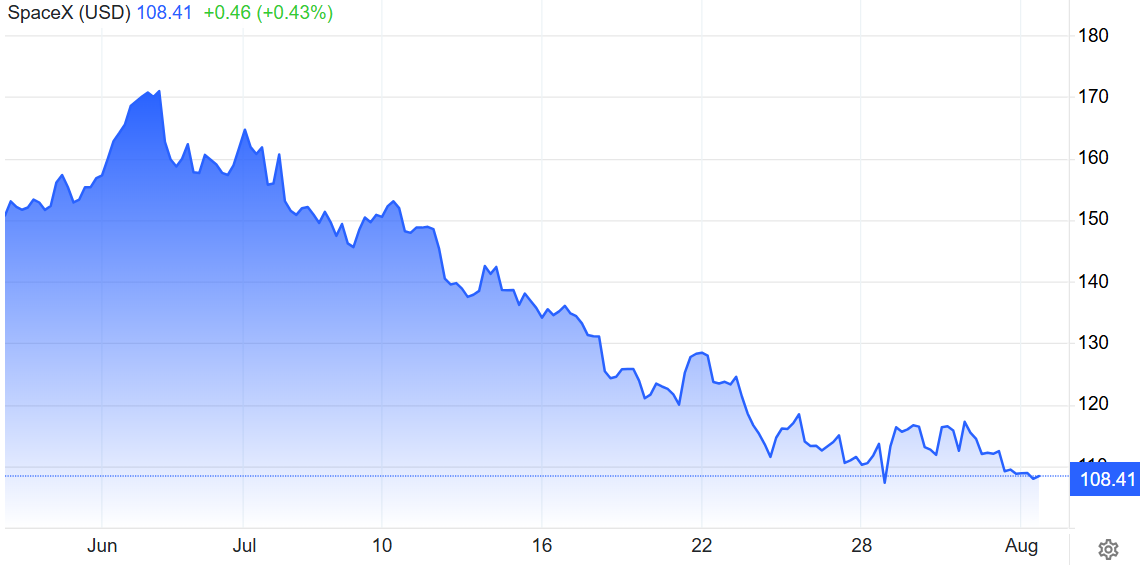
Meanwhile, SpaceX shares continue to be under pressure. It closed down 3.4% to $108.37 on Friday (July 31), hitting a record low of $107.01 during the session. This price has dropped by about 20% from the IPO price of $135 on June 12, and has plummeted more than 52% from the historic high of $225.64 set after listing. In July alone, SpaceX dropped 36.57% cumulatively. Both SpaceX and Tesla have plummeted, causing a devastating blow to Musk's personal wealth.
Musk's latest worth has dropped to around $684 billion, according to the Bloomberg Billionaires Index. Just over a month ago, on June 16, his wealth peaked at around $1.33 trillion — meaning that in just over a month and a half, more than $600 billion worth of wealth went up in smoke. This decline itself exceeds the total net worth of any of the richest people on Bloomberg's list of the 500 richest people in the world, with the exception of Musk.
The simultaneous sharp decline in the two core assets is the direct cause of the shrinking wealth. Since SpaceX hit a closing high of $201.80 on June 16, the stock price has plummeted 46%. Since Tesla released its second-quarter earnings report on July 22, its stock price has dropped 17%. Tesla's earnings report shows that for the first time in two years, the company recorded negative quarterly free cash flow, despite increases in car deliveries and revenue.
Musk holds about $129 billion worth of Tesla shares, as well as SpaceX shares worth more than 550 billion dollars. Changes in the value of these two major holdings are directly determining the wealth map of the richest people in the world.
Three long-term variables: lifting the ban, inclusion of S&P and Tesla merger
According to S3 Partners' Pierson, there are three key drivers to look out for in the year ahead:
The first is the process of lifting the ban. This is the most pressing short-term risk. After the first batch of 9115 million shares was lifted, there will be multiple rounds of batch unlocking, which will continue to put supply pressure on stock prices.
The second is inclusion in the S&P 500 index. According to relevant regulations, IPOs must meet the “licensing rules” (usually requiring 6 to 12 months of listing and continuous profit), and SpaceX will not be included in the S&P 500 index until mid-2027 at the earliest. But the market has begun to set prices for this ahead of time.
The third is a potential Tesla merger. Pierson pointed out that if SpaceX and Tesla achieve some kind of business merger, it will “speed up this integration process.” Although this idea is currently still speculative, it is not entirely unimaginable in the context of Musk controlling both companies at the same time.