
- PRICING
- LIVE QUOTES
- LEARN
- HELP


EN
AI myths are cooling down, and macro risks are heating up! US stock traders prepare for the “August storm”, Goldman Sachs bets on volatility backlash
The Zhitong Finance App notes that over the past few months, the S&P 500 index has remained in a narrow range. Even though the individual stock sector experienced shocking sharp fluctuations, they have largely offset each other. However, traders are preparing for this impending shift in the situation.
An investment blueprint is emerging: traders are hedging against the overall coordinated fluctuation of the market, while betting that the volatility of a single stock will decrease. This so-called “reverse dispersion transaction” was listed by Goldman Sachs Group as one of the best strategies for dealing with the current market.
As earnings season — a period where investors generally respond more strongly to company-specific news and pay less attention to macro headlines — is over halfway through, investors are turning their attention back to macro risk. From the war in Iran and the deeply divided Federal Reserve, to ongoing inflationary pressure, it can be said that macro-risks are endless.
Brent Cochuba, founder of options platform SpotGamma, said: “The macro situation is getting worse. Previously, people thought AI could lead us out of trouble, but now this view is being questioned.”
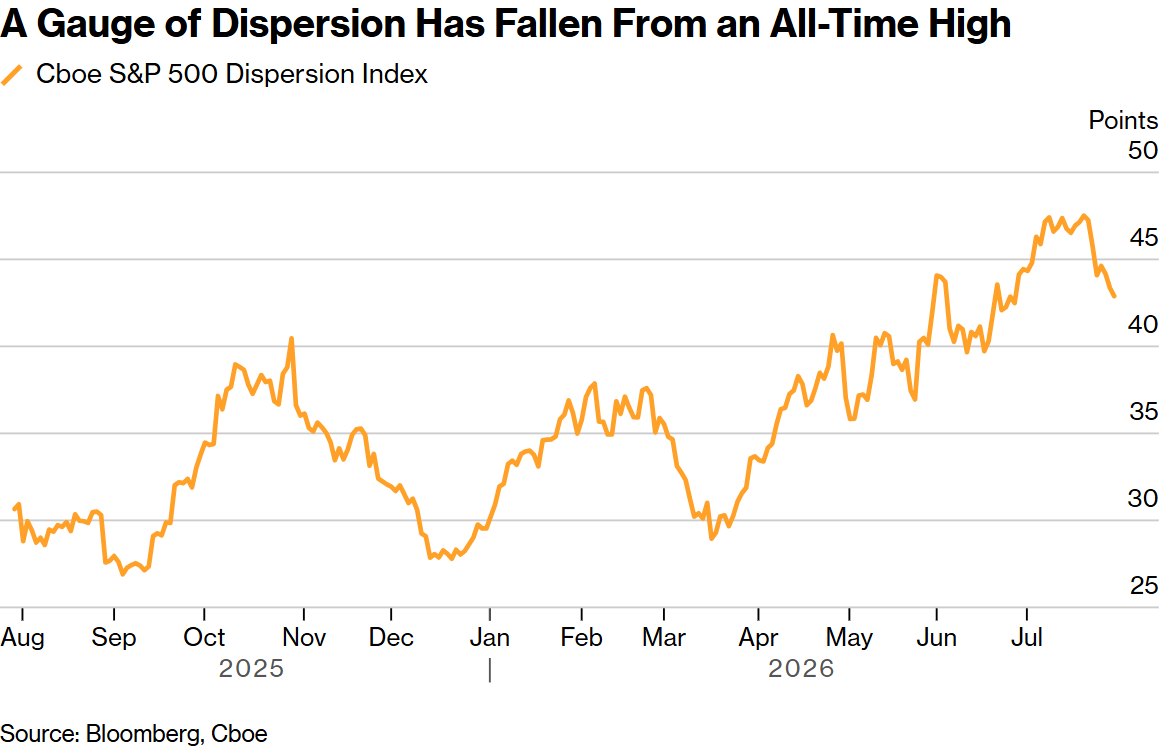
The degree of dispersion index has fallen from its all-time high
Over the past few months, reverse dispersion trading has been difficult, as the correlation between individual stocks has remained close to a record low, while the benchmark stock index is stuck in a narrow trading range.
Although the overall pattern remains the same, macroeconomic concerns have quietly begun to grow. According to data from the Chicago Board Options Exchange, after the indicator measuring the expected dispersion of large-cap stocks in the January period hit the highest level since 2020 earlier this month, it declined in six of the past seven trading days.
In the same period, the indicator measuring the implied correlation of the top 50 stocks in the S&P 500 index hit a record low earlier this month, and is now ushering in a third consecutive week of gains.
To be sure, none of this is a sign of the end, and the Cboe VIX Index (Cboe VIX Index) is still far below the key level of 20, which usually indicates increased market pressure.
RBC capital market traders like to compare the “high dispersion and low correlation” characteristics of the stock market to a waterfowl gliding on the surface of the water.
Matthew Davis, the bank's head of derivatives trading, said: “It's like a duck floating quietly on the surface of the water, but its feet are desperately paddling underwater. This dynamic has brought excellent returns to institutions involved in dispersion transactions.”
But as the calendar rolls into August — historically the same month with the most volatile US stocks as September — investors' demand for protective strategies is rising. Earlier this week, the standardized three-month bearish/call option bias indicator for the S&P 500 jumped to its highest level since April.
Goldman Sachs traders, including Gail Hafife, wrote in a report to clients this week: “As macro-uncertainty continues to loom, the market is also absorbing enthusiasm for momentum strategies, and the possibility of a 'high correlation event' (corr1 event, meaning a phenomenon where stocks fluctuate simultaneously in the same direction) has entered people's eyes.”
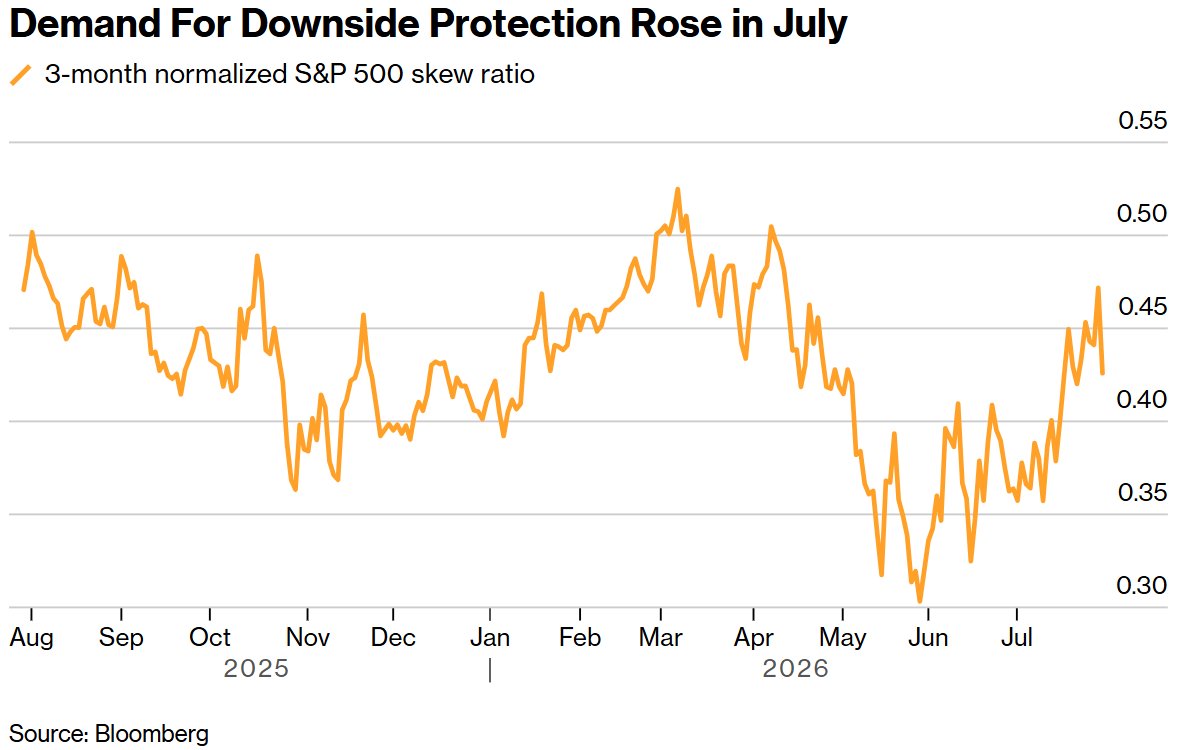
Demand for downside protection rose in July
Oraclum Capital Chief Investment Officer Vuk Vukovic holds short-term put options on the S&P 500 index, and if the stock index falls sharply, he will profit from it.
“You don't know if this will happen next month,” he said in a phone interview. It could happen in two years, but you have to be prepared.”
So far, the market has remained stable, and the S&P 500 index is 2.3% off its all-time high in June. However, some traders who are preparing for the intensification of macro-volatility are beginning to compare it to August 2024 — when Japan's unexpected interest rate hike triggered the cancellation of Japanese yen arbitrage trading, once propelled the VIX index above 65, and brought the S&P 500 index to its lowest point in three months.
Jamie Sanders, portfolio manager at Junley Henderson, said his current portfolio allocation would benefit if correlation increases.
On the phone, Sanders said, “If we do experience a major macro wash, or if the AI trend declines drastically, we may actually see this correlation pick up. Some kind of macro event, perhaps an impact caused by the Federal Reserve or an impact caused by AI, could significantly increase the index's volatility.”