
- PRICING
- LIVE QUOTES
- LEARN
- HELP


EN
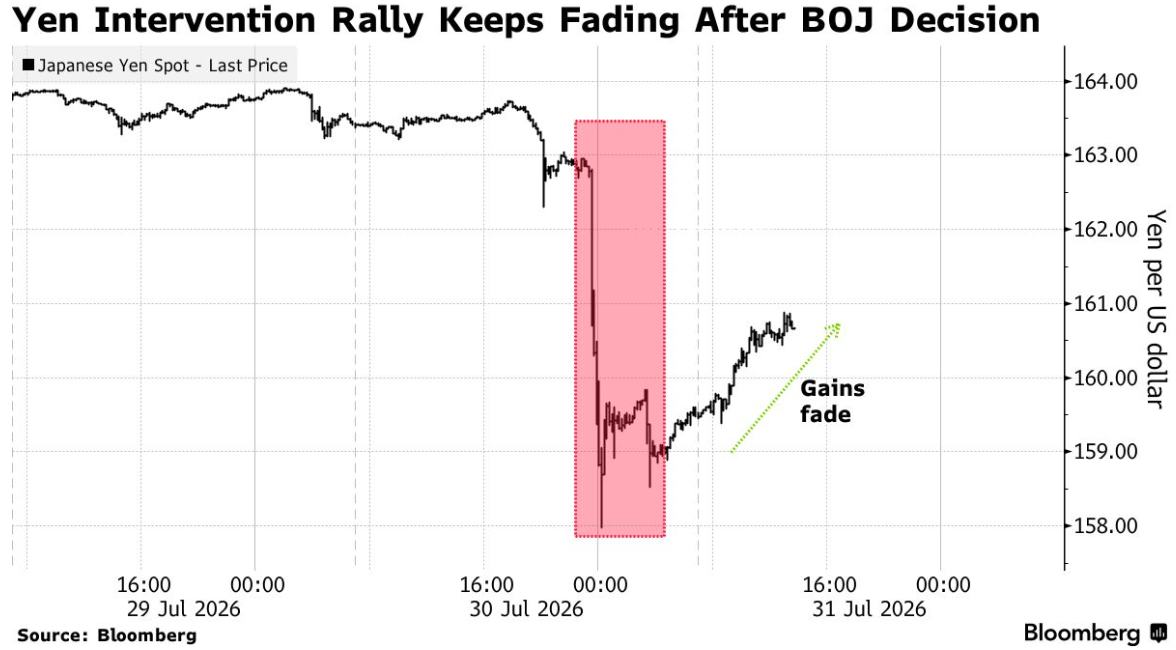
Will the joint intervention of the US and Japan last only one day? Ueda and the Hawks stated that they failed to calm the market, and the yen's rebound momentum stalled and returned to the 160 mark
The Zhitong Finance App noticed that the yen stagnated on Friday after experiencing a rebound driven by intervention. After the Bank of Japan kept interest rates unchanged and Governor Ueda Kazuo provided little new support to the yen, the yen fluctuated between ups and downs.
The yen reversed its decline against the US dollar, strengthening to 158.55 and previously weakening to 160.88. All 52 economists surveyed anticipated the Bank of Japan's interest rate decision. The voting results were 8 votes in favor and 1 against, and member Hajime Takata called for continuous interest rate hikes.
At the briefing after the meeting, Ueda adopted a slightly hawkish tone, leaving the door open for interest rate hikes at the upcoming conference, without implying that this is likely to happen. He stressed that he believes that the price outlook faces greater upward risk, and as the inflation trend is now very close to the central bank's 2% target, any upward price accident will cost more.
Ikue Saito, a strategist at J.P. Morgan Chase, said, “The continued and significant rise in yen requires a higher degree of hawkish stance,” and “we expect USD/JPY to continue to gradually recover to recover from last night's decline.”
The yen rose as much as 3.3% against the US dollar during Thursday's New York trading session, the biggest intraday gain since December 2023, before falling back. An informed market participant said that Japan intervened to support the yen, and the US authorities carried out an interest rate check (rate check) at around 2:30 a.m. Tokyo time.
Rinto Maruyama, senior foreign exchange and interest rate strategist at SMBC Nikko Securities, said, “By intervening before the Bank of Japan's monetary policy meeting, the authorities may aim to maximize influence and catch the market off guard. This is in stark contrast to the more transparent and easily identifiable intervention in April.” Maruyama added that the sharp rise in Japanese and US long-term bond yields is “a key factor behind Japan's foreign exchange intervention and the US exchange rate inquiry operation.”
People familiar with the matter said earlier this month that officials are willing to raise interest rates faster than economists' consensus, as the continued weakness of the yen increases the risk of upward inflation. Overnight index swaps show that the probability of interest rate hikes by October is around 88%.
Strategist Andre de Silva said that despite hawkish rhetoric, Bank of Japan Governor Ueda's press conference provided little evidence that the Bank of Japan is ready to speed up the normalization schedule of its policies. This left the yen lacking the policy catalyst needed to translate the sharp intervention-driven rebound into a broader trend reversal.
Finance Minister Katayama Satsuki said she was unable to answer questions about whether foreign exchange intervention was carried out. She reiterated that the authorities were ready to respond with a sense of urgency. A US Treasury representative did not respond to a request for comment.
US participation has increased the weight of intervention and may make traders more cautious. US Treasury Secretary Bessent said in an interview that he believes the yen is “seriously undervalued” and that “excessive fluctuations” are unhealthy. Japan is receiving more than moral support from the US, Japan's top monetary official, Atsushi Mimura said on Friday.
Japanese media had earlier reported that Japan had intervened and that the US authorities had inquired about the USD/JPY exchange rate. After hitting 157.98 on Thursday, the yen weakened to 160.75 in early Tokyo trading. Over the past 12 months, the yen has remained down about 6% against the US dollar, the worst performer among the G10 currencies.
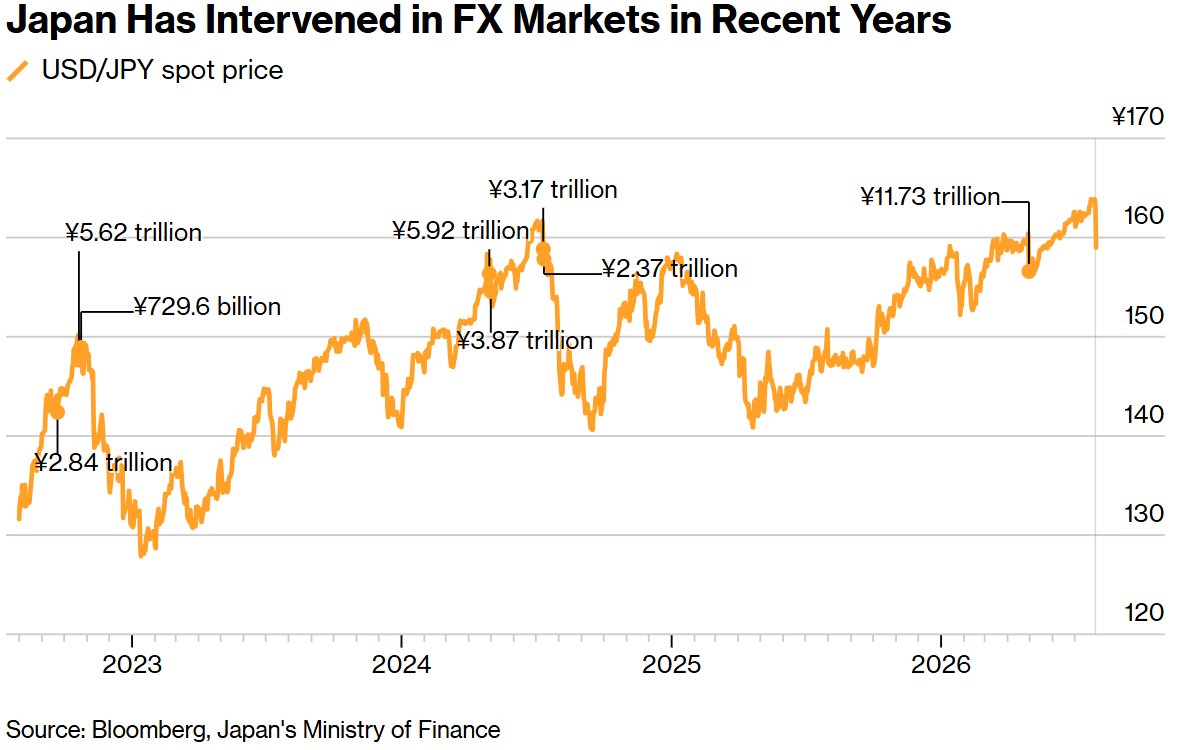
Japan has interfered in the foreign exchange market several times
The yen, which has fallen to a 40-year low in recent months, has been under relentless pressure from rising oil prices, ongoing budget deficits, and huge interest rate spreads. Although the Japanese authorities spent a record 11.73 trillion yen ($73.1 billion) to buy yen on the open market last quarter, the currency still plummeted.
According to Treasury reserve data, Japan may have used its foreign securities holdings (including US Treasury bonds) to fund the intervention.
Japan's unprecedented intervention expenditure not only highlights the extent to which this country is at stake, but also highlights how difficult it is to go against the current trend in a global foreign exchange market with an average daily trading volume of 9.5 trillion US dollars.
After 25 years without intervention, Japan re-entered the market to support the yen in 2022, then took action again in 2024, when the authorities tried to slow the depreciation of the yen against the US dollar. As central banks around the world raised interest rates sharply as inflation accelerated after the COVID-19 pandemic, and the Bank of Japan kept its policy interest rate negative at the time to stimulate Japan's economic growth, the decline in the yen began.
Although the Federal Reserve kept interest rates unchanged this week, traders still expect US borrowing costs to rise later this year — leaving the interest rate gap between the US and Japanese economies in an unfavorable range for the yen.