- PRICING
- LIVE QUOTES
- LEARN
- HELP


EN
Antec: Oversupply of industrial silicon continues to be in stock this week and continues to bottom out
The Zhitong Finance App learned that Antec data showed that the industrial silicon market showed a pattern of “low consolidation of futures and continued decline in spot goods” this week. The main contract hovered low in the 8100-8,300 yuan/ton range, and the 8,300 yuan/ton mark formed last week was not recovered; spot prices continued to decline, prices of various specifications and regions continued to decline, and overall market sentiment was weak.
Market performance: futures settled at a low level, and spot prices continued to decline
In terms of futures, the main 2,609 contract operated at a low level in the 8120-8,300 yuan/ton range this week. By the close of July 30, the main 2,609 contract closed at 8,175 yuan/ton, down 120 yuan/ton from 8,295 yuan/ton on July 24 last week, or about 1.45%. The market operated weakly in the 8120-8,210 yuan/ton range during the week, hitting an intraday low of 8120 yuan/ton on Thursday, and overall market sentiment was weak. In terms of holdings, the main contract volume on July 30 was about 291,000 lots, an increase from last week, and bear pressure continued to be released.
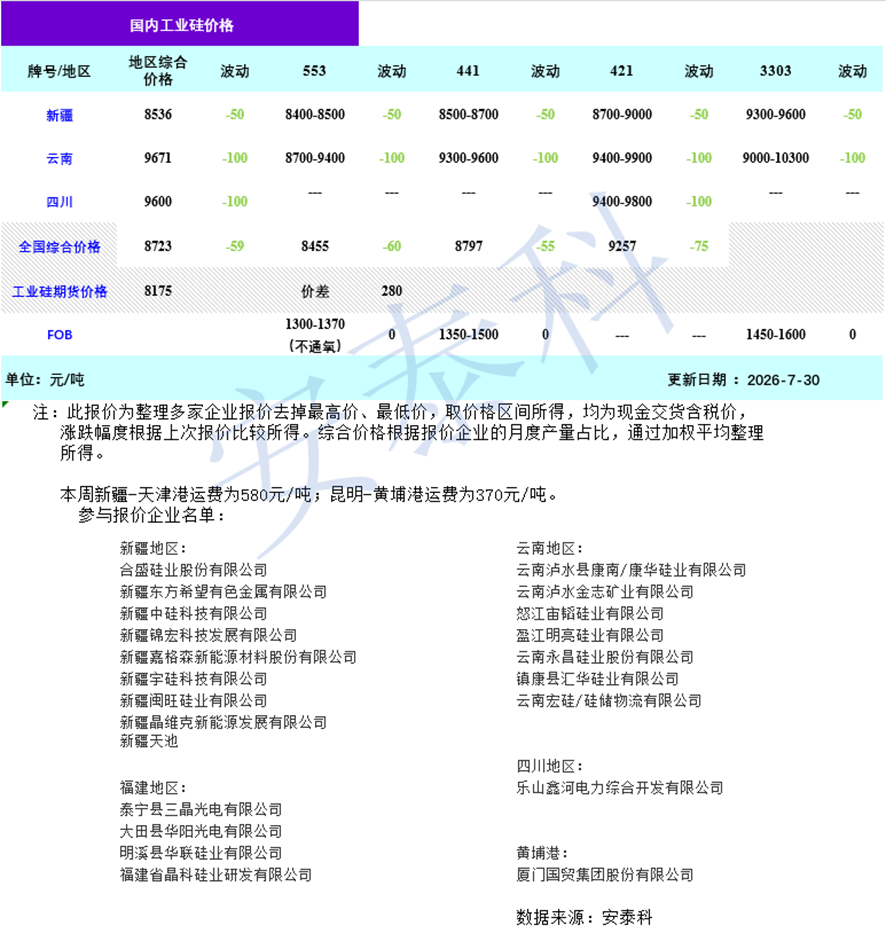
On the spot side, according to Antec's July 30 quotation statistics, the comprehensive price of industrial silicon nationwide was 8,723 yuan/ton, down 59 yuan/ton from last week. By specification, 553 #报8455元 /ton, 441 #报8797元 /ton, and 421 #报9257元 /ton were down 60 yuan/ton, 55 yuan/ton, and 75 yuan/ton, respectively, from last week. Looking at the subregions, the comprehensive prices in Xinjiang, Yunnan, and Sichuan were 8,536 yuan/ton, 9,671 yuan/ton, and 9,600 yuan/ton, respectively, down 50 yuan/ton, 100 yuan/ton from last week. The decline in the southwest production area continued to be greater than in the north, reflecting the continued release of supply pressure on the spot side during the flood season.
In terms of export FOB, prices for all specifications remained the same as last week, ending the previous continuous downward trend, but external demand support is still limited.
Judging from the transaction situation, trading in the spot market is still light. As futures prices run below 8,200 yuan/ton, downstream price pressure has not abated. Actual transactions are mainly small orders that are just needed. Large-scale inventory replenishment has yet to occur, and buyers and sellers continue to compete at low prices.
Supply side: Production remained high during the flood season, and supply disturbances increased in northwest China
The supply side continued to maintain a “high production operation” trend this week. The resumption of production during the Fengshui period in the southwest is already at its peak. Silicon companies in Sichuan and Yunnan that can resume production have all basically resumed production, and there is limited room for further increases in subsequent production. In terms of the main production areas in the northwest, regional performance is divided. Early power grid maintenance in the Yili region of Xinjiang was completed on July 27. Electricity supply returned to normal, production of some pre-fast-discontinued stoves in the region resumed production, and the region's daily output increased. Some silicon companies in the rest of Xinjiang are still undergoing maintenance, and production is expected to resume after August. Affected by rising electricity prices and costs, some enterprises in Inner Mongolia have entered a normal maintenance cycle, and the opening rate has been slightly lowered; other enterprises have extended maintenance periods due to delays in equipment inspection. It is also learned that due to rising electricity prices, individual enterprises in Gansu plan to stop production and maintenance in August, but subsequent developments are worth watching. Overall, the increase in production resumed in the southwest during the flood season has been fully realized, and the overall supply side is at a relatively high level; the resumption of production in Yili, Xinjiang brought about a certain increase, while supply contraction in Inner Mongolia and Gansu had limited impact on total volume, making it difficult to ease short-term supply pressure.
Demand side: Polysilicon continues to be weak, silicone production cuts are deepening, aluminum alloys are under pressure in the off-season
Overall support on the demand side is insufficient, and all fields are showing a weak trend. In terms of polysilicon, production is expected to rise to around 100,000 tons in July, and the consumption of industrial silicon has increased. However, the price of polysilicon itself continues to fall and inventories are high. Enterprise procurement is still dominated by pressure on demand. Incremental demand is limited, and the driving effect on industrial silicon is weak. On the silicone side, the market is operating weakly. Mainstream DMC prices remain stable at a low level. Downstream continues the “buy up, don't buy down” mentality, wait-and-see sentiment is strong, and the shrinking effect of production cuts on demand for industrial silicon continues to unleash. In terms of aluminum alloys, raw materials for traditional off-season superposition of aluminum scrap are tight, and the operating rate has been lowered slightly. Demand for industrial silicon is still in demand, and there is little change in demand. Overall, it is difficult for the demand side to provide flexible upward support in the short term, which is doubly suppressing high production on the supply side.
Looking ahead to the future market: supply and demand easing continues, and cost support still exists
Taken together, the current industrial silicon market is still in a weak pattern of “continued oversupply and insufficient demand support”. The increase in production resumed in the southwest during the flood season was fully realized, and production remained at a high level. Meanwhile, demand-side polysilicon, silicone, and aluminum alloys were generally weak, and there was no substantial improvement in the supply-demand conflict. Spot prices continued to decline but narrowed this week, reflecting continued market experimentation with current prices. The short-term forecast is to continue the weak and volatile trend. The lower part is effectively supported by the cash flow cost range, and the upper part is constrained by increased supply and inventory pressure. The focus is on whether the contraction of supply in the northwest can continue to ferment, whether production peaked during the high water season in the southwest, and when the downstream procurement mentality stabilizes.