
- PRICING
- LIVE QUOTES
- LEARN
- HELP


EN
The delivery of 16 billion “bloody chips” has been completed: the sharp fall of Citadel's demolition AI is the end point or the starting point for dominoes?
The Zhitong Finance App learned that Citadel, a hedge fund giant headed by Wall Street billionaire Ken Griffin, reached a deal with Situational Awareness, an up-and-coming hedge fund that is in deep collapse to help trigger a world-wide AI hashrate themed stocks, especially semiconductor stocks closely linked to AI computing power, to a long-lost “irrational aggressive” “bullish mood irrational catharsis”. Wall Street traders also began to debate fiercely: whether the worst AI sell-off phase has passed, or will there still be more AI computing power in the future Stock market collapse incident in the infrastructure industry chain.
In the US stock market on Thursday and the Asia-Pacific stock market on Friday, the semiconductor sector, which is closely linked to AI computing power infrastructure, staged a huge counterattack from “forced liquidation of extreme leveraged positions” to “retaliatory compensation.” If you look at the results recently announced by leaders in the AI computing power industry, such as Fanlin Group, Samsung Electronics, UMC, TSMC, SK Hynix, and Seagate, and the future outlook, the conclusion seems even more clear: the physical-level demand associated with AI computing power infrastructure is not in sync with the sharp decline and clearance of stock prices and extremely leveraged positions.
The Korea Composite Stock Price Index (KOSPI Composite Stock Index), which owns SK Hynix and Samsung Electronics, the two largest global supermemory chip giants, soared by a record 18% after experiencing a sharp sell-off in a fusing situation for three consecutive trading days. The benchmark stock index of TSMC, the “king of chip foundries” that controls nearly all of the world's AI chip production capacity, rose 8% in the Taiwanese stock market, and Japan's Nikkei 225 Index, which hosts leaders in the AI computing power industry chain such as Kioxia, Tokyo Electronics, and Edwin Test, also rose 4%. On Thursday, a much-publicized US semiconductor giant index (the Philadelphia Semiconductor Index, which can be called the “global semiconductor weather vane”) recorded its biggest increase since April 2025.
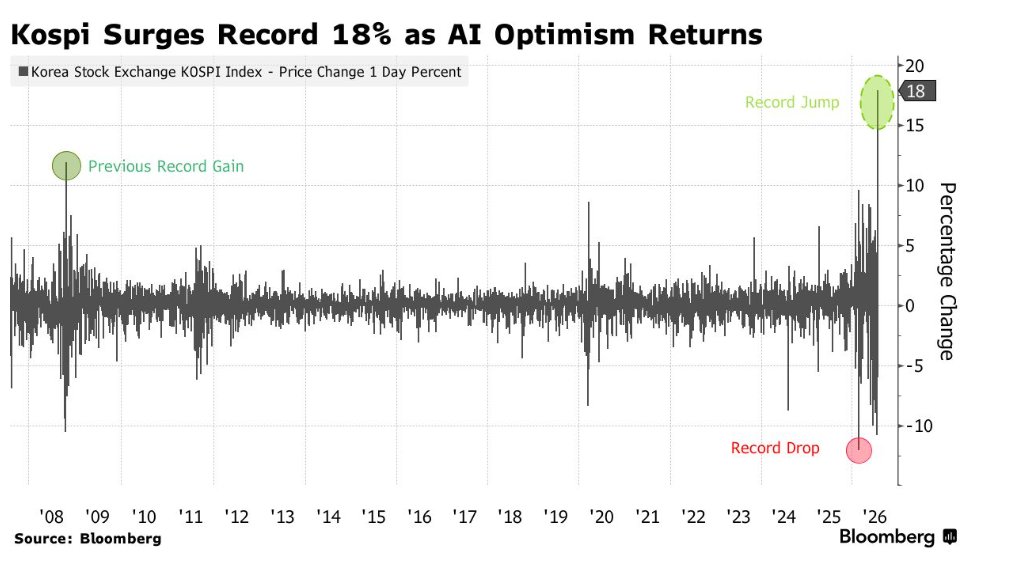
As shown in the chart above, the Korea Composite Stock Price Index surged at a record rate of about 18%, and optimism about AI has fully returned.
According to some market participants, Situational Awareness was forced to liquidate almost all of their open stock market AI investment positions, which helps explain the ongoing forced deleveraging liquidation and intense selling pressure in the global semiconductor sector in July: one round of sales will be transmitted repeatedly between global markets and further evolved into another round of super sales. Before retail investors and professional traders drastically cut loans, the Korean financial market's margin financing even hit a record high last month.
After Citadel took over most of the public stock portfolio at a discount, the market no longer had to endure the sell-off of highly leveraged hedge funds on the exchange, and other investors no longer worried about unknown large-scale strong orders. As a result, short recovery, dealer hedging adjustments, and the return of fundamental capital jointly created a violent rebound in global semiconductor stocks that began on Thursday.
Citadel undertook most of Situational Awareness's public stock portfolio, which was equivalent to removing a persistent, undifferentiated, and price-insensitive compulsory seller from the market; superimposing the performance of tech giants such as Microsoft and Amazon to re-allay concerns about AI return on investment, and AI computing power supply sides such as TSMC, UMC, and Seagate provided an extremely positive signal of AI computing power demand expansion. Korea's KOSPI rose by a record 17.91%. Micron, AMD, TSMC, and Samsung Electronics and SK Hynix led a retaliatory rebound in global chip stocks. To a large extent, this means that marginal pricers in the market have rapidly moved from additional margin, leveraged ETF redemptions, and forced liquidation of positions to the outlook for short compensation, the ability of institutions and retail investors to buy at low prices, and continued strong expansion of AI computing power fundamentals.
After Situational Awareness removed leverage, it was proven that the most intense mechanical selling pressure may have passed, but it cannot prove that all overleveraged institutions have been cleared; even if KOSPI surged nearly 18% in a single day, it is still about 30% lower than the historical high. The Philadelphia Semiconductor Index still fell by more than 20% in July, and retreated nearly 30% from the previous June high. The familiar dynamic, bullish atmosphere of AI computing power fundamentals like the expansion of AI risk appetite may be back, but the main upward trajectory of the AI-driven super bull market still needs to be confirmed by financial reports, orders, AI capital expenditure returns, and unbreakable technological lows.
From the 165-page AGI prediction to the “most crowded bulls” finally crashing, the “AI version of the answer” looked right but lost positions, and the 439% myth lost to the leverage cliff
Leopold Aschenbrenner's brilliance comes from directly transforming a set of highly penetrating technical judgments into capital market positions: he graduated from Columbia University in first place at age 19, joined the OpenAI “Super Alignment” team, and published 165 pages of “Situational Awareness” in 2024, suggesting that AGI will force the world to purchase data center power equipment, liquid cooling, data center CPUs, DRAM/NAND/HBM, data center optical communication and optical interaction at an exponential pace AI data center delivery process with a complete chain of connections, high-performance Ethernet network infrastructure, transformers, gas turbines, etc.
The fund of the same name was then established to attract well-known capital such as Jane Street and the founder of Stripe, and its management scale exceeded 20 billion US dollars within two years; by the end of June 2026, the fund's net return during the year reached an astonishing 439%, and the return since inception was over 1000%, making it the most legendary concentrated bettor in this round of AI bull market, and was even praised by some retail investors as “the answer to the AI superinvestment boom.”
His collapse was not an abrupt failure of AI's long-term logic; rather, the same macro-narrative controlled the bulls, bears, and the financing side at the same time. Situational Awareness concentrates on holding AI storage, cloud computing power, and power infrastructure assets such as SK Hynix, SanDisk, Nebius, CoreWeave, and Bloom Energy, while establishing shorts for some software companies that may be disrupted by AI; after the reversal of AI hardware congestion trading in July, multiple assets fell simultaneously, and some bears rose in reverse. The correlation suddenly moved closer to one during the pressure period, turning what seemed like a “long and short hedging” combination into losses in the same direction.
The hedge fund he heads fell by about 67% in July and had to choose between “quickly raising new capital” and “selling an open market portfolio”, and eventually transferred most of the approximately $16 billion public stock portfolio to Citadel; major brokers such as Goldman Sachs, J.P. Morgan, Bank of America, and Citibank participated in coordination. After the transaction was completed, the fund still retained about $10 billion in assets, including private equity such as Anthropic, so “all of the funds returned to zero” or “Citadel bought all assets” was inaccurate — what was really destroyed was its highly leveraged open market Strategy.
The so-called “overnight crash” essentially means that several weeks of book losses crossed the financing threshold within 24-36 hours and suddenly turned into a liquidity incident. The danger of leveraged combinations is not a mistake in judging the final direction, but rather that net assets are only a thin layer below the total exposure: using a four-fold total exposure as an example of the mechanism, the asset portfolio falls by 25%, which theoretically may eat up all initial equity. Afterwards, the main broker will increase the margin and reduce the financing amount, and require the fund to sell positions. Once the market recognizes that an institution has become a price-insensitive forced seller, other trading platforms may indeed sell their coincident positions, buy protection, or establish short positions ahead of schedule, further worsening the execution price.
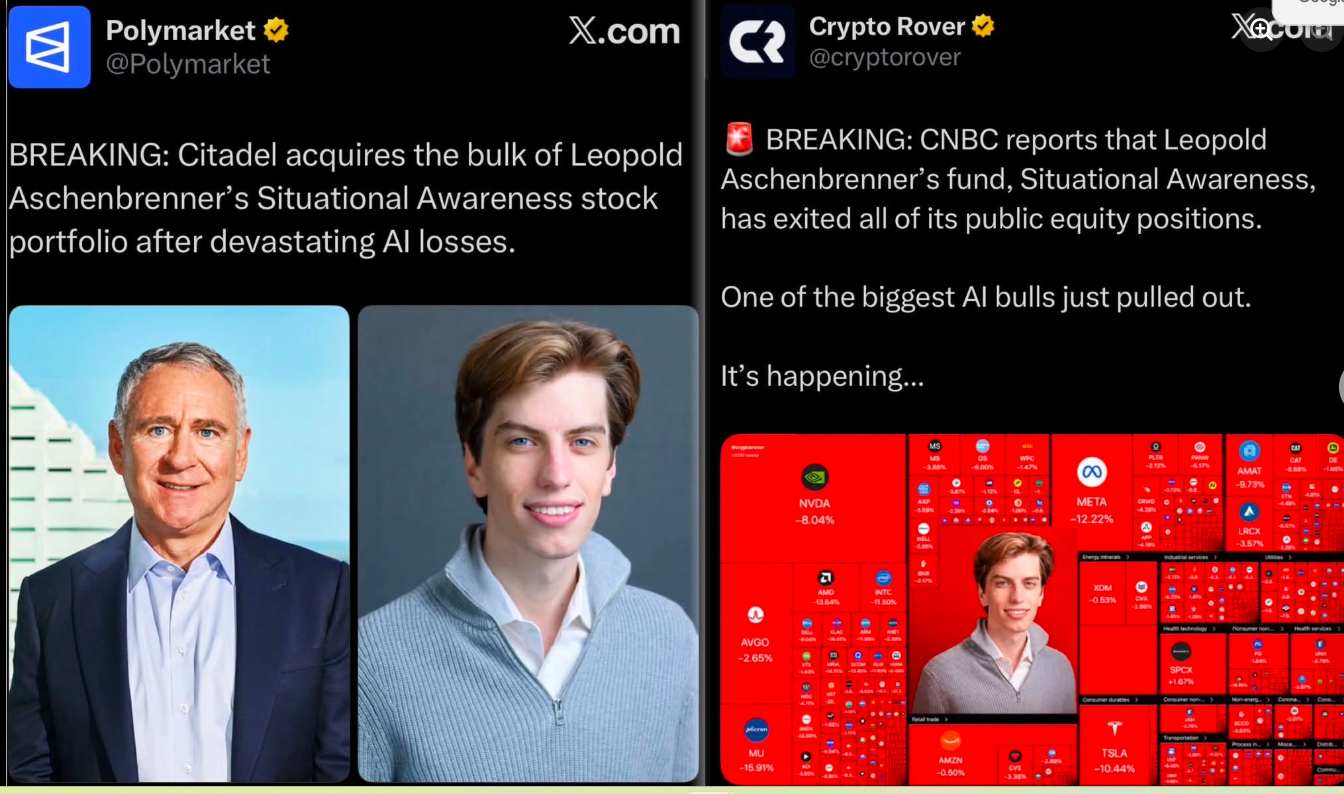
Citadel's key role is not to “save a genius,” but rather to turn a potential forced sale that continues to impact the exchange market for weeks into a massive asset transfer undertaken by an institution with stronger capital strength. When the market confirmed that Situational Awareness did not need to continue the disorderly sell-off, sellers' supply plummeted, and short buybacks entered at the same time: South Korea's KOSPI rose by a record 17.9%, Samsung Electronics and SK Hynix soared by about 28% and 30% respectively, and the Philadelphia Semiconductor Index also rebounded strongly.
Is the overcrowded AI deal completely over, or is it the night before Domino's fall?
The most profound conclusion of this myth is that Aschenbrenner may have seen the long-term direction of the AI computing power industry, but mistakenly equated technical certainty with stock path certainty. Demand for HBM, NAND, advanced packaging, CPU, optical interconnect equipment, power and liquid cooling is likely to continue to grow, but good investment strategies must be able to withstand valuation compression, sudden changes in correlation, tightening financing conditions, and reversal of crowded positions. The core of the “Kelly Criterion” (Kelly Criterion) is not “heavy positions when the win rate is high,” but rather maximizes long-term compounding and avoids bankruptcy; once a position exceeds the optimal ratio, even if the final industry judgment is correct, short-term variance is enough to allow investors to be cleared out of the market before the theme is realized.
Situational awareness proves the harshest rule of this AI bull market: the market rewards not those who see the future first, but those who see the future and have sufficient liquidity to survive into the future.
“This is really part of the selling pressure that has continued over the past few weeks.” Calvin Yeoh, the co-manager of Merlion Fund under Blue Edge Advisors, said about what happened to Leopold Aschenbrenner's hedge fund, “At the same time, all retail investors in Korea who use extreme leverage strategies have basically burnt out their positions, and there are no more or larger sellers there.”
“But that doesn't mean the market will rebound all the way back.” Yeoh said, “It just means that as of now, the clearance of leverage has basically been completed.”
The rebound over the past two days put an end to the turbulent July. The Philadelphia Semiconductor Index has accumulated a cumulative decline of more than 20% this month, making it the worst monthly performance since the global financial crisis.
The Korea Composite Stock Price Index fell 22% cumulatively in July, and SK Hynix and Samsung Electronics became the main drag. It was these two stocks that previously drove the Korean stock market to become the best performing market in the world earlier this year. Situational Awareness's portfolio once included SK Hynix, and the price of the company's American Depositary Receipts once fell below its issue price.
It's hard not to think of a long-term capital management company (LCTM) and 2008 when this glorious moment about Situational Awareness came to an end.
Yeoh isn't the only one who thinks the selling pressure is temporarily easing, but the incident also made investors wonder if other funds are facing similar difficulties. Some people on the trading desk compared it to the rapid collapse of long-term capital management companies in 1998. At the time, due to the systemic risk that the incident posed to financial markets, Fed policymakers came forward to organize bailouts.
Other analysts recall how banks and funds were acquired one after another during the global financial crisis.
“If there is one Situational Awareness, how many similar agencies are there in the market?” Cusson Leung, chief investment officer at KGI International Wealth Management, said, “This morning, it reminded me of a very similar situation. That was when J.P. Morgan Chase bought Bearsden in 2008.” He said in an interview. “There was also a bailout rebound in the market at the time, but then Lehman Brothers went out of business.”
The value of assets held by Situational Awareness has plummeted from 45 billion US dollars in early July to about 10 billion US dollars. Aschenbrenner had to liquidate the position to meet additional margin requirements. Subsequently, according to a person familiar with the matter who requested anonymity due to personal information, Griffin's Citadel hedge fund got in touch with Situational Awareness and bought most of its investment assets at a discount.
“The more important question is whether this is the only overleveraged area in the market.” Ulrich Urbahn, head of multi-asset strategy and research from asset management giant Berenberg, said, “If there are other funds that are also highly focused on AI, computing power, and semiconductors, then a single liquidation may just be the first domino to fall, not the last.”
According to Bloomberg Intelligence's exclusive statistics, in the past two weeks, capital flows from leveraged exchange-traded funds (i.e. individual stock leveraged ETFs) linked to Samsung Electronics and SK Hynix have also turned into large-scale net outflows; these products were previously thought to be factors increasing market fluctuations in Korea. Bloomberg Intelligence statistics show that as of Thursday, the asset management scale of these funds had plummeted from over $11 billion on June 25 to $4.1 billion. The South Korean government promised this week that it would take more measures to stabilize the market and said it would restrict retail investors from participating in leveraged ETFs.
“We've already seen large-scale leveraged bets clear, the process is nearing completion, and Situational Awareness being rescued is the last piece of the puzzle in the short term.” Joshua Crabb, head of Asia Pacific equities at Robeco, said, “The Asian market has benefited greatly from this because its valuation is already low, and some Korean tech stocks related to AI computing power infrastructure have become very cheap.”
Currently, this round of rebound is being driven by reduced positions, lower valuations, and improved market sentiment.
“This once again brings back the same old lessons as the long-term capital management company incident.” Amir Anvarzadeh, a stock strategist at Asymmetric Advisors based in the Japanese market, said, “This is the old saying from Keynes: 'The time the market remains irrational may far exceed the time you remain solvent. '”
After the fall of the AI prophet, the familiar feeling about the AI computing power carnival finally came back?
The security deposit system can be described as automatically eliminating highly leveraged buyers who are unable to continue financing. When the fund holds highly concentrated SK Hynix, storage, computing power infrastructure, and other AI assets, and borrowing to expand exposure, the fall in stocks will reduce the value of collateral, and the financier will immediately require cash or additional collateral; in order to meet the additional security deposit, the fund can only continue to sell the same assets, forming a negative convex cycle of “fall - make up the deposit - sell - further decline”. After Citadel took over most of the public stock portfolio at a discount, the market no longer had to endure the fund being sold off one by one on the exchange, and other investors no longer worried about unknown large-scale consolidation orders. As a result, short recovery, dealer hedging adjustments, and the return of fundamental capital have all created a violent rebound.
The underlying strategy of Situational Awareness is essentially to use high leverage to express a judgment that may be correct in the long term, but the short-term path is extremely dangerous: AGI and agents will drive the exponential expansion of global computing power demand, so concentrate on holding semiconductor, storage, data center, power, and private AI model companies, and amplify profits through financing.
Public reports confirm that Situational Awareness used a large amount of leverage and was subject to deposit recovery by the lender, but the specific contract portfolio has not been fully disclosed, so it cannot be asserted that all positions were structured through total profit swaps. Generally speaking, in the extreme leverage system of total return swap (TRS), the fund only needs to pay a portion of the initial deposit to the main broker to obtain a stock or stock basket return far greater than the principal amount; the fund receives rising profits and pays financing interest, and must bear all falling losses. The main broker usually buys the corresponding stock for delta hedging; when the price falls and the fund is unable to make up the change margin, the bank will stop swapping, selling the hedging stock, or disposing of collateral, thus turning book losses into real market sales.
According to Wall Street bankers, with this round of forced deleveraging liquidation coming to an end, a new round of AI-themed super bull market has shown “signs of starting again,” but it is not yet possible to announce that the main rise has been fully confirmed at the financial level.
J.P. Morgan strategist Mixo Das's latest forecast shows that the process of removing leveraged ETFs related to South Korea has probably been completed. In particular, the deleveraging process of hedge fund institutions has been completed by about 90%, which means that the “irrational sellers” that have caused continuous trampling are close to being exhausted; this is mutually confirmed by the incident where Citadel undertook most of Situational Awareness's public stock portfolio of about 16 billion US dollars — the strong position that continued to smash the market was transferred once, and the downward spiral of global AI assets obtained the conditions to stop bleeding.
According to the J.P. Morgan Chase Research Report, South Korea-related leveraged ETF assets have dropped from a peak of about 50 billion US dollars to 17 billion US dollars, and the long and short leverage ratio of hedge funds has dropped from 5.7 times to 3.2 times; these figures mean that the negative feedback of leveraged ETFs being forced to follow a decline in sales, reduction in swap financing, and simultaneous closing of positions with momentum strategies is exhausting.
The Korean stock market did have an extremely attractive crisis price at the valuation level, but the 5-times forward price-earnings ratio alone cannot prove the absolute bottom. The storage industry is highly cyclical. When profits are high, the forward price-earnings ratio is naturally low. The “cheapest price-earnings ratio” in history sometimes corresponds exactly to a peak in profit.
Industrial fundamentals, on the other hand, are providing fuel for this round of semiconductor counterattacks that lasts longer than making up for bears. Microsoft's Azure revenue increased 43% in the latest quarter, higher than market expectations of about 39.98%, indicating that AI capital expenditure has begun to be converted into cloud revenue and cash flow; Amazon AWS revenue increased 37% to US$42.2 billion, significantly exceeding market expectations. The backlog of orders jumped from US$364 billion to US$496 billion, and management said that most of the computing power capacity has already been booked by customers in 2027, and even if capital expenditure is raised to US$220 billion in 2026, it will not be able to fully meet demand. Fanlin Group's median revenue guidance for the next quarter reached US$8.1 billion, significantly higher than market expectations of US$7.09 billion, proving that AI demand is spreading along GPUs to HBM, DRAM, NAND, advanced packaging, etch deposition, and enterprise-grade SSDs.
To truly confirm the main upward curve of semiconductors, it is necessary that the major semiconductor weather vane indices do not break down key technical points during the rollback and adjustment, that South Korea's leveraged ETF funds no longer continue to flow out, and that cloud vendors such as Microsoft and Amazon continue to prove that capital expenditure can be converted into cloud revenue, order backlogs, and an acceptable asset payback period.
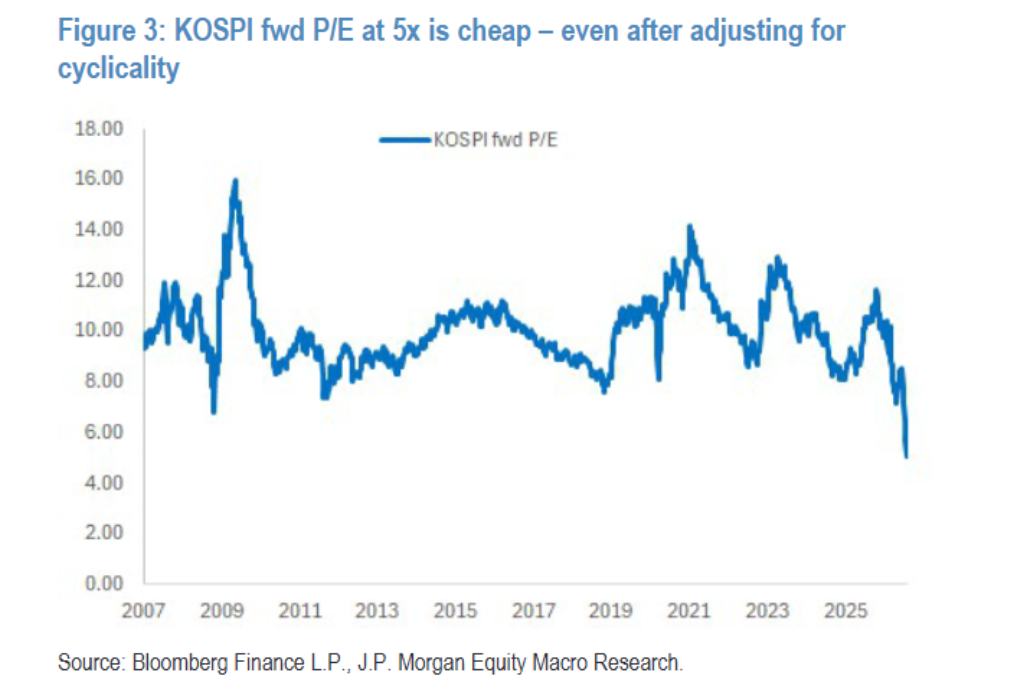
J.P. Morgan said that what really supports the medium- to long-term bullish logic of the Korean stock market and semiconductor stocks related to AI computing power topics is the almost endless continuous expansion of computing power infrastructure such as HBM, server DRAM, enterprise-grade SSDs, and advanced storage. Combined with supply discipline, spot and contract prices are still supported upward. The latest performance of US cloud computing leaders and tech giants such as Amazon, Google, and Microsoft once again allayed concerns about AI capital expenditure stalling, driving KOSPI to a record sharp rise of 17.91% on July 31, while Samsung Electronics and SK Hynix rose by about 28% and 30% respectively; this shows that the rebound not only comes from bear compensation, but also includes a reassessment of the fundamental AI boom situation where “AI capital expenditure is expected to continue to be transformed into cloud revenue, storage orders, and chip profits.”