
- PRICING
- LIVE QUOTES
- LEARN
- HELP


EN
The AI engine has been restarted, and European stocks have strongly reached new all-time highs! Pan-European Stoxx 600 fingers four consecutive days
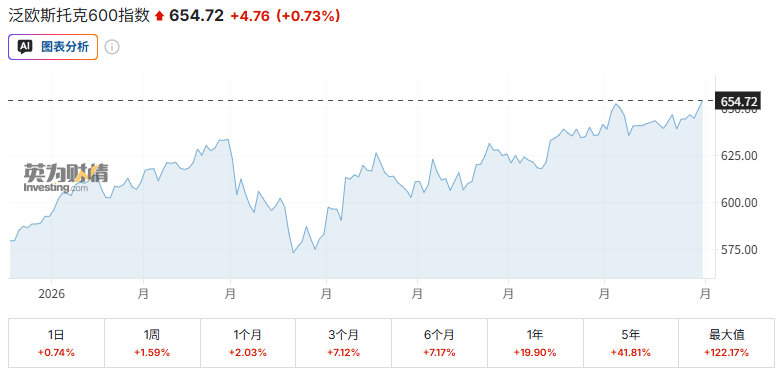
The Zhitong Finance App learned that due to the rebound in global technology stocks and the recovery in artificial intelligence (AI) investment sentiment, the European stock market experienced a general rise on Friday. The pan-European Stock 600 index hit a record high in the intraday period. It is expected to achieve monthly gains for the fourth month in a row, bringing a successful conclusion to the already tough July market.
As of the early trading session, the Stoxx 600 index had risen nearly 1%, once hitting a record high of 656.67 points, increasing the cumulative increase in July to more than 2%. Major countries' stock indexes rose across the board: Germany's DAX Index and Italy's FTSE MIB Index both climbed about 1%, France's CAC 40 Index rose 0.9%, and the UK FTSE 100 Index also recorded a 0.8% increase.
AI beliefs have been rekindled, and technology stocks have become pioneers in the rebound
The core impetus for this round of gains comes from the rapid restoration of confidence in the global AI industry chain. At one point, the European tech sector surged more than 2%, perfectly taking on the strength of US stocks overnight and the blowout in Asian semiconductor stocks.
As quarterly results announced by Microsoft (MSFT.US) and Amazon (AMZN.US) exceeded expectations and released strong capital expenditure forecasts, the market's deep concerns about the “bottomless money hole” and valuation bubble in the AI sector have been greatly mitigated. Boosted by this, South Korea's SK Hynix (SKHY.US) hit a one-day rise and fall of 30%, driven by a strong memory market. Samsung Electronics rose as high as 27%, and Korea's KOSPI index surged about 18% on a rare basis.
In the European market, French semiconductor materials company Soitec (SLOIF.US) surged 7%, chip leader Infineon (IFNNY.US) soared 6%, and lithography giant ASML.US (ASML.US) also recorded a 3% increase.
Florian Elpo of Lombard Odier Investment Managers said, “The most intense position clearance stage is probably over. From a valuation perspective, I think it's more reasonable now than a month ago, even though it's still not cheap. Therefore, this does not mean the end of AI trading, but it probably marks the end of the easy phase of 'buy with your eyes closed'.”
The earnings season showed resilience, and the sharp rise in energy profits supported half of the day
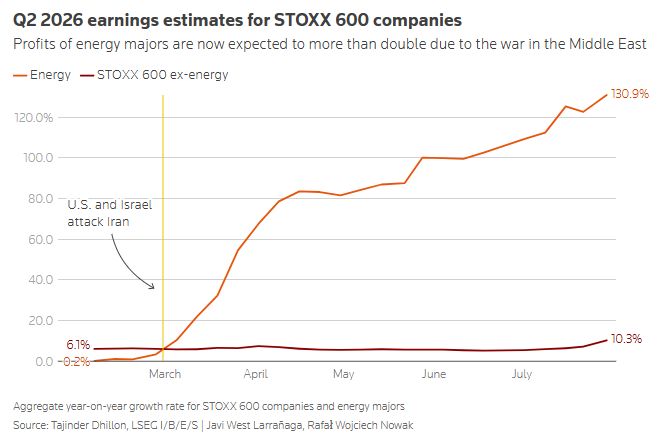
In addition to the restoration of macroeconomic sentiment, solid corporate earnings have provided solid fundamental support for European stocks. According to LSEG data, the earnings growth forecast for European blue-chip stocks in the second quarter has been raised to 20.8% due to the explosive growth of energy companies' profits. As the profits of energy companies are expected to more than double, this figure has been significantly boosted; if the energy sector is excluded, the overall profit growth rate is estimated to reach 10.3%.
Based on market forecasts from 225 companies that have announced results and those yet to be announced, the revenue of the components of the Stoxx 600 Index is expected to increase by 11.7%, which is expected to end the previous four consecutive quarters of contraction. Among the top ten industry sectors, eight sectors are expected to achieve profit growth. Among them, the basic materials sector is expected to record strong gains, while the technology and finance sector is expected to show moderate double-digit growth. The real estate, non-essential consumer goods, and healthcare sectors are expected to be the weakest performers this earnings season.
At the individual stock level, Crédit Agricole (CRARY.US)'s stock price surged nearly 5% because second-quarter profits surpassed market expectations; luxury sports car manufacturer Ferrari (RACE.US) raised its full-year profit guidelines with strong demand for personalized models and excellent pricing capabilities, and the stock price rose in response. The Swiss National Bank, on the other hand, announced huge profits for the second quarter due to rising foreign exchange earnings and stock valuations.
However, profit differentiation is also evident. British aircraft carrier International Aviation Group's stock price fell sharply by 5% due to a sharp decline in profits in the second quarter; Siemens Healthcare (SMMNY.US) had no choice but to lower its annual revenue forecast due to continued supply chain blockages and the slowdown in equipment orders in key overseas markets, and the stock price fell 3.3% in response. Furthermore, aerospace parts manufacturer Melrose Industries (MROSY.US) is expected to incur additional costs of about £25 million to £30 million in the second half of 2026 due to an accident at its plant in California, USA. The stock price plummeted 9.3%, and the stock price plummeted 9.3%, which is the bottom of the Stoke 600 component stocks.
Inflation and geopolitical risks still exist, and the central bank path is the focus
While the stock market is making great strides, falling oil prices have also brought unexpected benefits. There has been no major escalation in the conflict between the US and Iran. Combined with an increase in supply from key channels, the price of Brent crude oil has now been suppressed below 90 US dollars per barrel, which has mitigated market concerns about imported inflation to a certain extent.
However, macro-level uncertainty has not completely dissipated. Market participants are waiting with bated breath for the Eurozone's preliminary consumer price index (CPI) data for July to be released later today. Previously released data from various German states already showed stubborn price pressure, and economists generally expect overall inflation in the Eurozone to pick up slightly. Once the inflation data is stronger than expected, it is likely to disrupt the market's bets on the future pace of interest rate cuts by the ECB, posing a challenge to the continued rise in European stocks.
Throughout July, the European stock market survived many difficulties with strong second-quarter results amidst intense geopolitical frictions, oil price fluctuations, and vague interest rate signals from major global central banks. Currently, with the end of the month coming to an end, investors are closely monitoring the trend of inflation and subsequent statements from central bank officials to determine whether this four-month upward trend can continue to gain momentum in the second half of the year.