
- PRICING
- LIVE QUOTES
- LEARN
- HELP


EN
NAND still ranks as the “storage superoutlet” after HBM! However, the battle for share is heating up, and Kioxia's profits and prospects fall short of expectations
The Zhitong Finance App learned that Kioxia Holdings Corp. (Kioxia Holdings Corp.), a global leader in NAND flash memory headquartered in Japan, released the latest performance data on Friday. The memory chip giant released a relatively disappointing profit outlook, and the core performance indicators announced on the same day did not meet the agreed market expectations. This indicates that competition for NAND flash memory between Samsung, SK Hynix, Kioxia, and SanDisk is becoming increasingly intense, and the unprecedented sharp rise in NAND flash prices driven by the strong demand for artificial intelligence training/reasoning computing power There is a trend towards moderation. After the financial report was released, the PTS private trading system once reported about 44,100 yen, down about 5.2% from the official closing price. To a certain extent, this indicates that the market's characterization of the financial report is closer to “the extremely optimistic expectations that the performance growth rate is still strong but not as high as the market continues to rise.”
The Japanese chip superleader predicted on Friday that its operating profit for the first half of this fiscal year would reach about 3.16 trillion yen (equivalent to 19.7 billion US dollars). The estimated operating profit forecast for the current quarter is 1.89 trillion yen, which is lower than the optimistic expectations previously given by the market. The “half year of fiscal year” here refers to the first half of Kioxia's 2026 fiscal year, that is, from April to September 2026, about 1.89 trillion yen estimated from actual operating profit of 1.27 trillion yen from April to June and expectations from July to September, for a total of 3.16 trillion yen.
The company announced on the same day that the operating profit for the quarter ending June was approximately 1.27 trillion yen, which also fell short of analysts' agreed expectations of continuous improvement recently. As far as the bullish sentiment in Kioxia's stock price is concerned, the most important news revealed in this financial report is the announcement that a 1 split of 3 shares will be implemented from October 1, and shares will be repurchased up to 800 billion yen, with the aim of expanding Kioxia's shareholder base and striving to reduce the recent sharp decline in stock prices and extreme fluctuations in the short term.
In terms of Kioxia's latest performance, Kioxia's total revenue from April to June 2026 was about 1,767.1 trillion yen, representing a sharp increase of 415.5% year over year. Among them, SSD-led NAND storage revenue was about 1.1747 trillion yen, a sharp increase of 440% year over year, and smart device revenue was about 525.7 billion yen, up 565% year on year; Kioxia's quarterly operating profit was about 1.27 trillion yen, which meant a year-on-year increase of about 28.3 times, and the operating profit margin reached about 71.9%.
Compared with the previous quarter, revenue increased by about 76.2%, operating profit increased by about 112.8%, and net profit to mother increased by about 106.6%; the management company clearly stated that the main driving force was a significant increase in the average sales price of NAND due to generative AI data center customer demand. The latest performance data released by Kioxia undoubtedly shows a fact — that is, the AI data center construction frenzy continues to significantly drive NAND demand, and superimposed BiCS-10 has already entered the sample delivery stage, proving that the structural demand for high-capacity, high-bandwidth, and low-power NAND flash memory in AI data centers has not stopped.
However, this quarter's results and subsequent guidance fell short of the market's highly optimistic expectations, and also sent a signal that the upward slope of flash memory prices may slow down. Kioxia's latest performance data and outlook can be described as an “extremely strong fundamentals, but marginal expectations are cooling down” — that is, it is a major benefit to Kioxia's medium- to long-term competitiveness, but it cannot simply be defined as a major benefit for short-term stock prices. However, this financial report can provide fundamental support and confirmation of the semiconductor counterattack market.
As of the June quarter, AI data center demand, average NAND sales prices, and the SSD business exploded at the same time, and profits and cash flow jumped by orders of magnitude; however, the market had pre-priced an almost perfect storage supercycle, and the operating profit guidelines for the next quarter were slightly lower than agreed expectations, so the core dispute at the transaction level had shifted from “whether there is strong demand driven by AI” to “whether prices and profits can continue to exceed expectations”.
As NAND flash memory is being fully upgraded from a traditional “cold data/capacity storage” asset that has been positioned by industry insiders for a long time to an “expandable quasi-memory layer” in the AI reasoning era, Wall Street's bullish sentiment about Kioxia still seems to be hot. Nomura Securities previously maintained Kioxia's rating at a “buy” level, and the target price was raised from 115,000 yen to 126,000 yen**. The core judgment is that the NAND bit price continues to be higher than previously anticipated, and the level of supply and demand tension has not substantially eased. Based on the closing price of 46,500 yen in the Tokyo market on July 31, the target price represents a potential increase of about 171.0%. However, Nomura's target price was released before the announcement of the current financial report, and additional information that the 1.89 trillion yen guideline fell short of agreed expectations has not yet been reflected.
The 800 billion yen repurchase cannot hide competitive anxiety: Samsung, SK Hynix, Sandisi expand NAND production capacity, and the battle for NAND share escalates
Global investors previously had high hopes for Kioxia, as the company was one of the main beneficiaries of this record wave of artificial intelligence data center construction. This former Toshiba chip business supplies high-performance NAND memory chips used in data center servers. Its business growth is closely related to the growing capital expenses of large technology companies, including Facebook's parent company Meta Platforms Inc., and Google's parent company Alphabet.
However, Kioxia is facing a competitor with a larger scale and stronger financial strength. Samsung Electronics and SK Hynix are expected to launch the next generation of NAND memory chips next year and plan to accelerate the pace of NAND production capacity expansion. The major challenge facing Kioxia is undoubtedly to catch up with South Korean rivals and NAND giant SanDisk from the US in terms of production and NAND flash memory performance.
The company said earlier that it plans to expand production capacity only slightly higher than the industry's growth rate to avoid oversupply in the market. However, if Samsung and SK Hynix, which currently focus mainly on expanding DRAM and HBM production capacity with more complex manufacturing and packaging processes, shift capital expenditure to NAND, Kioxia may face the risk of losing market share.
The Kioxia BiCS-10 determines whether Kioxia can maintain its technical position in the cost, performance, and power consumption competition of the next generation of high-density NAND. Whether the CM10 enterprise-grade SSD with BiCS-10, can pass certification from US hyperscale cloud vendors and obtain multi-year orders will determine whether the technical advantages can actually be transformed into stable share, capacity utilization, and cash flow; in particular, Samsung has taken the lead in mass production of the PCIe 6.0 enterprise-grade SSD PM1763 using the 9th generation V-NAND. It is the most direct target product for CM10, SK Hynix The 321 layer NAND and the ultra-high capacity QLC SSD form a strong clash.
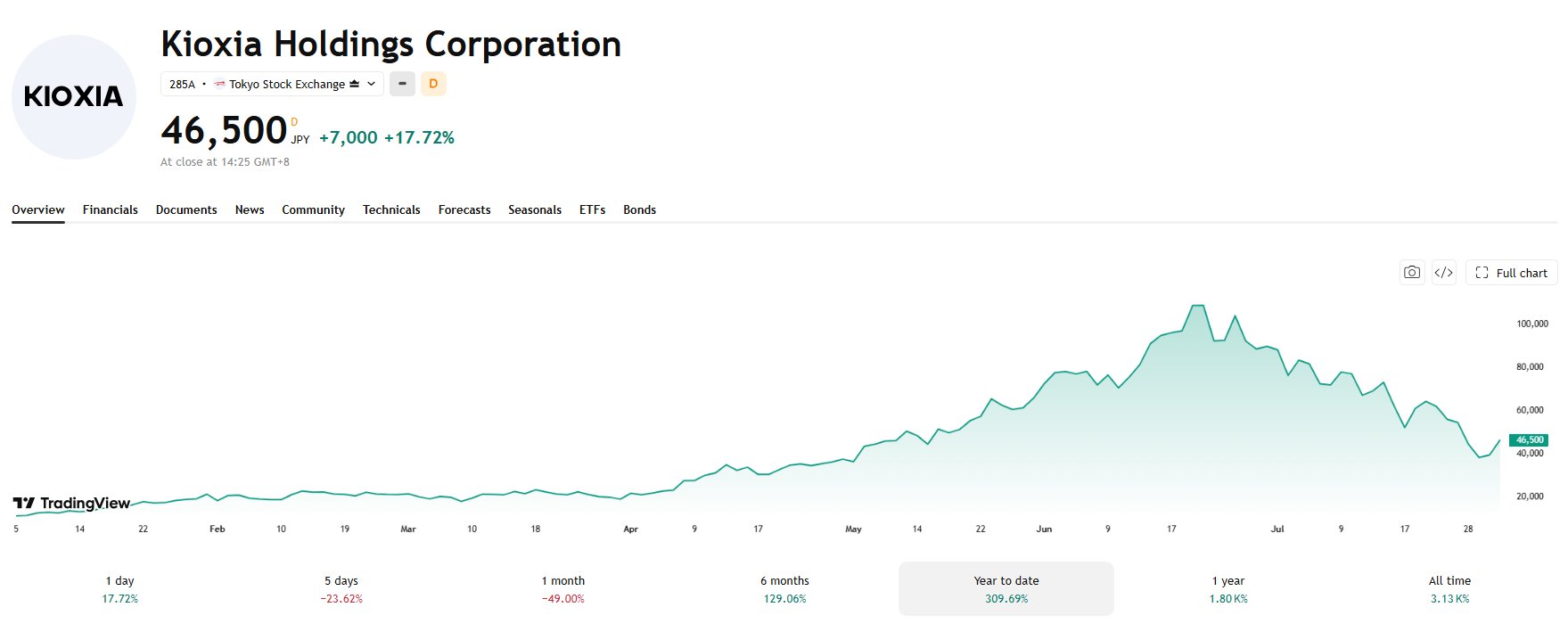
Kioxia's stock price has experienced drastic fluctuations. At some point this year, the company surpassed Toyota Motor Corporation and SoftBank Group for a short time to become the company with the highest market capitalization in Japan. Subsequently, as the global semiconductor sector fell into a continuous sharp decline caused by extreme deleveraging liquidation and overcrowded position clearing triggered by frequent breakdowns in the Korean stock market, investors were increasingly concerned about the vulnerability of tech giants to generate AI revenue that would not bring significant return on investment and that Kioxia's performance prospects faced increasingly intense competition. Kioxia's stock price fell sharply, erasing two-thirds of the previous increase in just one month.
Omdia analyst Akira Minamikawa said that Kioxia must make greater efforts to attract so-called American hyperscale cloud computing supergiants because these companies have closer ties with Korean suppliers. These large-scale AI data center constructions and “new cloud” computing power rental operators such as CoreWeave usually provide multi-year supply contracts, so that component suppliers can more clearly determine future needs.
Tomoichiro Kubota, chief market analyst at Matsui Securities, said, “Although the scale of this stock repurchase is extremely large for a Japanese company, it is unclear whether this will be enough to make up for a situation where profits fall short of expectations.”
Absolute growth is still amazing, and marginal growth under fierce competition is beginning to become a risk
Kioxia management expects July-September revenue to reach 2.39 trillion yen, up 35.2% month on month; operating profit is expected to be 1.89 trillion yen, up 48.8% month on month; and net profit to mother is expected to be 1.27 trillion yen, up 50.8% month on month. This is by no means a guide to the decline in AI computing power demand; what really makes the market cautious is that 1.89 trillion yen is about 3.1% lower than the average forecast of 1.95 trillion yen given by eight senior Wall Street analysts compiled by the LSEG survey after recent frequent revisions, which means that NAND prices continue to rise, but the upward slope may no longer continue to exceed extreme optimistic expectations.
The stock price reaction must also be taken apart: Kioxia closed at 46,500 yen in the Tokyo market on July 31, up 17.72%, and hit a rise or fall, but the financial report was released at the close of 15:30 Japan time. Therefore, the day's rise and fall mainly reflected a global semiconductor counterattack and bearish recovery before earnings reports, and cannot be attributed to the financial report itself.
However, after the release of Kioxia's earnings report and future outlook, PTS once reported around 44,100 yen, down about 5.2% from the official closing price. This indicates that the market's characterization of the financial report is closer to “extremely strong performance but not sufficient to exceed expectations” rather than the undisputed significant benefit of a complete revision of the valuation. At the same time, the repurchase of up to 800 billion yen and a maximum of 30 million shares, and the 1 split of 3 shares effective October 1 will improve supply, demand, and liquidity per share, but they cannot replace the latest market predictions on the NAND price cycle.
PTS is Japan's private trading system (Private Trading System), that is, investors trade stocks outside of the Tokyo Stock Exchange through electronic platforms operated by securities companies, and some platforms provide after-market night trading; therefore, “PTS reports 44,100 yen” is equivalent to the after-market transaction price formed after Kioxia officially closes, and can be used to observe the immediate market reaction after financial reporting, but since trading volume and liquidity are usually lower than the main board, its price fluctuates more and cannot be completely equivalent to the official opening price the next day.
Kioxia - the most typical chip giant benefiting from the memory chip supercycle
Large AI training sets, model weights, checkpoints, vector databases, RAG corpus, multi-modal data, logs, and inference results all need to reside in high-capacity storage for a long time; during training, large-scale data needs to be continuously fed from object storage and local NVMe SSDs to the GPU cluster; the inference era further generates massive KV caches, long contexts, agent states, and retrieval data. HBM is responsible for the “hot data layer” with the highest bandwidth, DRAM is responsible for the working memory of the system, while enterprise-grade NAND SSDs carry a “thermal data and persistence layer” with a much larger capacity than HBM and a lower cost. Therefore, NAND is not a replacement for HBM, but rather co-expands the capacity with HBM and DRAM in the AI server's storage tier.
Notably, NVIDIA is promoting the expansion of some very large, short-life KV caches from expensive GPU video memory to rack or cluster flash storage layers. Kioxia's latest CM10 series is being designed for AI inference, KV Cache, and Nvidia CMX context storage solutions. It uses PCIe 6.0, NVMe 2.1 and BiCS-10, and the capacity covers 1.6TB to 61.44TB. The sequential reading performance is up to 92% higher than the previous generation, random reading is up to 85%, and supports cold plate liquid cooling. This means that enterprise-grade SSDs are being upgraded from traditional back-office storage to computing power infrastructure that directly affects GPU utilization, initial token latency, and inference throughput.
Kioxia's tenth generation BiCS FLASH, or BiCS-10, uses a 332 layer 3D NAND, 1Tb TLC particle, CBA wafer bonding and OPS structure. The NAND interface speed reached 4.8 Gb/s, which is 33% higher than the eighth generation; the bit density was increased by 59%, and the energy efficiency of writing and reading was increased by 18% and 30%, respectively. The economic significance of these improvements is not simply “more layers,” but each wafer can produce more bits while reducing power consumption per capacity, cooling costs, and server rack occupancy, thereby improving Kioxia's bit cost and total customer cost of ownership. BiCS-10 has begun to be delivered. Fab2 production is planned at the Kitakami Plant, and enterprise-grade and data center SSDs will be introduced first. The CM10 is a PCIe 6.0 enterprise SSD series for AI data centers. It is a downstream finished product and uses BiCS-10 flash memory.
What is more noteworthy is that NAND flash memory can be described as being fully upgraded from a traditional “cold data/capacity storage” asset that has been positioned by industry insiders for a long time to an “extended quasi-memory layer” in the AI inference era. It is likely to become one of the most important cutting-edge technology outlets in the memory chip industry after HBM's super storage system. The major advent of the HBF technology route constructed from NAND flash memory (that is, “high-bandwidth flash memory”) can be described as further strengthening this judgment. Sandisk (Sandisk), SK Hynix, and Samsung clearly define high-bandwidth flash memory (HBF) as a new form of NAND for AI “memory walls”. The goal is to provide greater capacity in AI inference, and claim that HBF can achieve performance close to “unlimited capacity HBM” in related inference tests, while significantly increasing the usable memory capacity.
Overall, this performance data and future outlook are a major benefit to Kioxia's fundamentals — revenue structure, profit elasticity, cash flow, and technical routes have all been verified; however, it is only beneficial to short-term stock prices “bottoming out rather than immediately revaluing”. The actual return of stock prices to the main upward wave requires that the actual operating profit for the next quarter once again exceed the agreed expectations of around 1.95 trillion yen, and prove that BiCS-10 production, yield, and large-scale customer orders are fulfilled simultaneously.
Nomura said earlier that the 126,000 yen bullish logic proposed by it is to be fulfilled requires three conditions: the NAND contract price continues to rise, Samsung and SK Hynix still concentrate most of the additional capital on HBM and DRAM rather than drastically expanding NAND, and BiCS-10 and CM10 successfully won the next-generation NAND share competition led by Samsung and Hynix, and passed the certification of US hyperscale cloud vendors and converted into multi-year orders. Therefore, 126,000 yen represents a bull market scenario where the storage supercycle continues and Kioxia takes the share of AI enterprise-grade SSDs, rather than an unconditional benchmark value.