
- PRICING
- LIVE QUOTES
- LEARN
- HELP


EN
IPO outlook | Behind Guangdong's breakthrough into Hong Kong stocks: Cold chain digital intelligence leaders earn 5.9 billion dollars a year, gross margin of less than 3% all year round
The cold chain market for agricultural products in China is experiencing a round of definite growth. In recent years, the market has continued to expand, driven by policy incentives, expansion of cold storage and logistics capabilities, and growing consumer demand for fresh, high-quality products. Data show that in 2025, China's agricultural cold chain market has increased to 531.9 billion yuan, an increase of more than 23% over 43.8 billion yuan in 2021; the cold chain agricultural products sales market is 3643.9 billion yuan, an increase of 28.5% over 2836.7 billion yuan in 2021. However, at this stage, the “big but not strong” characteristics of the industry are still prominent. There are many participants, low concentration, uneven degree of standardization, digital penetration rate is still low, and a large number of distribution links still rely on manual experience and offline coordination. This structural gap is also nurturing huge new business opportunities.
Zhitong Finance noticed that recently, Shenzhen Yue10 Holdings Co., Ltd. (hereinafter referred to as “Guangdong Ten Smart”) once again submitted a prospectus to the Hong Kong Stock Exchange. This company, founded in 2019, claims to be a “technology-driven enterprise” and has independently developed and continuously upgraded the Guangdong Ten Smart Cold Chain Cloud Platform. As of July 21, Guangdong's comprehensive cold chain digital intelligence solution has been deployed by more than 750 domestic cold chain operators, covering about 30 provinces, autonomous regions and municipalities directly under the Central Government. Furthermore, in terms of sales revenue of cold chain agricultural products in 2025, the company ranked 6th in the cold chain digital agricultural products sales market in China.
However, turning over the prospectus, a more complicated picture emerged: Guangdong Shishuzhi's cumulative net loss from 2023 to 2025 exceeded 2 billion yuan, and the cash flow from operating activities continued to be negative. Whether Guangdong's tech-labelled wisdom can rely on its fundamentals to impress discerning investors in the secondary market still seems to be a question that will take time to verify.
The scale of revenue has skyrocketed, and the profit schedule is showing?
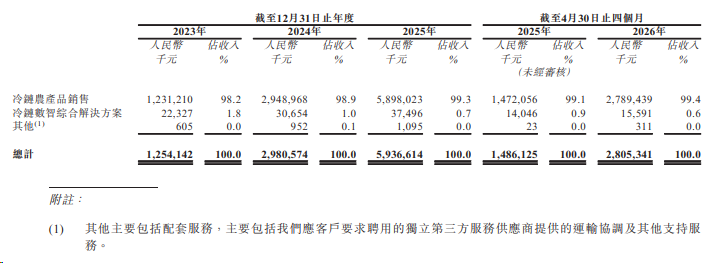
In the past few years, with the advancement of China's cold chain logistics infrastructure and the development of agricultural digitalization, the cold chain agricultural product sales market has continued to expand. According to the data, the market size of China's cold chain digital agricultural products sales market has reached 601.2 billion yuan in 2025. Benefiting from the development of cold chain infrastructure and favorable policy support for logistics digitalization, Guangdong's revenue scale exploded in 2023-2025, growing continuously from 1,254 billion yuan to 5.937 billion yuan, corresponding to a compound annual growth rate of 117.6%. In the first 4 months of this year, Guangdong's revenue was 2,805 billion yuan, a year-on-year increase of 88.8%.
Looking at the split revenue structure, sales of cold chain agricultural products are the main source of revenue for Guangdong Shishuji. From 2023 to 2025, the revenue from this business accounted for 98.2%, 98.9%, and 99.3% of total revenue, respectively. In 2025, sales of cold chain agricultural products contributed 5.898 billion yuan in revenue. In contrast, the revenue of the cold chain digital intelligence integrated solution business in the same period in 2025 was only about 37.5 million yuan, and its share of total revenue has declined to 0.7% from 1.8% in 2023.
Judging from the difference in profitability, the gross margin of the above two business lines of Guangdong Shishuji is also very different: from 2023 to 2026, the comprehensive gross margin of the cold chain digital integrated solution business was 82.2%, 89.8%, 93.8%, and 94.4%, respectively. Not only did the gross margin remain above 80%, but it also showed the characteristics of increasing year by year; as a comparison, the gross margin of cold chain agricultural product sales hovered below 3% for a long time.
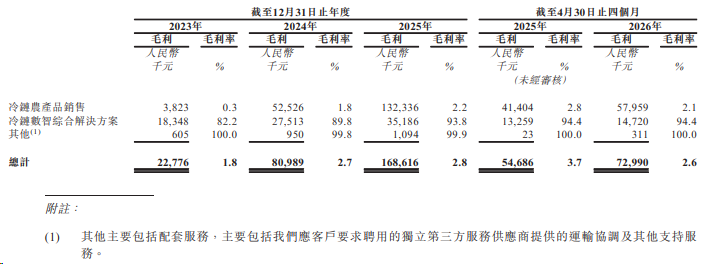
The profitability of the main business is weak. As a result, the comprehensive gross margin of Guangdong Shishuzhi remains low all year round. The data shows that from 2023 to 2026, the company's gross profit was 22.776 million yuan, 809.89 million yuan, 169 million yuan, and 72.99 million yuan respectively, with corresponding gross margins of 1.8%, 2.7%, 2.8%, and 2.6% respectively. Moreover, judging from net profit indicators, in 2023-2025, Guangdong Shishuzhi's net losses reached 28.266 million yuan, 219 million yuan, and 1,764 billion yuan respectively, with a total net loss of more than 2 billion yuan over three years. In the first 4 months of 2026, Guangdong Shisuzhi's net profit was 35.882 million yuan, successfully reversing losses. It is worth mentioning here that Guangdong Shijiazhi recorded a huge loss in 2025, but this performance was not due to poor operation, but rather to book losses of 1,833 billion yuan due to changes in the fair value of the attached preferred shares issued by it, accounting for 104% of the total losses for the year.
The expansion of the business landscape is positive, and the implementation of the strategy is ready to be tested
With a low profit base, they went to battle lightly. Will the resubmitted Guangdong Ten Smart Company push the door to the Hong Kong stock market in one fell swoop?
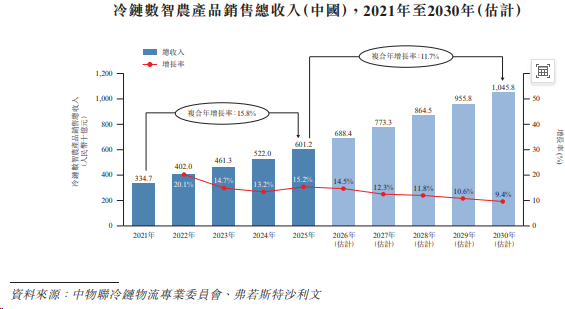
First, from an industry perspective, the cold chain digital agricultural product sales circuit is still expanding at this stage. Currently, the digital penetration rate of the cold chain agricultural products sales market is still relatively low, and the digital needs of a large number of small and medium-sized wholesalers and cold chain operators have not been fully satisfied. According to Frost & Sullivan data, China's cold chain digital agricultural products sales market is expected to reach 1.05 trillion yuan in 2030, and the compound annual growth rate from 2025 to 2030 is 11.7%, far higher than the 4.1% growth rate of the overall cold chain agricultural products sales market. In other words, there is still considerable room for growth on the subdivided circuit where Guangdong's top ten intellects are located.
As far as the strategic path is concerned, Guangdong Ten Smart has planned four clear driving directions in its prospectus: overseas expansion, domestic penetration, R&D investment, and strategic investment. Among them, the overseas market is the most noteworthy new variable of Guangdong Ten Suji. The company plans to enter regions with stable demand for imported cold chain agricultural products such as Southeast Asia and the Middle East in stages, while selectively exploring opportunities in North America and Europe. The essence of this strategy is to replicate the “purchase-sales” link that has already been run domestically to overseas. However, overseas expansion means higher operating costs and more complex compliance requirements, and the company's ability to execute in this area has yet to be verified.
The strategy for the domestic market is more focused on inventory exploration. The Guangdong Ten Digital Smart Plan relies on more than 750 cold chain operator nodes that have been deployed to reach a centralized potential customer base at a lower cost and turn them into trading customers through standardized entry procedures and transparent pricing mechanisms. The logic behind this idea is that the company's existing solution deployment network itself is a customer acquisition channel, and there is no need to rely on a huge offline sales team like traditional traders. At the same time, the product portfolio is optimized by analyzing historical transaction data and regional demand characteristics, and the transaction frequency and customer unit price of existing customers are increased.
At the R&D level, the company plans to continue to strengthen data analysis capabilities and shift the R&D focus from improving platform functions to data governance and intelligent decision support. In addition, the company has also set aside funds for selective investment and acquisitions. The goals include domestic and foreign cold chain traders and upstream slaughter and processing enterprises with mature market positions, with the intention of improving the industrial chain layout through epitaxial mergers and acquisitions.
Ultimately, however, the credibility of a strategic plan still depends on the pace and efficiency of implementation. The geographical differences in overseas markets, the long-term nature of brand building, and the uncertainty of mergers and acquisitions are all real challenges facing Guangdong's top ten intellects. With the profit base still low, whether these investments can be converted into substantial profit contributions within a predictable period of time is a question that the market cannot avoid when evaluating their long-term value.
All in all, the rapid revenue growth of Guangdong Ten Smart has proven the explosive power of its business model in the booming segmentation circuit, but as the company submits the report twice, I believe the market will also look at it with a more careful eye. In my opinion, there will probably be no clear answers to this series of questions in the short term when the high-margin cold chain digital intelligence integrated solution business can be expanded, whether the profit ceiling for cold chain agricultural product sales can actually be broken through, and whether the long-term investment in overseas expansion and brand building can be realized as scheduled. However, in the face of the secondary market, Guangdong Ten Digital Intelligence, which has a technology label, probably still needs to show more solid profit performance in order for investors to truly be convinced of its long-term value.