
- PRICING
- LIVE QUOTES
- LEARN
- HELP


EN
Tokyo inflation accelerates for the second month in a row, and the Bank of Japan is still on track to raise interest rates
The Zhitong Finance App learned that the growth rate of inflation in Tokyo has accelerated for the second month in a row, so the Bank of Japan's path of raising interest rates again in the coming months is expected to remain unchanged. According to data released by Japan's Ministry of Internal Affairs and Communications on Friday, Tokyo's consumer price index (CPI) after excluding fresh food in July rose 1.9% year on year, higher than the 1.8% increase expected by economists. Excluding fresh food and energy prices, the core indicator that measures the level of inflation that the Bank of Japan closely monitors, rose 2% year over year. The overall consumer price index also rose 2%.
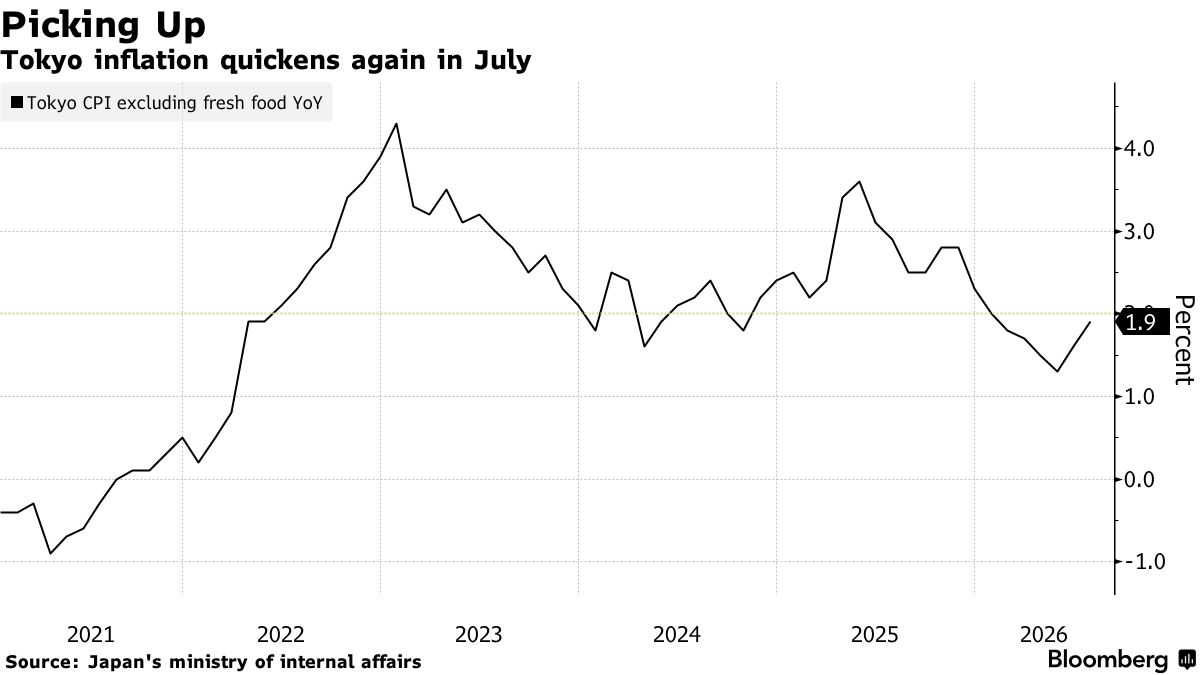
The Tokyo CPI is generally regarded as an important leading indicator for measuring price trends across Japan. The slowdown in the decline in electricity and natural gas prices and the continued rise in processed food prices are jointly driving up the Tokyo Price Index. However, due to government measures, the decline in gasoline prices has increased.
Takeshi Minami, chief economist at the Agriculture and Forestry Research Institute, said, “As the situation in the Middle East continues to escalate, I think prices, especially energy-related commodity prices, will continue to rise, and the cost of food and other commodities will increase further. As a result, the inflation rate is likely to remain above 2% starting this fall.”
Other data shows that Japan's economy remained relatively resilient in June despite continued challenges to energy procurement and supply chains from the Middle East war. According to data released by Japan's Ministry of Economy, Trade and Industry on Friday, Japan's industrial output in June increased 1.3% from the previous month and 4.2% year on year; retail sales increased slightly by 0.5% year on year, but fell 4.1% from the previous month.
Taken together, these data released a few hours before the Bank of Japan announced its policy decision will further support policymakers' stance of continuing to push forward interest rate hikes. Markets generally expect the Bank of Japan to keep interest rates unchanged at Friday's policy meeting. Currently, the main issue that the market is concerned about is the pace of future interest rate hikes.
Economist Taro Kimura said, “Tokyo's July CPI report shows that inflation is accelerating as oil prices soar from March to June and the weakening yen pushes up energy, food, and other import costs. These data should further reinforce the Bank of Japan's judgment that underlying inflation is moving closer to the 2% target and support it in continuing to reduce monetary stimulus measures.”
The weak yen has been an important factor driving inflation to remain high, as the cost of imported food and energy continues to rise. Kohei Okazaki, chief market economist at Nomura Securities, said, “The impact on energy costs is significant, and the rise in crude oil prices driven by the situation in the Middle East seems to have finally spread to the wider economy.” “The rise in prices has not only occurred in the crude oil and chemical products sector, but is also clearly reflected in the prices of household consumer goods.”