
- PRICING
- LIVE QUOTES
- LEARN
- HELP


EN
Wall Street's “precision chess game”? From the bursting of AI star funds to a tech stock frenzy, national capital is suspected of using Castle Fund to “dismantle” AI risks
The Zhitong Finance App learned that after several weeks of bloody storms caused by the bursting of the AI bubble, Wall Street broke big news on Thursday: Situational Awareness (SA), a mythical hedge fund founded by Silicon Valley star investor and former OpenAI researcher Leopold Aschenbrenner, suffered a “disaster of extinction” due to the use of high leverage in centralized AI holdings. According to reports, the fund has urgently sold its public stock portfolio of up to 16 billion US dollars to Ken Griffin (Ken Griffin)'s Citadel Fund (Citadel). This landmark event not only announced the fall of the brightest star in the current AI hedge fund era, but the “empty hole” expectations brought about by it also detonated a sharp rebound in US stocks overnight.
However, there is a different version of the story circulating among Wall Street traders. In this version, it's not just a regular liquidation — Castle Fund reached a deal within 24 hours to take over this “bloody chip,” but also a precise chess game woven together with geopolitics, industrial policy, and capital games.
From 439% annualization to rapid collapse: AI bubble on leverage
Situational Awareness is collapsing even faster than it has risen. Just a few weeks ago, Aschenbrenner was Silicon Valley's hottest fund manager. With the in-depth long article “Situational Awareness” published in 2024 to accurately predict AI computing power bottlenecks, he won the battle.
With a highly centralized allocation of AI infrastructure and extensive use of leverage, the fund's performance has been remarkable. People familiar with the matter revealed that as of the end of June 2026, the fund's net return was as high as 439%; the cumulative net return since inception was over 1000%. At the beginning of July, the scale of asset management swelled to 45 billion US dollars.
However, the ultimate return comes from extreme risk. According to reports, AschenBrenner aggressively uses high leverage to amplify investment returns in AI memory chips and related technology stocks. SA funds heavily invested in SK Hynix (SKHY.US), Micron Technology (MU.US), SNDK.US (SNDK.US), and CoreWeave (CRWV.US) were dealt a devastating blow during the severe deleveraging wave of global AI concept stocks over the past month. In July alone, its core holdings generally fell by more than 35%, and Margin Call under high leverage instantly pushed this 10 billion rising star into the abyss.
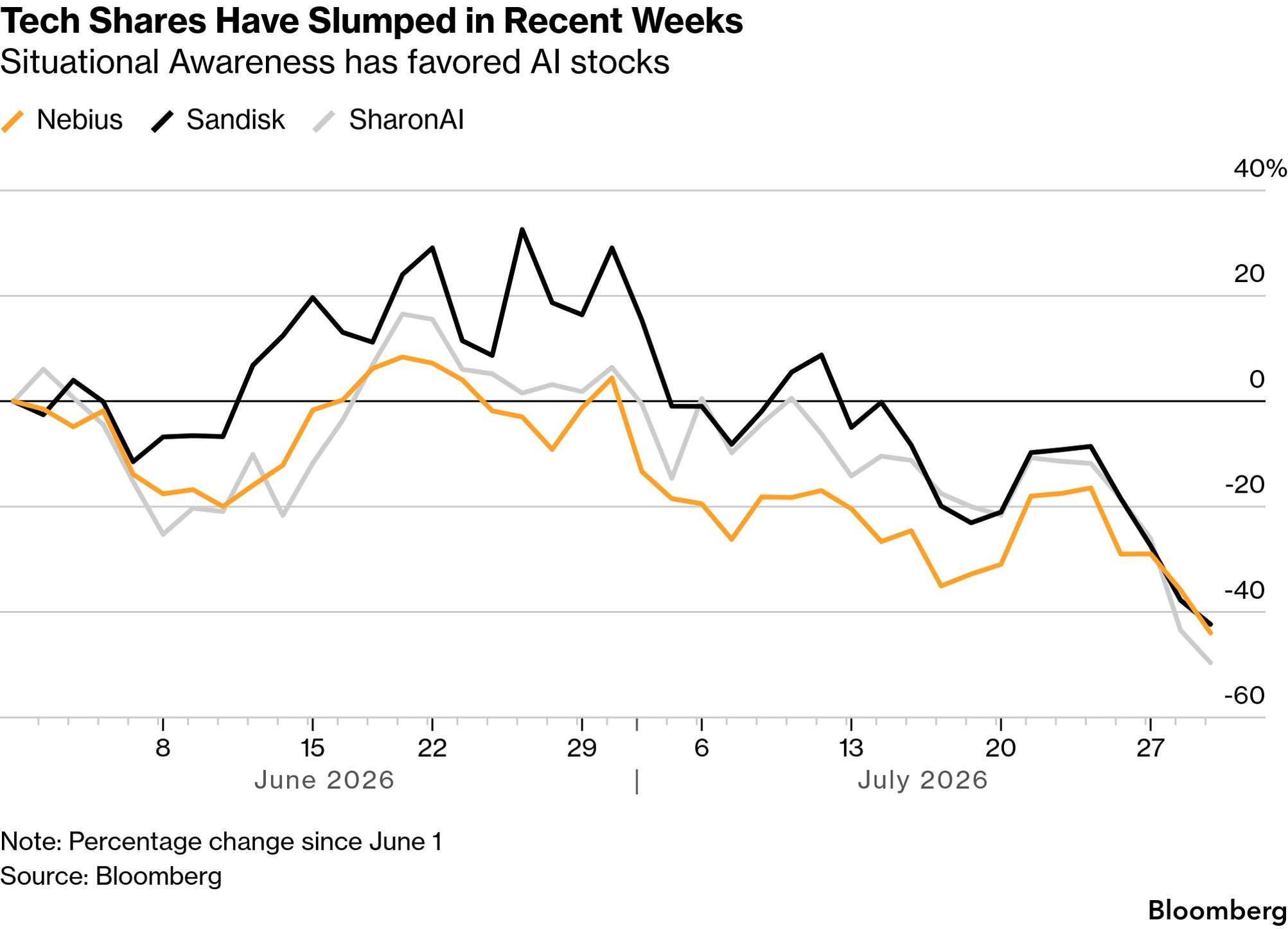
Due to the rapid pace of loss, Aschenbrenner tried to finance urgently or find a successor. In the end, he had to concentrate on reaching a package deal with Castle Securities to close the position and stop losses as quickly as possible to prevent losses from expanding further. People familiar with the matter revealed that major brokers, including Bank of America, Goldman Sachs and J.P. Morgan Chase, have been helping the fund meet margin requirements or reduce positions in an orderly manner. The fund urgently negotiated with a number of large institutions on Wednesday, hoping to sell some of its assets or raise new capital.
In the end, Castle Fund finalized the transaction in less than 24 hours to buy most of the fund's public stock holdings. According to reports, large multi-strategy funds such as Millennium Management have also participated in the bidding. Major brokers such as Goldman Sachs and J.P. Morgan are responsible for coordinating asset sales.
Castle's quick takeover and a bizarre US carnival: conspiracy theories have surfaced
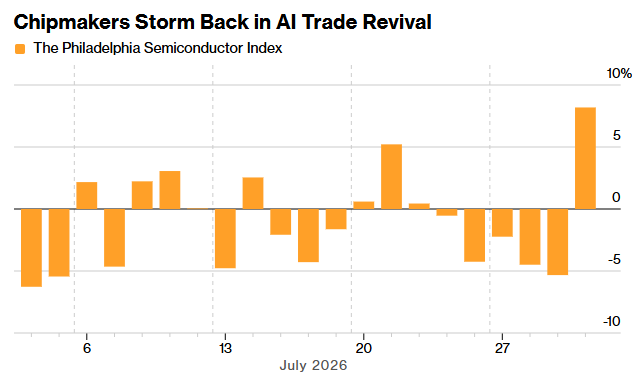
What really made the market atmosphere strange was that when news of Situational Awareness's bursting out came out, US stocks, especially the technology sector, which had previously surpassed the decline, not only did not fall due to panic, but instead ushered in a retaliatory surge. Investors generally interpret that with the last “stubborn” high-leverage AI bulls being completely cleaned out, the sell-off pressure on the market has been cleared in stages.
The most dramatic scene happened on July 30th. After the news broke, former Situational Awareness stocks collectively surged: SanDisk closed up 25.99%, CoreWeave 21.51%, Nebius 27.13%, SK Hynix 17.52%, Micron Technology 18.36%, Western Digital 15.37%, AMD 13%, and Oracle 8.34%.
And the “amazing coincidence” at this point in time is that in the past week, the US just suspended its military attack on Iran, and a heated dispute broke out within the White House over the blocking of the AI open source model. Furthermore, the transaction involved $16 billion in assets, and completed due diligence, pricing, and delivery in less than 24 hours — which suggests that the castle probably had a long time in advance about Situational Awareness's position structure. Although there is no evidence that the “visible hand” directly interferes with the market, the timing is indeed too coincidental, and conspiracy theories are rampant.
Agents of “National Capital”: Griffin's Political Undertones
The core anchor of the conspiracy theory is the identity of Citadel founder Ken Griffin. Griffin is not only one of Wall Street's most successful hedge fund managers, but also a Republican superfinancier. Griffin is not only the Republican Party's supermoney holder, but is also rumored to be inextricably linked to the Trump administration and various intelligence agencies. The Federal Election Commission's latest disclosure shows that the Republican Party has raised 1.1 billion US dollars in campaign funding for the midterm elections, which is more than three times that of the Democratic Party. Of this funding, Griffin made a single donation of $10 million to the Senate Leadership Fund. In the 2024 election cycle, Griffin was the fifth largest political donor in the US, donating tens of millions of dollars to Republican political groups.
At a time when geopolitical tension and the direction of the AI industry is uncertain, letting a hedge fund that knows the industry's internal information but is too aggressive in risk control leave the market quietly — let a “Silicon Valley Prodigy Fund”, which has deep AI industry core secrets (Situational has extremely deep internal information from top AI teams) but is too aggressive in terms of risk control, quietly leave the market, and the “National Will” or “Wall Street Founding School” to receive bloody chips through institutions such as securities with strong carrying capacity. The Castle Foundation, which has strong risk absorption capacity and a background in politics and business, undertakes bloody chips, and is seen as a behind-the-scenes method for “Wall Street establishment” and “national will” to join forces to prevent a chain collapse of AI strategic assets, which in turn causes a systemic financial crisis.
Is national capital “defusing” systemic risk?
According to some opinions, the castle's takeover was essentially a “financial stabilization” operation involving the Wall Street establishment and the will of the country. Arguments supporting this view include: first, Fitch clearly warned in the “Third Quarter Global Risk Outlook” that AI-related market pullback risks have become one of the main short-term risks in the global credit environment; second, the Bank for International Settlements (BIS) also warned that the AI investment collapse may spread to the credit market; and third, Goldman Sachs and J.P. Morgan Chase have requested additional security deposits from hedge funds with excessive concentration on technology assets.
If Situational Awareness's $16 billion position “hard lands” on the open market, it could trigger a wider chain reaction of forced liquidation. Orderly acceptance through an agency such as Castle is equivalent to suddenly removing a boulder crushed on the AI sector.
Famous economist Jim Cramer described this incident as a “liquidation incident,” believing that forced liquidation may indicate that AI transactions have bottomed out. Market analysts pointed out that after the fund was cleared, the “huge chip selling pressure” was finally completely lifted, which attracted large amounts of bottom-up funds and shortfall compensation.
Analysts linked the “liquidation of SA's positions” to the “shocking reversal of US stocks at the end of the session”, believing that this was the same trader's operation behind the scenes: first let rivals liquidate positions through shorting and leverage, and then use the release of liquidity after the takeover to cover up the general market counterattack.
Is the castle “orderly liquidation” of AI assets as a “white glove” with national will?
Another notable detail is that Castle bought the portion of the public portfolio supported by leveraged financing from brokers, and the fund retained positions purchased with its own funds, as well as investments in private companies such as Anthropic. Among them, Anthropic's holdings are valued at around $5 billion.
Aschenbrenner's fiancee, Avital Balwit, is Anthropic CEO Dario Amodei's chief of staff. Conspiracy theorists interpret this link as the reason why Aschenbrenner's fund was able to keep Anthropic shares is because Anthropic itself is a core pawn in the US government's AI strategy — a company that has always been viewed as a representative of “safe AI” and is closely linked to national security agencies. And Aschenbrenner received a “partial exemption” through this level of personal relationships.
Anthropic is not only OpenAI's biggest competitor, but more importantly, it has close “national security” cooperation with the US Department of Defense and the intelligence community. Conspiracy theorists point out that given Leopold Aschenbrenner's deep understanding of the militarization of AI shown in his “Situational Awareness” paper, he may have been absorbed into some kind of “national project” a long time ago. When leverage in the secondary market broke down, Ken Griffin (Ken Griffin), who has close ties to the White House and the Republican Party, came forward to quickly “pocket” this part of the assets through Castle Securities to ensure that when the AI singularity approaches, the shares of core AI companies do not fall into the hands of foreign sovereign funds or competitors due to the collapse of the open market.
On the other hand, Castle won strategically valuable shares in AI computing power and power infrastructure at a very high discount, and completed a perfect collection of low-level chips. Situational Awareness's portfolio centrally controls a large number of AI core computing power and power infrastructure stocks such as Micron, CoreWeave, Nebius, and SK Hynix. If Situational is allowed to forcibly close positions on the open market, or if overseas capital is taken over as a “white knight” at a low level, the “AI national security assets” that the US military and the White House highly value will be infiltrated by offshore capital.