
- PRICING
- LIVE QUOTES
- LEARN
- HELP


EN
Omnicell’s (NASDAQ:OMCL) Q2 CY2026: Beats On Revenue But Stock Drops On Weak Guidance

Healthcare tech company Omnicell (NASDAQ:OMCL) beat Wall Street’s revenue expectations in Q2 CY2026, with sales up 7.4% year on year to $312.2 million. On the other hand, next quarter’s revenue guidance of $304 million was less impressive, coming in 2.9% below analysts’ estimates. Its non-GAAP profit of $0.94 per share was significantly above analysts’ consensus estimates.
Is now the time to buy Omnicell? Find out by accessing our full research report, it’s free.
Omnicell (OMCL) Q2 CY2026 Highlights:
- Revenue: $312.2 million vs analyst estimates of $310.4 million (7.4% year-on-year growth, 0.6% beat)
- Adjusted EPS: $0.94 vs analyst estimates of $0.47 (significant beat)
- Adjusted EBITDA: $67.23 million vs analyst estimates of $39.45 million (21.5% margin, 70.4% beat)
- The company reconfirmed its revenue guidance for the full year of $1.24 billion at the midpoint
- Management raised its full-year Adjusted EPS guidance to $2.22 at the midpoint, a 17.1% increase
- EBITDA guidance for the full year is $180 million at the midpoint, above analyst estimates of $162.8 million
- Operating Margin: 10.4%, up from 2.8% in the same quarter last year
- Free Cash Flow Margin: 17.9%, up from 10.7% in the same quarter last year
- Market Capitalization: $1.88 billion
Company Overview
Driven by the vision of an "Autonomous Pharmacy" with zero medication errors, Omnicell (NASDAQ:OMCL) provides medication management automation and adherence tools that help healthcare systems and pharmacies reduce errors and improve efficiency.
Revenue Growth
A company’s long-term sales performance can indicate its overall quality. Any business can experience short-term success, but top-performing ones enjoy sustained growth for years. Over the last five years, Omnicell grew its sales at a mediocre 4.8% compounded annual growth rate. This was below our standard for the healthcare sector and is a tough starting point for our analysis.
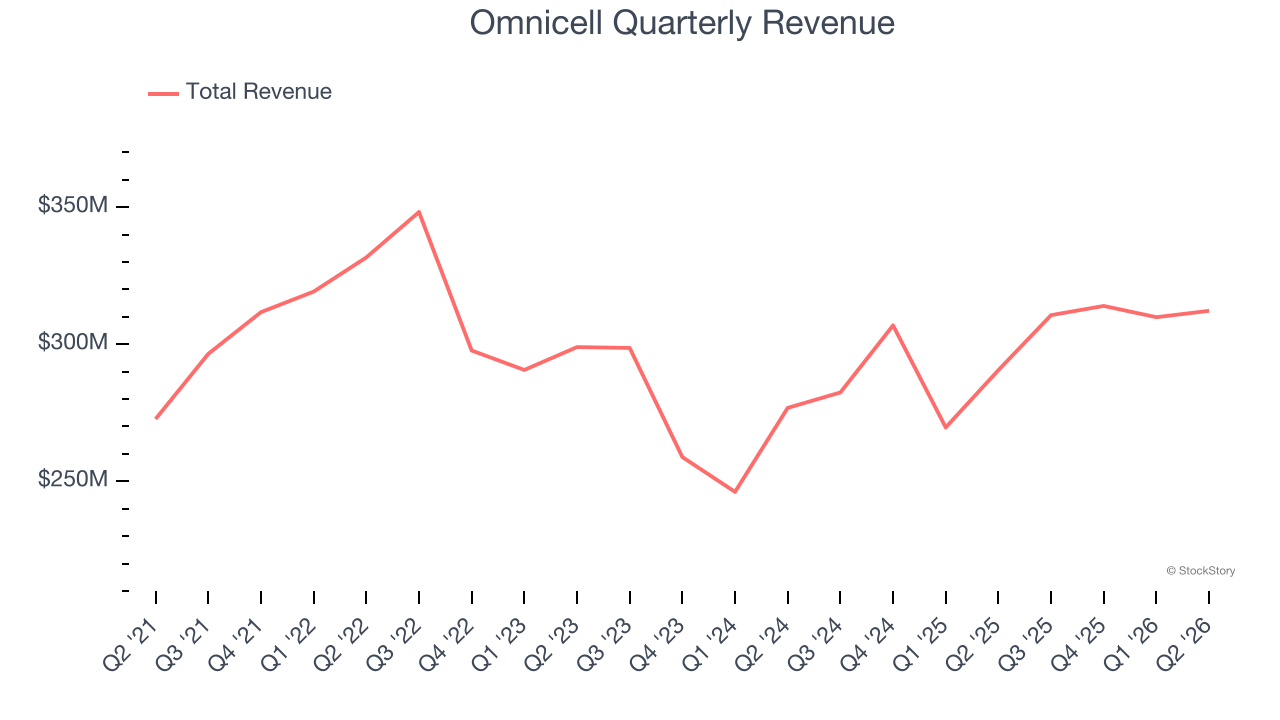
Long-term growth is the most important, but within healthcare, a half-decade historical view may miss new innovations or demand cycles. Omnicell’s annualized revenue growth of 7.4% over the last two years is above its five-year trend, which is encouraging. 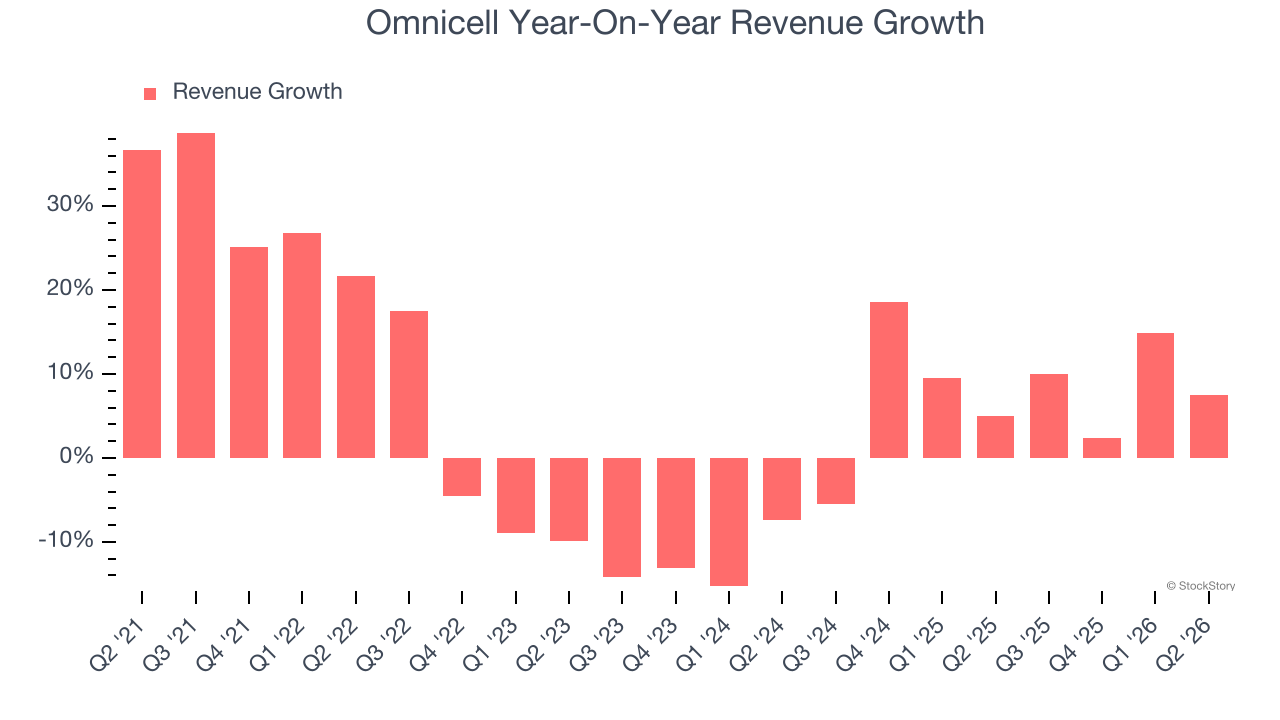
We can dig further into the company’s revenue dynamics by analyzing its most important segment, Product. Over the last two years, Omnicell’s Product revenue averaged 11% year-on-year growth. This segment has outperformed its total sales during the same period, lifting the company’s performance. 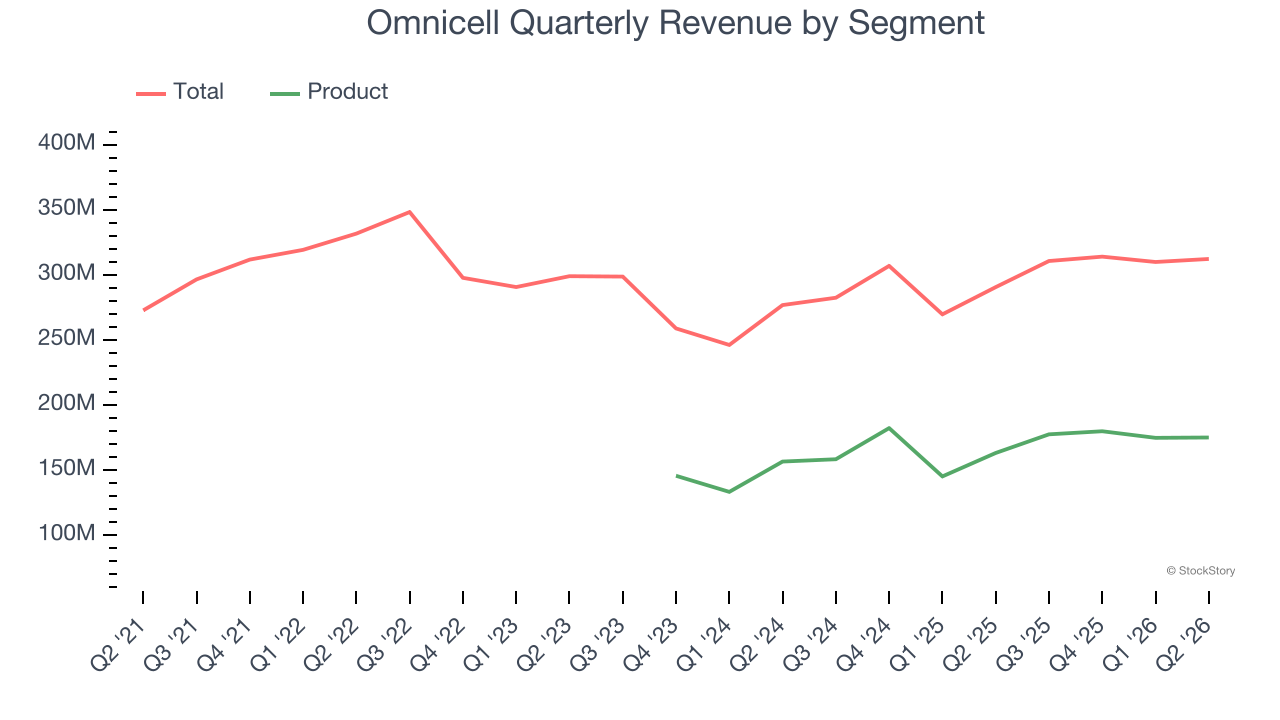
This quarter, Omnicell reported year-on-year revenue growth of 7.4%, and its $312.2 million of revenue exceeded Wall Street’s estimates by 0.6%. Company management is currently guiding for a 2.1% year-on-year decline in sales next quarter.
Looking further ahead, sell-side analysts expect revenue to grow 2.3% over the next 12 months, a deceleration versus the last two years. This projection is underwhelming and indicates its products and services will face some demand challenges.
ONE MORE THING: The $21 AI Application Stock Wall Street Forgot. While Wall Street obsesses over who’s building AI, one company is already using it to print money. And nobody’s paying attention.
AI chip stocks trade at ridiculous valuations. This company processes a trillion consumer signals monthly using AI and trades at a third of the price. The gap won’t last. The institutions will figure it out. You need to see this first. Read the FREE Report Before They Notice.
Adjusted Operating Margin
Omnicell was profitable over the last five years but held back by its large cost base. Its average adjusted operating margin of 9.3% was weak for a healthcare business.
Looking at the trend in its profitability, Omnicell’s adjusted operating margin decreased by 3.8 percentage points over the last five years, but it rose by 4.7 percentage points on a two-year basis. Still, shareholders will want to see Omnicell become more profitable in the future.
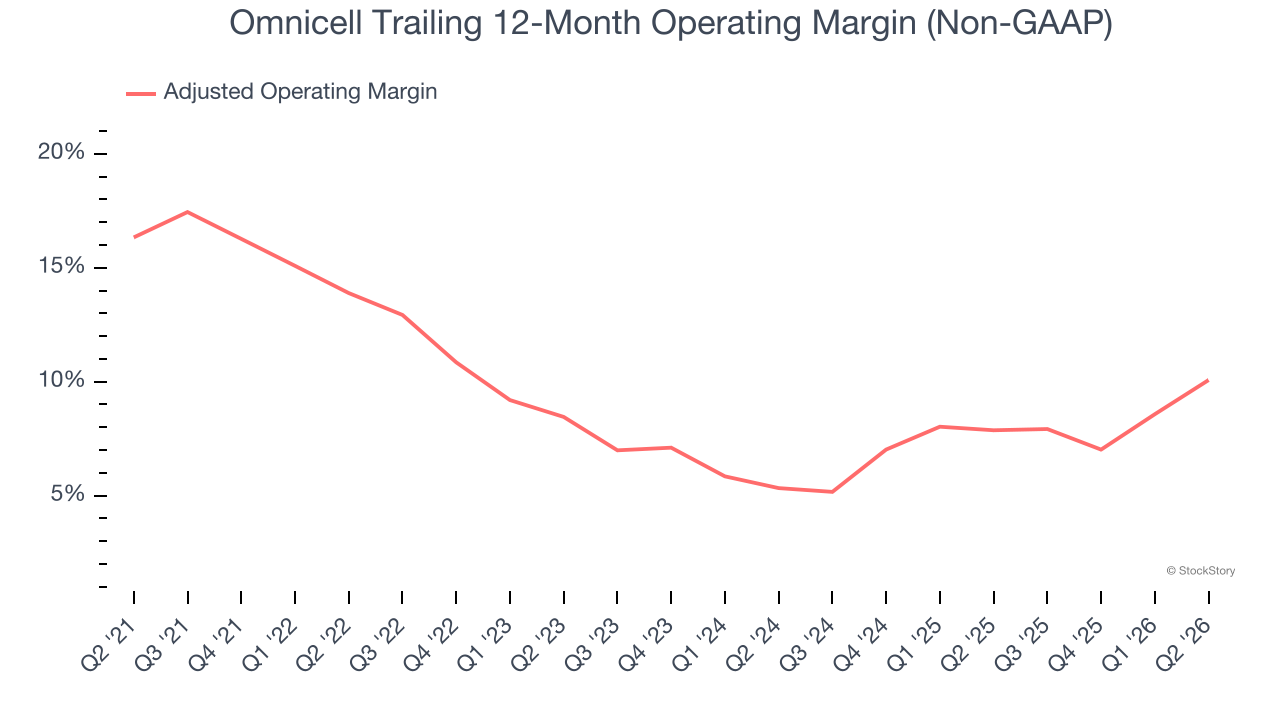
This quarter, Omnicell generated an adjusted operating margin profit margin of 14.3%, up 6 percentage points year on year. This increase was a welcome development and shows it was more efficient.
Earnings Per Share
Revenue trends explain a company’s historical growth, but the long-term change in earnings per share (EPS) points to the profitability of that growth — for example, a company could inflate its sales through excessive spending on advertising and promotions.
Sadly for Omnicell, its EPS declined by 6.2% annually over the last five years while its revenue grew by 4.8%. This tells us the company became less profitable on a per-share basis as it expanded due to non-fundamental factors such as interest expenses and taxes.
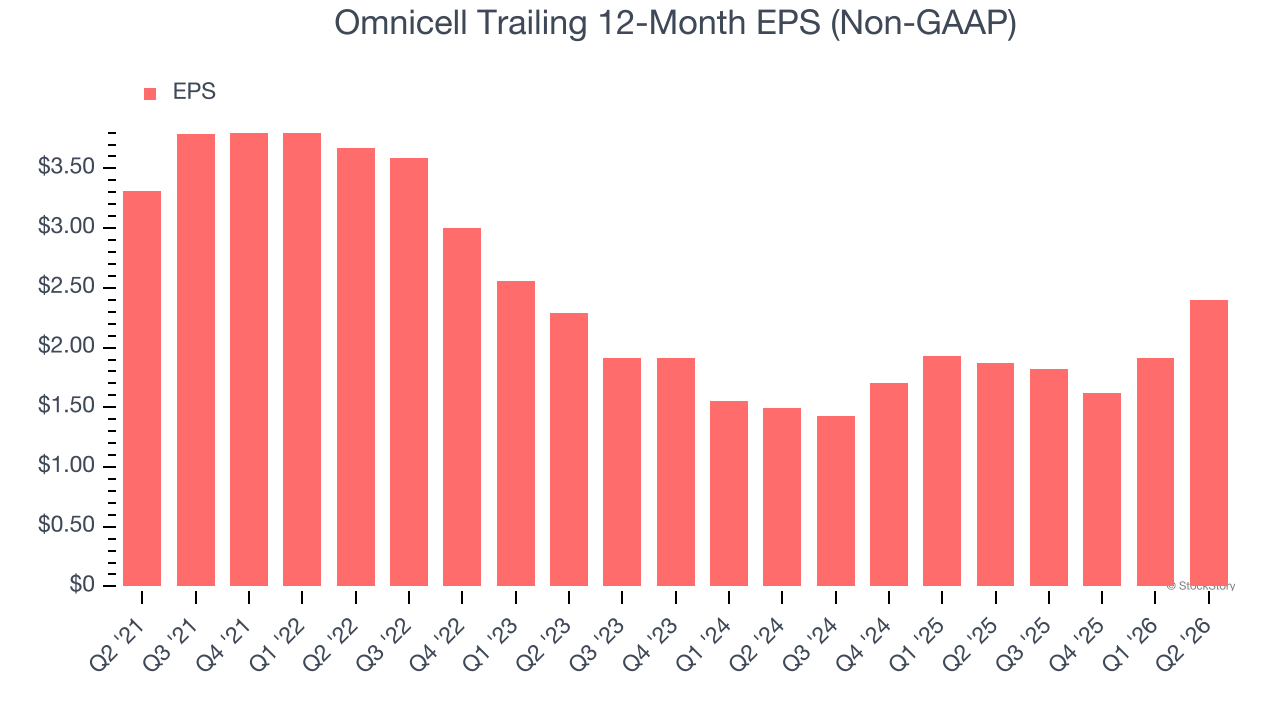
Diving into the nuances of Omnicell’s earnings can give us a better understanding of its performance. As we mentioned earlier, Omnicell’s adjusted operating margin expanded this quarter but declined by 3.8 percentage points over the last five years. This was the most relevant factor (aside from the revenue impact) behind its lower earnings; interest expenses and taxes can also affect EPS but don’t tell us as much about a company’s fundamentals.
In Q2, Omnicell reported adjusted EPS of $0.94, up from $0.45 in the same quarter last year. This print easily cleared analysts’ estimates, and shareholders should be content with the results. Over the next 12 months, Wall Street expects Omnicell’s full-year EPS to shrink by 19.8% from $2.40 to $1.92.
Key Takeaways from Omnicell’s Q2 Results
It was good to see Omnicell beat analysts’ EPS expectations this quarter. We were also glad its full-year EBITDA guidance trumped Wall Street’s estimates. On the other hand, its revenue guidance for next quarter missed and its EPS guidance for next quarter fell short of Wall Street’s estimates. Zooming out, we think this was a mixed quarter. The market seemed to be hoping for more, and the stock traded down 5.6% to $39.08 immediately following the results.
So do we think Omnicell is an attractive buy at the current price? The latest quarter does matter, but not nearly as much as longer-term fundamentals and valuation, when deciding if the stock is a buy. We cover that in our actionable full research report which you can read here (it’s free).