
- PRICING
- LIVE QUOTES
- LEARN
- HELP


EN
The “light capital AI” route is facing a major test of performance! Apple (AAPL.US) is on the list tonight, and the options market is cautiously bullish
The Zhitong Finance App learned that in the early morning of Friday, Beijing time, Apple will release financial results for the third fiscal quarter of fiscal year 2026. This is not only a key window for the market to test its performance resilience and AI strategy, but it will also be the last earnings conference call before Tim Cook (Tim Cook) hands over the position of CEO (CEO) to hardware director John Ternus (John Ternus) on September 1. Facing the peak of stock prices approaching historic highs and market capitalization approaching 5 trillion US dollars, the derivatives market is sending a strong signal of high risk hedging and profit locking in.
Cautious signals from the options market: Volatility expectations are moderate, bullish bets are huge, but the downside defense line is congested
Although the market generally expects Apple to hand over a solid report card again, the options market's pricing reflects unprecedented prudence. Currently, Apple's stock price is close to 338 US dollars, and the average premium for the 340 US dollar cross-option is about 12.05 US dollars. The short-term trading range is expected to be 328.45 US dollars to 352.55 US dollars, implying that the stock price fluctuates about 3.5% to 3.8% after the financial report. According to Cboe LiveVol data, this implied fluctuation is far higher than the historical average fluctuation of over 1% over the past year. According to SpotGamma data, options market pricing fluctuated around 4% after financial reporting.
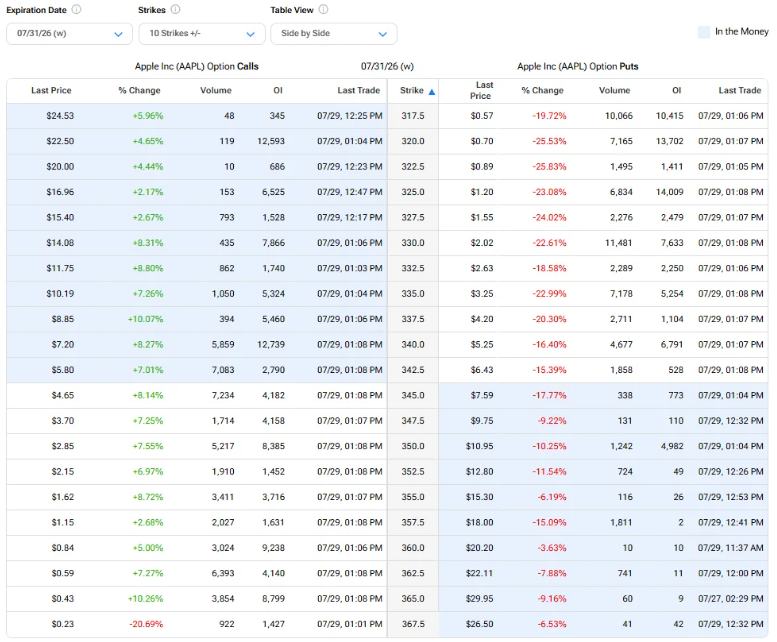
The historical average daily fluctuation after Apple's earnings report was only 1.63%, but the implied fluctuation shown by the options market this time has reached nearly double the historical average. The trading volume of put options is concentrated at exercise prices of $330, $317.50, and $300, with each exercise price trading volume close to or greater than 10,000 contracts.
Despite the surge in demand for bearish protection, bullish bets are just as huge — options traders placed $442 million in call options last week, climbing the total premium to $590 million ahead of earnings reports. Apple's bearish/call option ratio is 0.89, which is about 0.72 above normal, indicating that bullish betting is heating up in tandem with hedging activity. In terms of call options, the most traded fictitious call option is at an exercise price of $362.50, which means that the stock price needs to rise by more than 6% to achieve real value.
This rapid accumulation of deep false put options indicates that institutional and retail investors are rushing to build a downward protective barrier to prevent the iPhone 17 cycle from falling short of expectations or stock price retracement caused by an unexpected surge in AI capital expenditure. The “bearish overcrowding, bullish restraint” layout shows that the market recognizes Apple's historical resilience, but investors are paying an additional “safety premium” for CEO handovers, memory cost shocks, and any surprises under the $5 trillion valuation.
Performance expectations: The revenue growth rate is close to the upper limit of the guideline, and iPhone leads the growth
The market's expectations for Apple this quarter are quite adequate. Wall Street Consensus estimates that Apple's Q3 revenue is about US$108.96 billion, up 15.87% year on year, close to the company's previous revenue guidance limit of 14% to 17%; earnings per share are expected to be 1.89 US dollars, up 20.38% year on year. Apple has surpassed analysts' revenue expectations for 13 consecutive quarters.
The iPhone remains the core engine of growth. The market expects iPhone sales to reach $53 billion this quarter, up about 20% year over year. Goldman Sachs offered a more optimistic split: iPhone revenue is expected to be $54.8 billion (+23% year over year), driven by a 15% increase in shipment volume and an average sales price increase of about 7%. The rise in component costs — especially the increase in the price of memory chips — has instead boosted consumers' preference for high-end Pro models, supporting average sales prices.
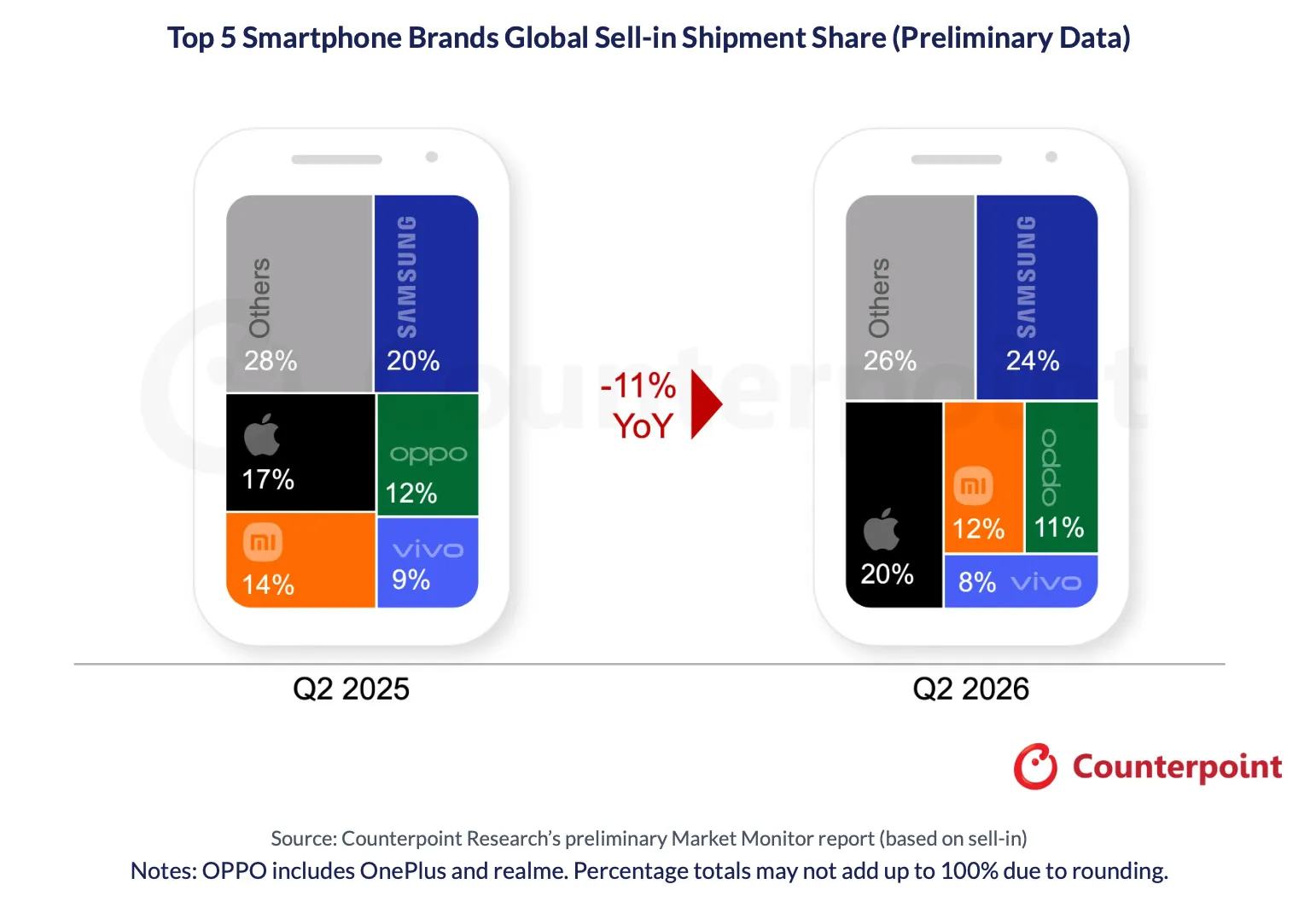
According to Counterpoint data, global smartphone shipments fell 11% year on year in the second quarter, and Apple shipments bucked the trend and increased by about 3%, and the global share reached 20% for the first time. UBS pointed out that Apple was the only leading smartphone manufacturer that did not raise prices for all products in the second quarter, which helped it gain share in key markets such as China, the US, and Europe.
The Chinese market is the biggest variable. Apple's revenue in Greater China increased 38% in the last quarter. The iPhone recorded “the best performance quarter in history” in the Chinese market. Users of upgraded switches reached a record high, and new users who switched from the Android camp also achieved double-digit growth. However, whether this trend can continue in Q3 will have a direct impact on overall performance.
The high-margin service business is still an important profit “ballast stone”. The market expects service revenue of about US$31.4 billion, an increase of about 14% over the previous year. The gross margin of the service business exceeds 70%, far higher than the gross profit margin of the product business of about 37%. However, according to Sensor Tower data, the year-on-year growth rate of App Store revenue has slowed to 3.2% from 9.8% in the previous quarter, but the strong performance of iCloud and licensing businesses is expected to offset this impact.
Apple's overall revenue for the second quarter was US$111.2 billion, a record high for the March quarter, with a year-on-year increase of 17%. The iPhone 17 series contributed $56.99 billion in single-quarter revenue, and the service business also set a new record of US$30.98 billion.
Cost surges: Storage price increases put pressure on gross profit margins, and the September fiscal quarter is even worse
Management has warned that as DRAM and NAND prices continue to rise, memory procurement costs will rise significantly, giving gross margin guidance of 47.5% to 48.5%, lower than 49.3% in the second fiscal quarter. Counterpoint Research estimates that due to price increases of LPDDR5X and NAND, the cost of a single iPhone component has increased by about $200.
Bank of America expects product gross margin to fall from a high level to 36.8%, fall further to 34.1% in September, and only rise to 38.5% after the release of the high-priced iPhone in December. The bank clearly reminded investors: “The fiscal season in September is the key cycle to focus on.” KeyBanc analyst Brandon Nispel is even more pessimistic — if Apple increases iPhone prices to cope with cost pressure, user growth will slow down, ultimately dragging down service business growth.
Fortunately, Apple previously benefited from lower-cost inventory to cushion part of the impact, but this smooth wind factor is fading away. If component costs continue to rise faster than Apple's offset through pricing or supply chain efficiency, profit margin expansion may slow.
Last month, Apple raised the prices of MacBooks and iPads, officially passing on higher memory and storage costs to consumers for the first time. But the price of the iPhone hasn't been adjusted yet — Morgan Stanley deduces that if Apple wants to maintain its existing gross profit margin during the iPhone 18 cycle, it may need to raise the starting price of the iPhone 18 Pro by about $200.
The reverse victory of “light capital AI”: from AI loser to biggest winner
Since this year, Apple's stock price has risen by about 25%, making it the most prominent among tech giants with a trillion-dollar market capitalization; however, Nvidia's cumulative increase this year was only 5.6%. This differentiation reflects a deep shift in the capital market's AI investment logic — from chasing “who spends the most money on AI” to favoring “who can reap AI dividends at the lowest cost.”
Hyperscale cloud vendors, such as Alphabet, Microsoft, Meta, and Amazon, are collectively spending hundreds of billions of dollars on AI infrastructure construction. And these companies' stock prices are clearly under pressure this year — analysts call this trend “AI capital expenditure skepticism” — the larger the gap between capital investment and return on revenue, the heavier the pressure on stock prices.
Apple's stock price performance in 2026 is a story about “not doing it”. The capital expenditure for fiscal year 2025 was only about 12.7 billion US dollars. While Microsoft, Google, and Meta competed for AI data centers with 100 billion dollars of capital expenditure, Apple adopted a hybrid architecture of “mainly the end side+supported by private cloud”, and the capital expenditure remained stable. At a time when doubts about the return on AI investment are spreading, this “asset-light” strategy has instead become the biggest differentiating advantage.
Wall Street has seen Apple as a “safe haven” during the turbulent era of AI. Nigam Arora, founder of The Arora Report, said: “Apple has a great opportunity to help stabilize the market this week. Investors see it as a defensive stock because it doesn't invest tens of billions of dollars in AI infrastructure like some of its peers.”
At the AI product level, Apple officially released Apple Intelligence and the upgraded Siri AI in WWDC 2026. Basic AI features are free, but some high-load features will set daily usage limits, and users will need to subscribe to iCloud+ to unlock higher limits. Whether this “light capital+subscription monetization” path can show commercialization results in this financial report will be the focus of investors' attention.
Valuation and outlook: a “perfect price” of $5 trillion
On July 28, Apple's stock price hit an all-time high of 342.89 US dollars in intraday time. The market capitalization once broke through the 5 trillion US dollar mark, making it the second listed company in history to reach this valuation milestone. Just the day before, Apple had just surpassed Nvidia and regained the top position in global market capitalization.
At the valuation level, the current stock price corresponds to about 38 times the expected price-earnings ratio for this year. Analysts expect earnings per share to grow by around 9% in FY2027 — for a single-digit company, a price-earnings ratio of nearly 40 times means that the market has put a lot of optimistic expectations ahead of time.
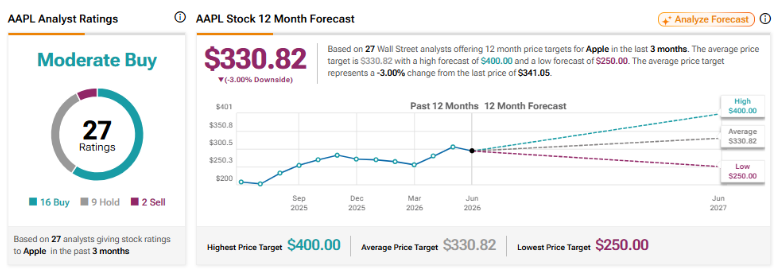
Wall Street's consensus rating for Apple is a “moderate buy” — 16 purchases, 9 holdings, 2 sales in the past three months. The average target price is around $330.82. Bank of America, on the other hand, is more optimistic, maintaining a “buy” rating with a target price of $380.
The product cycle adjustments faced by Apple this quarter are also worth paying attention to. Apple will no longer be selling all new iPhones at the same time this year — the Pro, Pro Max, and folding screen versions will be launched as scheduled in September, but the standard version and the new iPhone Air will be delayed until March 2027. Bank of America estimates that due to this, revenue for the fourth fiscal quarter was about 106 billion US dollars, while the Wall Street consensus was 114 billion US dollars. There is a difference of about 8 billion US dollars between the two.