
- PRICING
- LIVE QUOTES
- LEARN
- HELP


EN
“Voting with your feet” in the bond market: Walsh hawkish rhetoric is hard to stand still, and 30-year US bond yields soar to a 19-year high
The Zhitong Finance App learned that the bond market sent a clear signal: although Federal Reserve Chairman Kevin Walsh said tough words on curbing inflation, he doesn't seem to be in a hurry to use the central bank's policy tools to fulfill his promises.
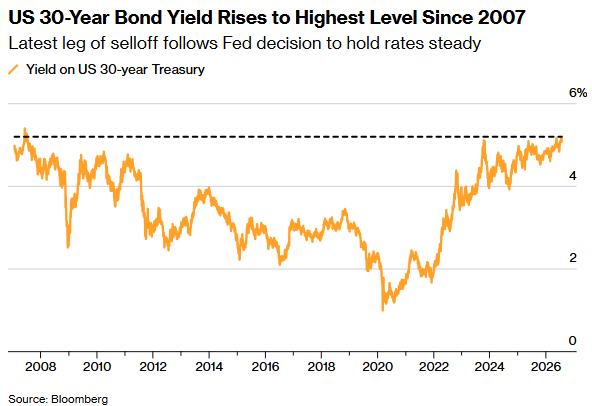
After the Federal Reserve kept interest rates unchanged for the seventh month in a row, investors sold off 30-year US Treasury bonds in a big way, driving their yield to soar by 14 basis points to nearly 5.23%, a record high in 19 years. The market's inflation expectations are rising at the same time, the US dollar is weakening, and US stocks are falling under pressure — investors generally bet that Walsh is only delaying the inevitable rate hike.
This shift in the market reflects growing concerns among investors that it will be difficult for Walsh to contain inflation which has been above the Federal Reserve's target level for five consecutive years.
In this context, bondholders, on the one hand, lowered the yield on shorter-end treasury bonds — which showed that they quickly lowered their bets on the Fed's immediate interest rate hike; on the other hand, they demanded that long-term treasury bonds provide higher risk compensation to hedge against inflationary uncertainty in the next few years. The decline in two-year yields went hand in hand with the rise in 30-year yields, making the yield curve steeper after the current Federal Reserve decision, at least the highest since the mid-90s of the last century.
Ben Emmons, managing director of fixed income at Highline Asset Management and founder of FedWatch Advisors, said that this steepening shows that Walsh's “policy strategy lacks credibility.”
“It is a convenient way for the market to make its own judgments and tighten the monetary policy environment,” Emmons pointed out. “However, once inflation accelerates, the market assumes that the Federal Reserve is falling behind the curve again, and this approach may be counterproductive.”
The resolution kept the benchmark interest rate unchanged at 3.5% to 3.75%. Since the last rate cut in December last year, this interest rate level has remained unchanged for seven months. At this point, just over two months have passed since US President Trump promoted Walsh to take over the Federal Reserve.
Trump previously downplayed inflationary pressure and repeatedly criticized Walsh's predecessor Jerome Powell for failing to cut interest rates, which heightened market concerns about whether the Federal Reserve can maintain its political independence — and independence is the cornerstone of its policy credibility.
However, since the last meeting, Walsh has emphasized on several occasions that the Federal Reserve will do whatever it takes to return inflation to the target level of 2%.
Despite this, the Federal Reserve maintained a wait-and-see attitude, although Walsh described the economy as still strong. During the press conference, when repeatedly asked why the consumer price index was still holding on at a time when the consumer price index was still rising by 3.5% year-on-year, Walsh pointed out that the jump in long-term market interest rates has objectively taken on part of the Federal Reserve's policy tightening work.
Jack McIntyre, portfolio manager at Brandywine Global Investment Management, said, “I don't remember seeing reporters on the spot where they were confused and asked for more clarification. The market feels the same way.” He believes that the sharp rise in long-term yields reflects a lack of confidence in the market, and that “long-term investors don't believe in his anti-inflation narrative.”
Walsh's statement prompted traders to postpone the expected timing of the Federal Reserve's first rate hike until later this year. The two-year US Treasury yield has declined, and traders are now relying instead on subsequent inflation and employment data to determine the Federal Reserve's policy path.
As investors bet that the Federal Reserve will face increasing pressure to act, the stock market fell sharply, and the S&P 500 index closed down 1.5%. This is clearly evidenced by the three voting commissioners opposing keeping interest rates unchanged and advocating immediate interest rate hikes at this meeting.
Kevin Flanagan, head of investment strategy at WisdomTree, said, “The appearance of three negative votes means that internal differences are being made public.”
On the eve of the meeting, some Wall Street institutions have begun predicting that the Federal Reserve will raise interest rates. Traders gradually raised the probability of interest rate hikes to 40%, showing that in such a short period of time before a decision was made, market consensus was rarely seriously divided.
This uncertainty is likely to continue, as Walsh is abandoning his predecessor's usual practice of sending early signals of policy direction to the market, which he fears will make policymakers passive.
Conning North America's chief investment officer Cindy Beaulieu pointed out that Walsh didn't even take the opportunity to hint where he would speak at the Jackson Hole annual meeting at the end of August — and this occasion has always been an important window for central bank officials to release policy signals.
“He described this as 'a blank sheet of paper',” Beaulieu said. “This may cause the market to have more doubts about whether the Federal Reserve is actually preparing to raise interest rates.”
A series of changes in the bond market are beginning to put a real brake on the economy by driving up long-term interest rates. This trend is driven not only by continued high inflation, but also by other factors, such as growing federal debt and a new wave of huge financing due to investment in artificial intelligence by large technology companies.
WisdomTree's Flanagan said, “The market is already tightening financial conditions for the Federal Reserve. However, in the end, the effects of market tightening are limited. If Walsh continues to maintain his hawkish rhetoric and economic data points in the direction of interest rate hikes, then his credibility will be tested.”