
- PRICING
- LIVE QUOTES
- LEARN
- HELP


EN
Dear Palantir Stock Fans, Mark Your Calendars for August 3
Every earnings season brings plenty of updates, but only a handful of reports have the potential to change the conversation around a stock. That moment may have arrived for Palantir Technologies (PLTR), the data analytics and artificial intelligence software company, which is set to report second-quarter earnings after the closing bell on Monday, Aug. 3. Despite consistently delivering strong operational results, the stock has struggled to translate that performance into sustained gains.
PLTR stock’s remarkable rally lost steam in 2026 as investors rotated out of enterprise software stocks following rapid advances in AI models from Anthropic and OpenAI. After racing to nearly $200 late last year, PLTR has spent much of 2026 trading in a narrower range, currently down 39.4% from its all-time high. Robust revenue growth, expanding margins, and solid government and commercial demand have kept the business humming, leaving Wall Street split between valuation concerns and confidence in the company’s long-term AI leadership.
The pullback has taken some of the froth out of the stock, but it has also raised the stakes for the upcoming earnings report. Investors will be looking for more than another revenue beat – they want evidence that Palantir’s growth story remains intact. Many analysts believe another quarter of robust government and enterprise demand could help reignite the stock’s momentum.
With expectations running high once again, let’s analyze what Wall Street expects from Palantir’s upcoming earnings report.
About Palantir Stock
Founded in 2003, Denver-based Palantir began to support national security through smarter data. Fast forward, and it now powers decision-making across governments and industries through Gotham, Foundry, and its newest force multiplier, the AIP, launched in 2023. This is not just software, but strategic infrastructure. Palantir enables institutions across four continents to transform fragmented data into operational clarity and action. With a market cap of $296.14 billion, it is a software titan in the large-cap space.
Palantir investors have had to adjust to a very different market in 2026. After riding the AI wave to a 52-week high of $207.52 last November, the stock has spent much of this year giving back those gains. Shares tumbled to a 52-week low of $106.37 on June 25 and remain 39.4% below their peak. Over the past 52 weeks, PLTR has declined 19.48%, while the stock is down 29.23% year-to-date (YTD) and 8.82% over the past three months.
What’s interesting is that the business has not been the problem. Palantir has continued reporting record revenue growth, beating expectations and raising guidance. Instead, investors have become increasingly focused on whether the company’s premium valuation can keep pace with its lofty growth expectations.
That caution has been fueled by several factors. Investors have worried about slower international growth, uncertainty over the renewal of Palantir’s U.K. NHS contract, and the challenge of sustaining extraordinary growth as the company gets larger. Broader concerns over inflation, geopolitical tensions, and a more risk-averse market have also weighed on sentiment.
Another headwind came from the broader AI trade. Money rotated out of AI software stocks and into semiconductor names benefiting from the AI infrastructure boom. Palantir also faced fresh scrutiny as concerns about competition from Anthropic resurfaced. Adding to the pressure, investor Michael Burry reiterated his bearish stance, arguing that Anthropic was “eating Palantir's lunch” while continuing to question the company’s lofty valuation.
However, sentiment has started to improve in July. PLTR has gained 8.9% over the past month, helped by reports that Burry trimmed his short position, a series of bullish analyst notes, and an expanded partnership with Nvidia (NVDA) that integrates Nemotron AI models into Palantir’s platform for the United States government and allied customers. As investors warm back up to AI software and Palantir continues delivering strong operating results, the stock appears to be regaining some momentum.
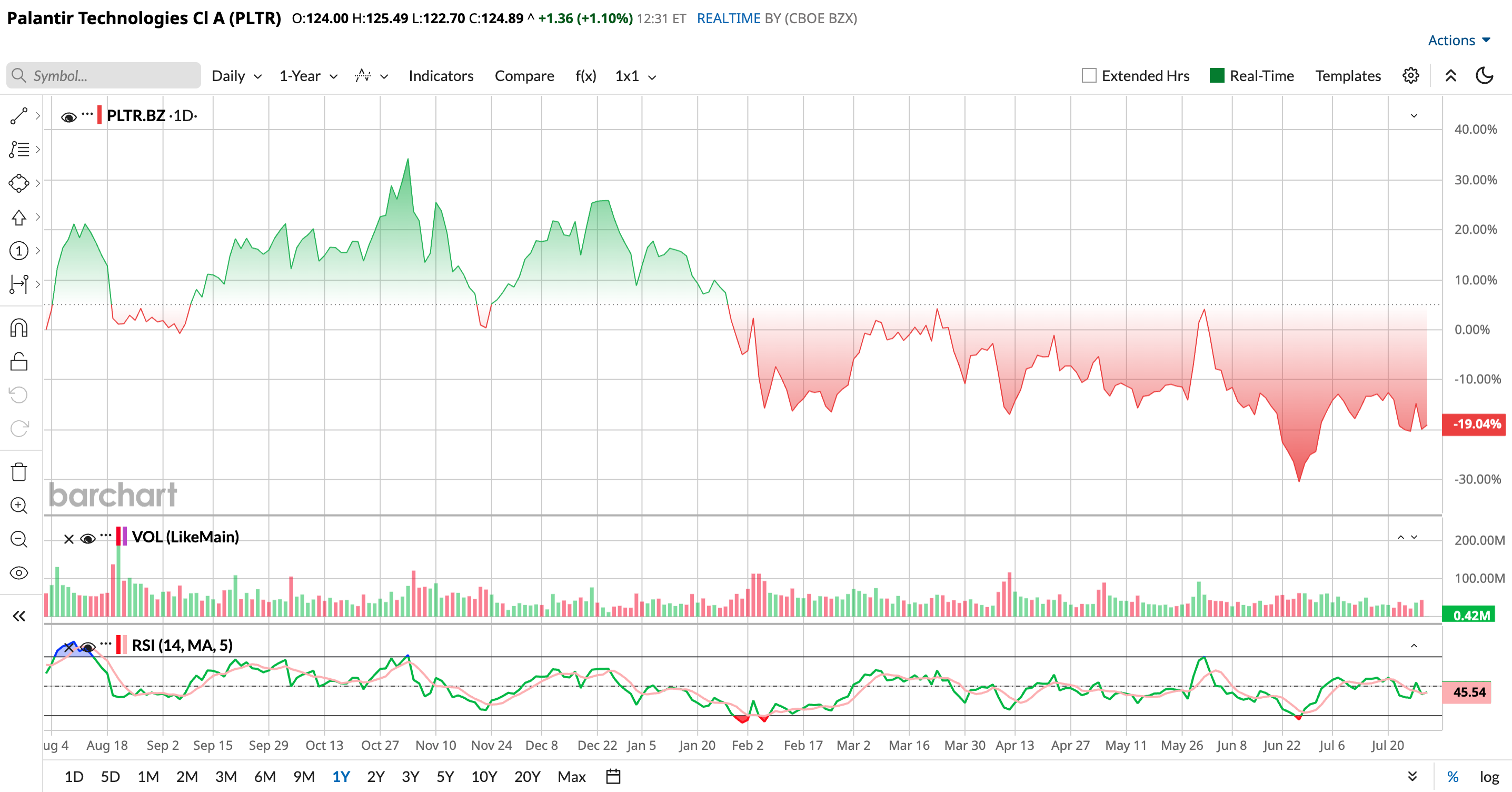
Palantir's stock is not exactly a bargain. Even after its recent pullback, PLTR trades at 83.69 times forward non-GAAP earnings and 38.35 times sales, remaining priced well above most software peers. Investors are clearly paying for years of AI-driven growth, leaving the stock with little room for execution hiccups or slower-than-expected growth.
A Snapshot of Palantir’s Q1 Numbers
Palantir’s Q1 report, released in May, was impressive. It cleared Wall Street’s expectations, posting record first-quarter revenue of $1.63 billion, up 85% year-over-year (YOY). It marked Palantir’s 11th consecutive quarter of accelerating revenue growth. That signals a remarkable streak for a company of its scale and one that underscores the growing demand for its Artificial Intelligence Platform (AIP).
The biggest growth engine remained the U.S. market. Total U.S. revenue surged 104% annually, fueled by robust demand from both commercial customers and government agencies. The commercial business revenue jumped 133% YOY, as more enterprises adopted Palantir’s AI software to automate workflows and improve decision-making. Meanwhile, the company’s government segment showed no signs of slowing, with U.S. government revenue climbing 84% to $687 million, driven by new contract wins and expanding deployments.
Palantir ended the quarter with 1,007 customers, a 31% YOY increase, while existing clients continued spending more on its platform. The company’s top 20 customers generated an average of $108 million per customer in trailing 12-month revenue, up 55% annually. Net dollar retention reached 150%, indicating customers are significantly expanding their use of Palantir’s software over time. Plus, total contract value bookings soared 135%, providing a healthy pipeline for future growth.
The company’s bottom line remained just as impressive. Adjusted EPS came in at $0.33, comfortably ahead of analysts’ estimates. Operating cash flow nearly tripled to $899 million, and Palantir finished the quarter with $2.3 billion in cash and no short-term debt, highlighting the strength of its balance sheet alongside its rapid growth.
Management also struck a confident tone for the quarters ahead. It raised full-year 2026 revenue guidance to $7.65 billion to $7.662 billion, implying roughly 71% annual growth, while lifting its outlook for U.S. commercial revenue to more than $3.224 billion, representing growth of at least 120%.
For Q2, the company expects revenue between $1.797 billion and $1.801 billion and adjusted income from operations of $1.063 billion to $1.067 billion, setting a high bar for its upcoming earnings release.
Meanwhile, analysts tracking Palantir expect the company’s Q2 revenue to be around $1.8 billion, and EPS is projected to rise impressively by 115.4% YOY to $0.28. Looking ahead, fiscal 2026 EPS could be around $1.17, up 85.7% annually, and rise by another 41.9% to $1.66 in fiscal 2027.
What Do Analysts Expect for Palantir Stock?
Oppenheimer has turned increasingly bullish on PLTR ahead of its Q2 earnings report, reiterating an “Outperform” rating and a $200 price target and believes Palantir is well-positioned to beat consensus estimates and raise its full-year guidance.
According to Oppenheimer analyst Param Singh, the company’s momentum continues to be driven by strength in both its U.S. government and commercial businesses. The analyst expects U.S. government revenue to grow in the low-80% range during Q2, supported by higher Department of Homeland Security spending, the ongoing war in the Middle East, and expanding adoption across multiple U.S. military branches and combatant commands. While growth in Europe may remain softer as some allies explore alternative providers, Oppenheimer believes Palantir’s domestic government business remains a powerful growth engine.
On the commercial side, the analyst argues that concerns about competition from large language model providers are overstated. It believes Palantir’s Ontology platform serves far more complex enterprise workflows, giving the company a durable competitive advantage while positioning it for continued growth.
Baird analyst William Power is also in Palantir’s corner, maintaining an “Outperform” rating and a $200 price target. He also expects continued strength across both the commercial and government businesses and believes free cash flow could eventually reach $8 billion in 2027, although his current forecast stands at a more measured $6.7 billion.
Recently, Cleveland Research highlighted softer spending trends among the company's commercial customers, according to StreetInsider.com, and PLTR stock came under pressure on Tuesday.
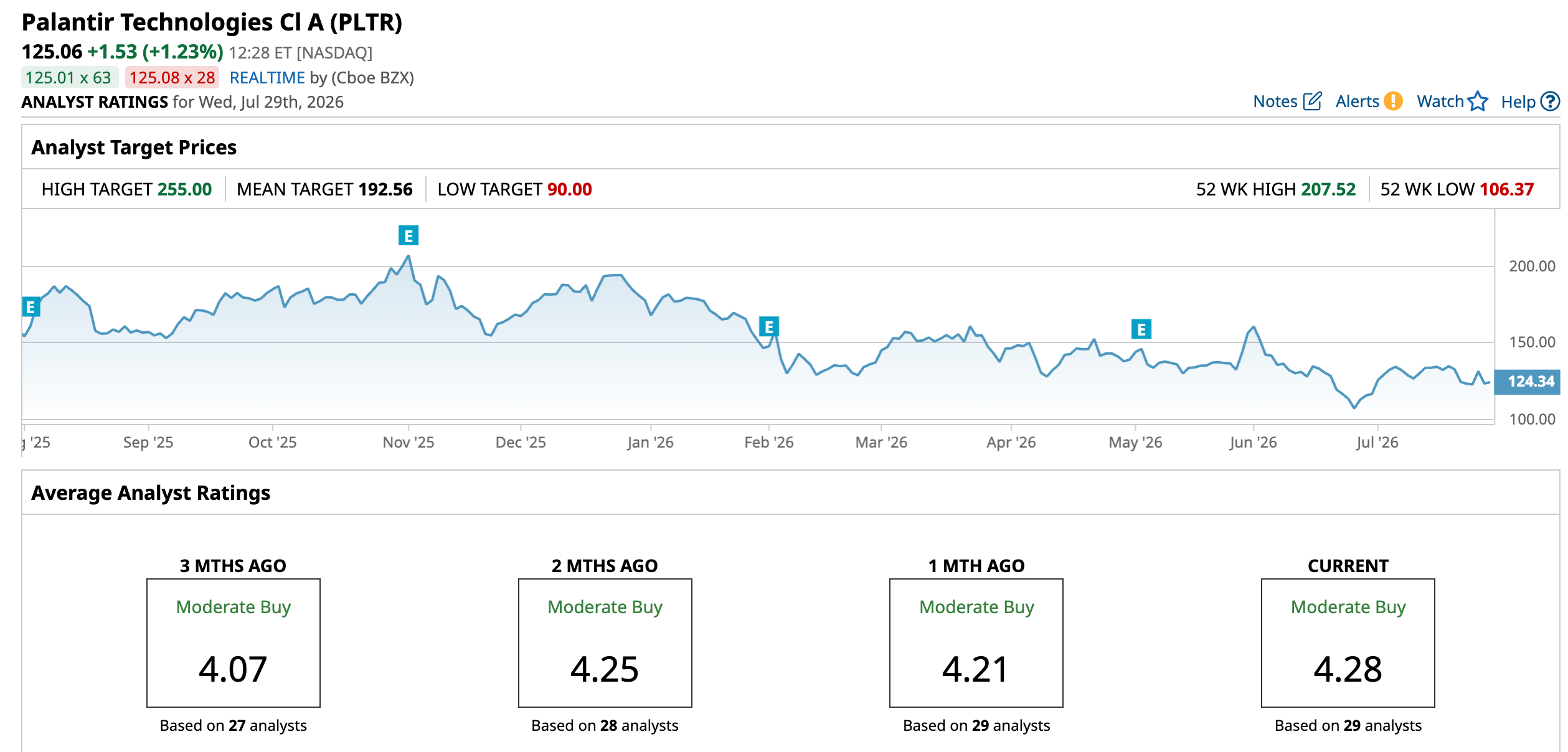
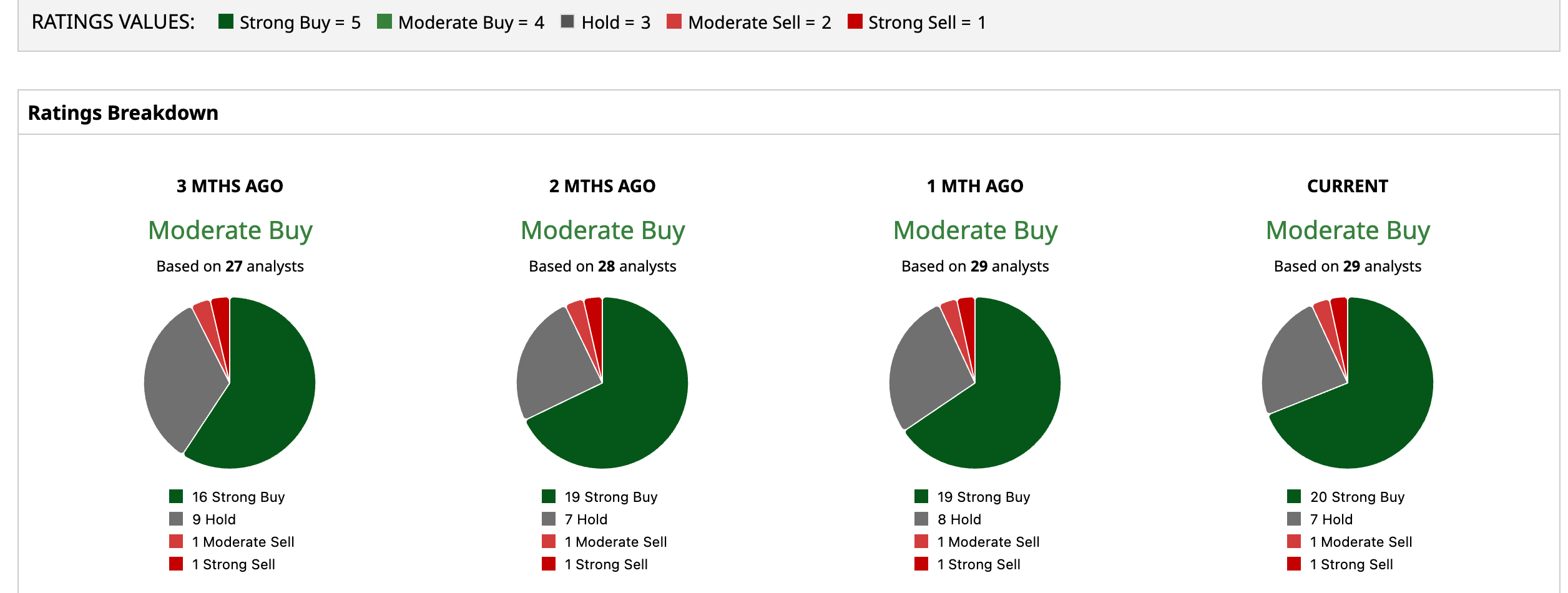
The debate around Palantir is not going away anytime soon. Growth bulls continue to outnumber valuation skeptics, leaving the stock with a consensus “Moderate Buy” recommendation. Of the 29 analysts, 20 advise a “Strong Buy,” seven analysts play it safe with a “Hold,” one leans slightly bearish with a “Moderate Sell,” while the remaining one analyst goes full pessimistic with a firm “Strong Sell.”
PLTR’s average analyst price target of $192.56 implies the tech stock has upside potential of 54%. The Street-high target of $255 signals that PLTR can still rise as much as 103.9% from current levels.
Conclusion
Palantir’s upcoming earnings report could be a defining moment for the stock. The company continues to execute exceptionally well, backed by strong AI demand, expanding government and commercial businesses, and a long track record in artificial intelligence (AI). Now the question is whether it is growing fast enough to justify its premium valuations.
After a sharp pullback from its peak, some see an attractive entry point, while others remain cautious. If Palantir once again delivers better-than-expected growth and raises guidance, the stock could regain momentum. But with expectations still running high, even a solid quarter may not be enough if the results fall short of the market’s lofty standards.
On the date of publication, Sristi Suman Jayaswal did not have (either directly or indirectly) positions in any of the securities mentioned in this article. All information and data in this article is solely for informational purposes. For more information please view the Barchart Disclosure Policy here.