
- PRICING
- LIVE QUOTES
- LEARN
- HELP


EN
Is the 40% drop still a bummer? Wall Street scrambles to launch SpaceX (SPCX.US) derivatives: play an “anti-fall card” to make a profit of high processing fees
The Zhitong Finance App notes that Wall Street is competing to launch complex investment products linked to SpaceX (SPCX.US) shares, with the aim of preventing future losses for buyers during a sharp sell-off after the stock price debut.
According to regulatory documents, at least five financial institutions, including Morgan Stanley and Marex Group Ltd., are seeking to launch structured notes linked to SpaceX to limit downside risk — prevent declines of up to 50% in some cases — while capping earnings over the next few months or years.
From options to leveraged exchange-traded funds, Wall Street has built a complete investment ecosystem around Musk's rocket, satellite, and AI conglomerate since its initial public offering in June.
Aaron Brachman, executive managing director of Washington Wealth Group, a subsidiary of Steward Partners, said that as the stock price falls more than 40% from its peak after listing, trading fervor and sharp price fluctuations, more institutions may follow suit.
“As the liquidity in the options market for any new share continues to increase, other banks are more likely to confidently price the risks associated with it,” he said. The more volatile a stock is and the more it captures public interest, the more likely it is to create notes for it.”
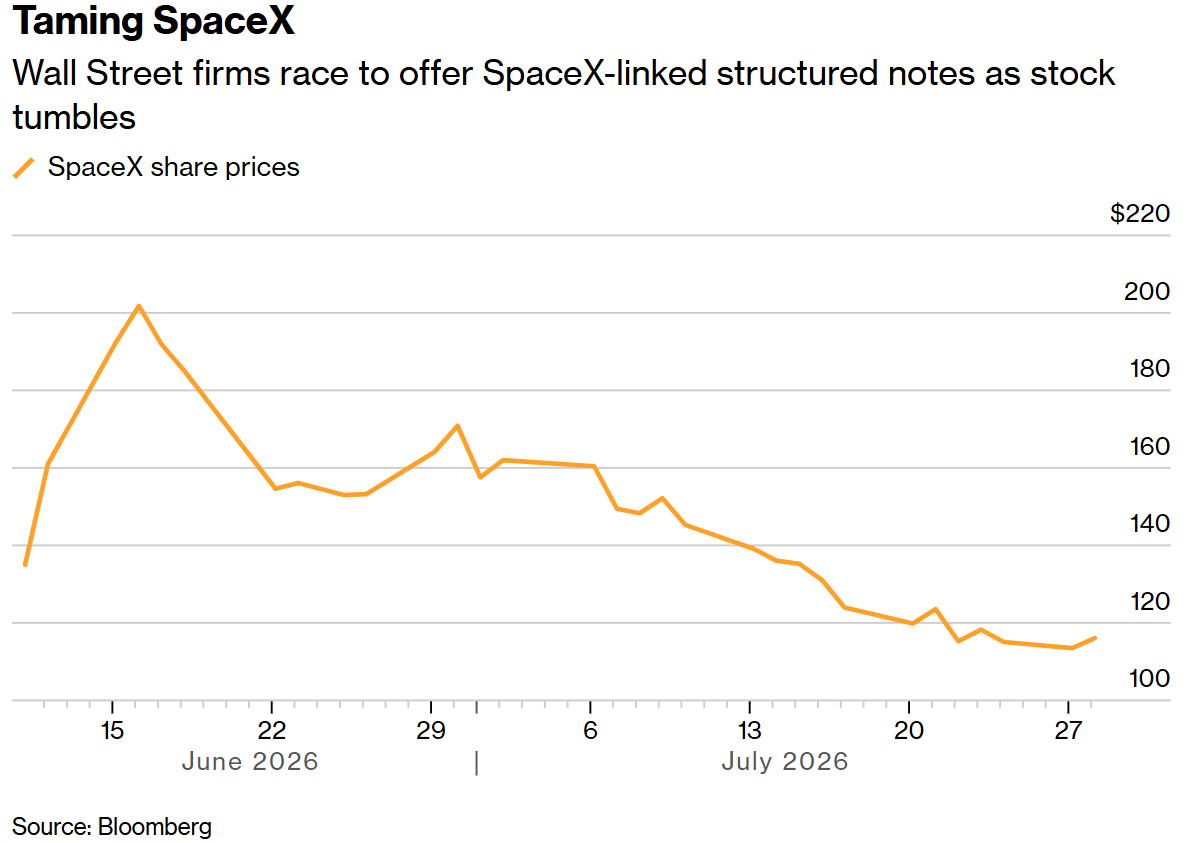
Wall Street firms compete to issue related structured bonds as SpaceX shares plummet
These products are yet another recent example of Wall Street using popular stocks to launch new products, many of which come with high fees.
Structured notes combine fixed income characteristics with derivatives, operate as debt-like securities, and provide enhanced payments compared to standard bonds. They are most commonly used by high-net-worth individuals, family offices, and discretionary managers seeking customized risk profiles in their portfolios.
Sarah Laconte, director of structured product sales at Marex in the US, said, “This is one of the fastest structured product offerings linked to new securities.” “Demand for stock targets, volatility, and AI-related transactions is already the norm in the structured notes ecosystem.”
Marex is introducing a nine-month automatically redeemable note. If the closing price of SpaceX shares reaches or exceeds its initial value on the scheduled date, the principal amount will be fully refunded. As long as the notes are active, investors can earn at least 1.8% interest each month regardless of the stock's performance. At maturity, investors will guard against a decline of up to 35%, but if the stock price falls below this critical point, they will have to bear all the downside losses.
At Morgan Stanley, a note is designed to provide a fixed payment of 40% as long as SpaceX shares remain flat or rise when they expire in early 2028. The repayment also applies when the stock price falls by less than 50%, but if the decline exceeds this threshold, the note holder will be completely exposed to downside risk.
Other institutions seeking to provide structured notes linked to SpaceX include Citigroup, Wells Fargo, and RBC Capital Markets. Previously, GraniteShares had applied to sell an automatically redeemable ETF with the company.
Brachman of Steward Partners is not optimistic about single-share structured notes because of what he calls the “inversion of risk and reward.”
“They cap your upside in highly volatile companies, but once you break through the protection threshold, they often make you bear an infinite downside,” he said. In that case, why not just buy stocks directly?”