
- PRICING
- LIVE QUOTES
- LEARN
- HELP


EN
Bosideng (03998) FY25/26 ESG Report: Systematically Promoting Sustainable Governance and Setting a Benchmark for ESG Practice in the Industry
On July 28, Bosideng (03998), a leading Chinese down jacket company, released the 10th ESG (Environmental, Social and Governance) report, which systematically disclosed the practical results of the 2025/26 fiscal year in the field of sustainable development.
Against the backdrop of China's economy moving towards high-quality development and the continuous deepening of the global green and low-carbon transformation, ESG has gradually changed from a bonus point for enterprises to an important factor affecting the long-term competitiveness of enterprises. For Bosideng, which has been deeply involved in the down jacket circuit for 50 years, the company deeply embeds the concept of sustainability into the entire value chain of R&D, production, logistics, retail, etc., and transforms ESG practices into product strength, brand strength and management resilience, and has become the core cornerstone of the brand's steady and far-reaching business.
Top-level governance first: from strategic planning to full-link implementation
The key to the effective implementation of an ESG strategy is whether an enterprise can establish a governance system with clear rights and responsibilities, perfect mechanisms, and quantifiable assessments.
The Zhitong Finance App learned that Bosideng has established an ESG governance structure that runs through the entire business from the top down. The Chairman of the Board and CEO is directly responsible for ESG work, and 5% of their compensation structure is directly linked to climate action performance.
At the strategic level, the company uses the “1+3+X” ESG strategic framework as the core, focusing on the three core areas of “product pioneering, natural improvement, and people-oriented”. The sustainable development supervisory team coordinates and promotes the integration of ESG indicators into the business processes of each business unit through cross-departmental coordination mechanisms.
At the same time, Bosideng is fully upgrading the ESG digital management platform. The plan is to cover various scenarios such as stores, supply chains, logistics, office and employee behavior, enhance data management capabilities for key indicators such as carbon emissions, chemical risk, and supplier performance, and achieve data traceability, quantifiable processes, and optimization of management.
In terms of industry standards, under the personal leadership of the Chairman of the Group Board of Directors, the Group has led and participated in the formulation and publication of various group standards. By settling scientific methodologies, building a standard framework, collecting data bases, and repeatedly verifying standards by experts, the role of an enforcer of industry standards has gradually been elevated to a co-builder of rules, leading the “China Plan” to speak in international narratives.
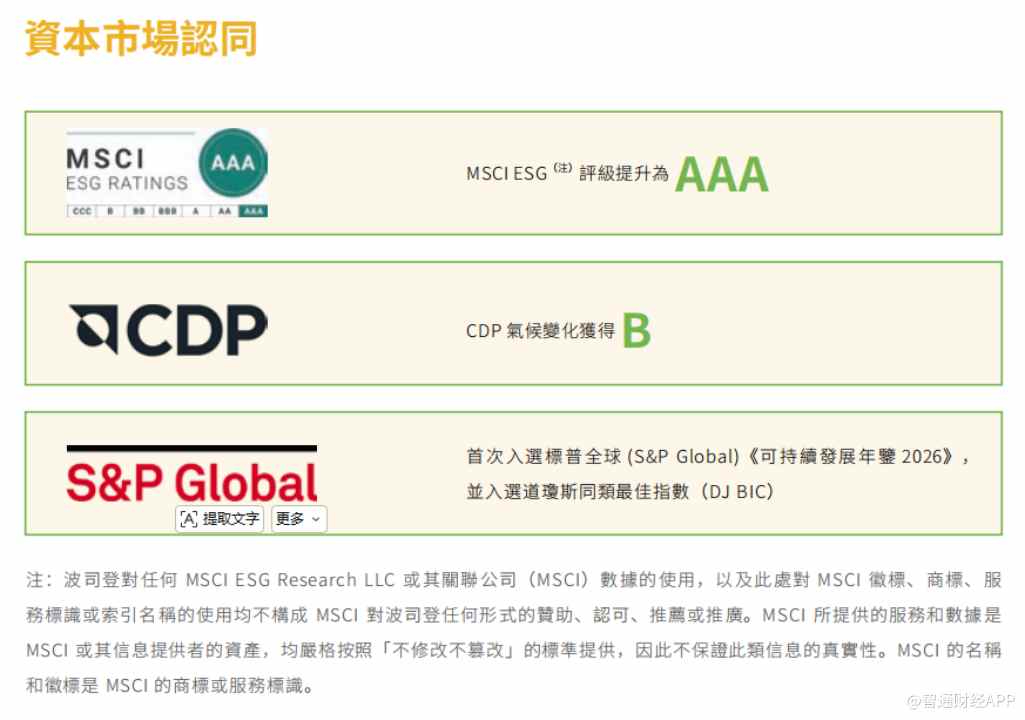
With continued practice in building responsible supply chains, etc., Bosideng was selected as a member of the first batch of “25 Sustainable Development Chain Master Alliances” of the UN Global Compact and included in the 2025 representative case of the United Nations “Creating a Sustainable Brand” Vision Initiative. In October 2025, MSCI upgraded Bosideng's ESG rating to AAA, making the company the first and only company in the Asian textile and garment industry to receive this highest rating.
Reducing carbon across the value chain: anchoring net zero emissions from operations until 2038
As global climate governance deepens, corporate carbon reduction practices are shifting from a single operation link to a collaborative carbon reduction transformation across the entire industry chain. Bosideng continues to promote carbon reduction practices around its own operations, industrial chain collaboration, and ecological restoration.
In the terminal operation process, Bosideng promoted 100% of the country's more than 1,000 direct-run offline stores to complete energy-saving transformation, and fully use LED high-efficiency lamps and intelligent temperature control to improve energy efficiency. Among them, the Beijing Sanlitun Dengfeng flagship store is more deeply involved in the preparation of domestic retail “carbon-neutral stores” industry standards to explore green retail.
In the logistics sector, Bosideng optimizes national distribution routes through an intelligent dispatch system, increases the proportion of new energy transport vehicles, and combines measures such as photovoltaic power generation and intelligent warehousing in the East China Core Logistics Park to reduce carbon emissions in the logistics process. In the 2025/26 fiscal year, the average carbon footprint of the company's single express delivery decreased by 28% year-on-year, promoting improved logistics efficiency and collaborative development with low-carbon transformation.
In terms of the green transformation of the supply chain, Bosideng continues to promote the green transformation of upstream and downstream collaboration as a “chain owner”. In the 2025/26 fiscal year, the total amount of clean energy used by upstream suppliers reached 5,455 megawatt-hours, promoting energy structure optimization from production sources; the company organized 10 special ESG training sessions for suppliers throughout the year, with 100% supplier audit and training coverage, promoting the extension of green production requirements upstream and downstream of the supply chain.
In terms of ecological restoration and resource recycling, Bosideng continues to promote the practice of “carbon reduction+carbon sequestration+recycling”. The company launched a new round of 660-acre “carbon-neutral forest” project in Alashan, planning to plant 33,000 trees to enhance ecological carbon sink capacity through desert vegetation restoration; in the field of waste control, the company obtained the China Quality Certification Center (CQC) zero waste landfill management system diamond grade certification to continuously improve the waste recycling and resource utilization system; the packaging process fully uses FSC or FSC Mix sustainable forest certified paper to reduce forest resource consumption at the source.
Facing the long term, Bosideng has clearly defined the goal of achieving net zero emissions from operations by 2038, and continues to promote carbon emission reduction in the direction of green supply chain transformation, energy structure optimization, and product life cycle management, and explore low-carbon development paths in line with the characteristics of the textile and garment industry.
Driven by product innovation: green innovation enhances product value
Bosideng integrates the green and low-carbon concept into the whole process of product development, design and service, and promotes the transformation of sustainable attributes into the core competitiveness of products and long-term brand value.
Technology research and development is an important support for green product innovation. In the 2025/26 fiscal year, Bosideng applied for a total of 471 patents and 314 authorized patents, bringing the total number of authorized patents to 1,812.
In terms of material innovation, the company actively explores low-carbon environmentally friendly materials such as bio-based nylon, recycled polyester, and fluorine-free waterproof fabrics, and launched a recycling product line using a single bio-based material to reduce resource consumption and improve product recyclability. In terms of functional innovation, the application of innovative technologies such as dynamic cold protection technology and temperature control technology enhances thermal insulation performance while promoting product weight reduction, taking into account user experience and low carbon properties.
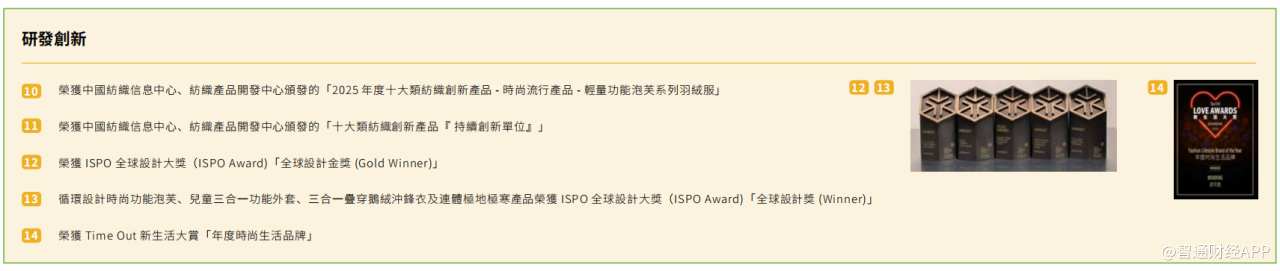
In terms of circular economy practices, Bosideng continues to promote product innovation in the Circular 3.0 series. With the goal of “from clothes to clothes (G2G)”, it enhances the possibility of product recycling through a single polyester material and modular detachable design, and solves the pain points of the industry where recycling of traditional mixed materials is difficult. The product was certified as a recyclable label by the Swiss TESTEX agency CIRCULARITY, and won the ISPO Global Design Gold Award and the American IDEA Industrial Design Silver Award.
In addition, Bosideng extends the product life cycle through services such as the “Renovation Workshop”. In the 2025/26 fiscal year, the company provided a total of 183,000 product maintenance services, corresponding to a reduction of about 274.5 tons of textile waste; at the same time, consumers were guided to practice green consumption through activities such as used clothing transformation and recycling fashion.
The value of sustainable development is also gradually reflected in an increase in brand value. According to a special survey during the reporting period, 90.8% of consumers surveyed agreed that Bosideng is a brand that focuses on environmental protection and sustainable development, and the increase in brand sustainability awareness contributed about 1.7 percentage points to overall revenue growth. As of 2025, Bosideng has been on Brand Finance's top 50 global apparel brands for six consecutive years, ranking 45th; the brand's overall customer satisfaction reached 96%, and the 400 customer service hotline satisfaction rate reached 98.7%.
People-oriented: focus on talent development and practice social responsibility
Ultimately, the core of sustainable development lies in “people.” Bosideng's social responsibility practices include not only internal talent training and protection of rights and interests, but also external feedback, forming a win-win situation for enterprises, employees, and society.
In terms of building an internal talent system, Bosideng has established a dual-channel career development path between the management sequence “Eagle Program” and the professional hierarchy. Through the “721” practical training model, digital learning platform, and special academic promotion plan, Bosideng provides growth support for employees at different levels. In the 2025/26 fiscal year, the company's employee training coverage reached 100%, and the total annual training time exceeded 185,000 hours; the proportion of women in management reached 52.5%, an increase of 0.7 percentage points over the previous fiscal year. At the same time, the company launched a total of eight equity incentive plans, covering 285 core key employees, and incorporating ESG indicators into the performance management system.
In terms of social responsibility, Bosideng has donated a total of 1.55 billion yuan in donations over the years. The charity footprint covers 30 provinces across the country, benefiting 1.923 million needy people. From the “Love to China” donation of cold weather supplies that have continued for many years, to student aid programs for needy students in college, to continuing unpaid blood donation activities for 22 years, to emergency aid during the Hong Kong Tai Po fire, Bosideng continues to use actions to interpret the warm brand core and highlight the responsibility and responsibility of Chinese companies.
Continued release of ESG value: helping enterprises develop in the long term
As the global concept of responsible investment continues to deepen, ESG governance capabilities have become an important reference for institutional investors to evaluate the long-term value of enterprises. For Bosideng, ESG practices are gradually forming a synergy between brand building, product innovation, supply chain management, and capital market value: on the business side, green products help enhance consumer recognition and brand loyalty; on the supply chain side: green management capabilities promote the resilience of the industrial chain; on the capital market side, MSCI ESG AAA rating, selected for the S&P Sustainable Development Yearbook and other authoritative international recognition, further enhancing the company's ability to create long-term value.
From the first to the tenth ESG Report, Bosideng's sustainable practices have gradually deepened from “compliance disclosure” to “strategic integration.” At a new stage of high-quality development in the textile and garment industry, ESG is becoming an important path for enterprises to cross the cycle and build long-term competitive advantage. Bosideng promotes full-link sustainable practices around “product pioneering, natural improvement, and people-oriented”, providing a reference industry model for Chinese consumer brands to explore green transformation.