
- PRICING
- LIVE QUOTES
- LEARN
- HELP


EN
AI congested transactions ushered in major liquidation! Tech giants split apart, money laundered semiconductors into “value havens”
The Zhitong Finance App notes that after the influx of chip stocks and so-called “AI winners”, investors are now rushing to cut such exposure and rebalance their portfolios. Even with this in mind, the sell-off that has accelerated in recent days due to competitive risks in China still seems too early.
The reversal in AI trading this month was quite drastic. UBS Group outperformed a basket of stocks linked to AI spending (including semiconductors) by a record 42 percentage points over a basket of stocks deemed at risk of AI disruption. Although this dramatic reversal occurred after months of winning, it reflected the abrupt closure of excessive positions, particularly within the chip sector.
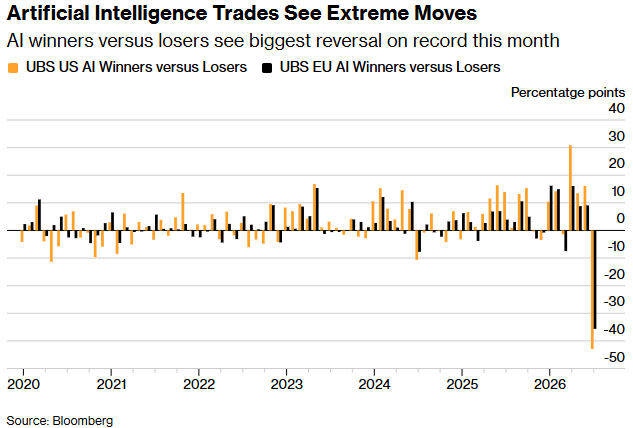
Artificial intelligence transactions have experienced extreme fluctuations
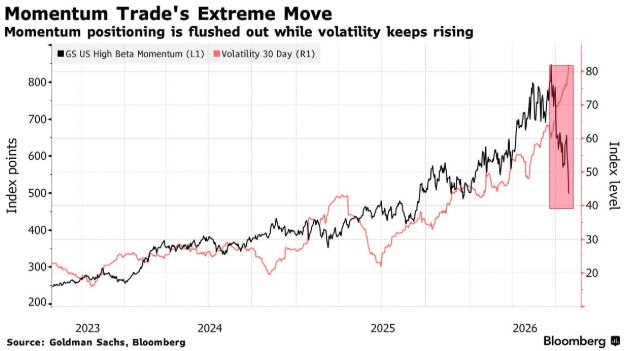
As far as investment factors are concerned, momentum trading continues to perform poorly. The background of “rising spot prices and rising volatility” has long since disappeared. Volatility is still rising to the level of the COVID-19 pandemic, yet prices are plummeting. Given that momentum was once one of the busiest trades and has now taken back all of its gains since February, the bottom may be near.
Goldman Sachs Group Equities Executive Brian Garrett said his team continues to believe “the collapse of momentum has reached the second half.” The Goldman Sachs team believes that, given the high correlation between AI and momentum trading, it is reasonable to increase exposure, while pointing out that the actual volatility of the Momentum matchmaking basket is still “surprisingly high.”
As far as Asmack is concerned, the decline caused by a report that a Chinese state-owned enterprise has begun manufacturing infiltrating deep ultraviolet (DUV) lithography equipment is probably an overreaction. First, DUV devices are often called the “workhorses” of the semiconductor industry, and are less advanced than ASML's precision extreme ultraviolet (EUV) lithography equipment essential for large-scale manufacturing of critical AI chips.
Industry research analyst Masahiro Wakasugi pointed out that although Asmack's sales and operating profits are at risk of being impacted by 20%, this still seems like a long way off.
Wakasugi wrote in the report, “China once had a precedent with a localization rate close to 100% in the field of strategic chip manufacturing. If the cost is not constrained, domestic suppliers may be able to make submersible DUV devices,” “but it may still take about 7-10 years to fully bridge the technology gap with Asmack.”
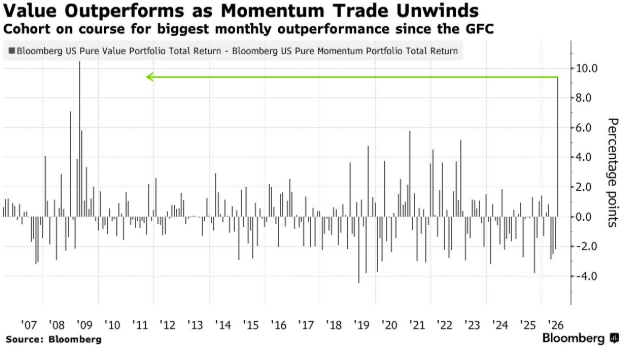
This is not a clean-up of excess positions, which raises the risk of widespread sell-off in the market, but rather the rotation and rebalancing of asset portfolios after excessive reliance on a single transaction. In fact, value factors have become the main beneficiaries of this rotation. Even within the tech sector and in giant stocks, investors have switched to value stocks.
Bank of America derivatives strategists, including Arjun Goyal and Vittoria Volta, said, “The tech pullback once again unsurprisingly showed rotation rather than indiscriminate sell-off, with sectors such as healthcare and finance clearly outperforming.” “As a result, despite the pullback, the level of correlation is extremely low, even within the 'Big 7 — Apple, which has lower AI exposure and more 'value attribute', has risen, while recent winners such as Alphabet Inc. and Nvidia have declined.”
The strategists added that the rise in technology stocks is still the core trend in the medium to long term. However, the Bank of America team said that given the existence of catalysts such as giant earnings reports and the Federal Reserve's interest rate decision, the risk of further extension of momentum trading “prompted investors to 'rent' rather than 'hold' a rebound through asymmetry in options.” They suggest using a semiconductor ETF (SMH) bullish option spread strategy, which provides an attractive and limited risk method that can both lay out a semiconductor rebound and lock in downside risk exposure.
Market attention will soon be focused on the performance and guidance of tech giants. Microsoft and Meta will release earnings after the market today, while Apple and Amazon will follow suit tomorrow. Profit expectations have risen sharply, but the company is still exceeding expectations by a large margin. Of the S&P 500 constituent stocks that have published financial reports so far, 85% were pleasantly surprised, tracking the highest proportion in five years for Bloomberg Industry Research. Even so, it failed to push the market higher.
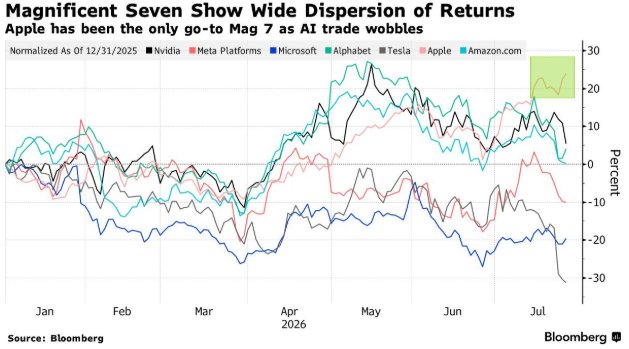
Daniela Hathorn, senior market analyst at Capital.com, said, “Investors are becoming more picky this earnings season. Strong revenue growth is no longer enough to satisfy the market unless accompanied by evidence that high spending is being transformed into sustainable profitability,” “this makes the subsequent performance of the remaining 'Big Seven' companies particularly important to the overall direction of the stock market.”